DSP-OHMNI Instruction Manual I-GARD
27
In this case there will only be two ‘coils’ (actually DSP functions)
‘Coil’ No Name Force Coil Data
00 Reset ff00 =on 0000=off
01 Pulse ff00 =on 0000=off
The response of Table 13.4 will confirm the request
TABLE 13.4 RETURNED INFORMATION FROM DSP FOLLOWING A FORCE BIT REQUEST
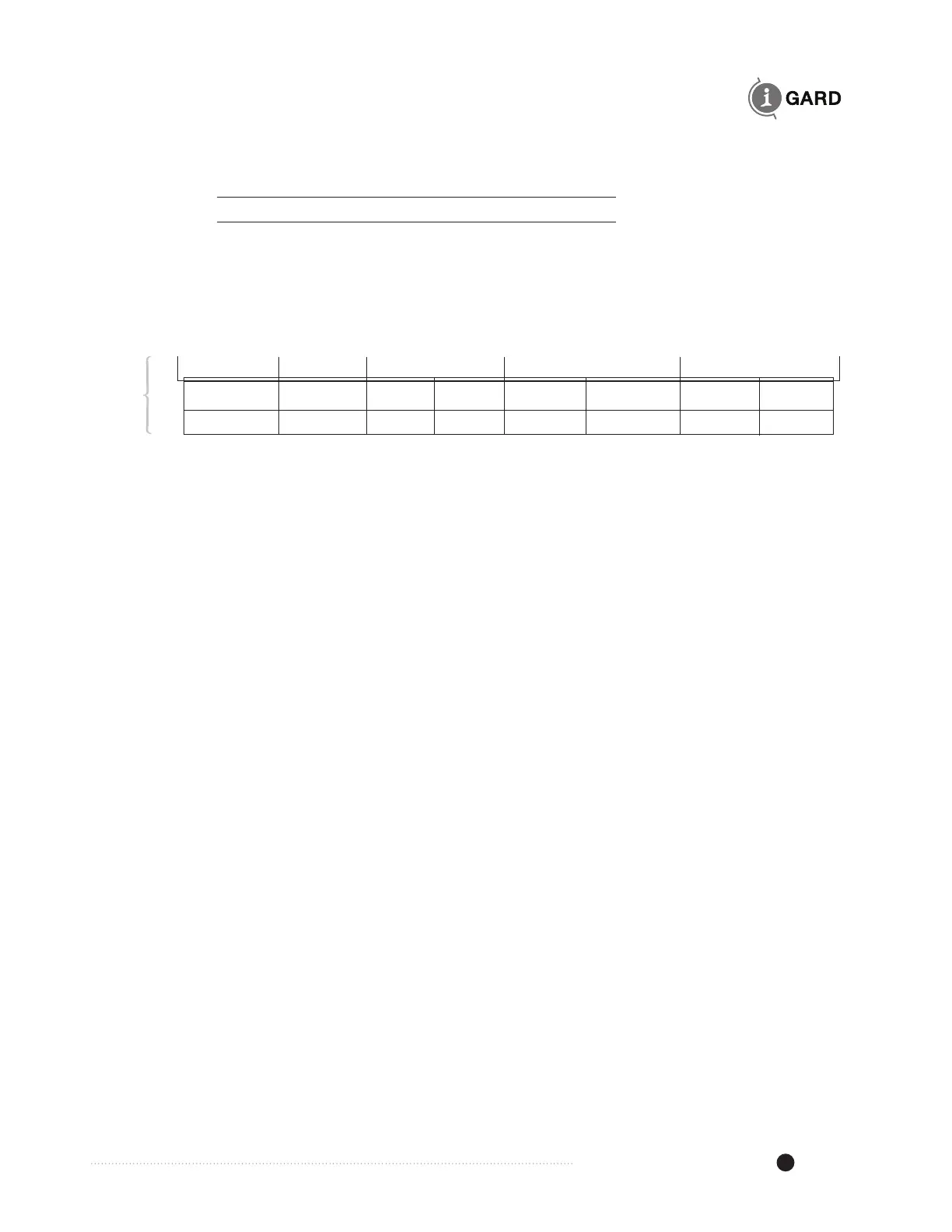
Unit I/D Function Coil Address Force Coil CRC
High Low High Low High Low
01 05 00 00 ff 00 nn nn
Which is just an echo of the request.
The registers can be read either one at a time or in a continuous block up to a maximum of 100
registers at a time.
There are times when the DSP processor will not be able to respond to a request since it is busy
with other tasks and no response will be returned. For this reason it is recommended to request
the maximum number of registers used by the system in a single request. Since the DSP is set
up to 50 current registers, 50 Status registers and 50 Priority registers followed by the System
function registers, it is best to read the data with three consecutive requests.
NOTE that the DSP will not respond to requests if the DSP-DM is in the SETUP mode.
The Feeder Module currents Igf values are contained in the first 50 registers as follows. The
values range from 0x00 to 0xff although maximum for a first fault condition will be 0x64 or 100%.
Table 13.5 lists the register addresses in the MODBUS convention.


 To Next Page