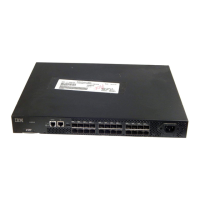
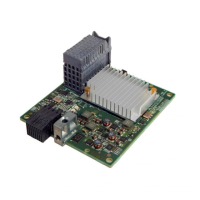
host bus adapter (HBA). The interface card between
a server or workstation bus and the Fibre Channel
network.
hot-pluggable. A field replaceable unit (FRU) that can
be removed or installed without turning the system off.
Also called ″hot swappable.″
hot swappable. See hot-pluggable.
HTTP. See Hypertext Transfer Protocol.
hub. A Fibre Channel device that connects nodes into
a logical loop by using a physical star topology. Hubs
will automatically recognize an active node and insert
the node into the loop. A node that fails or is powered
off is automatically removed from the loop.
Hypertext Transfer Protocol (HTTP). In the Internet
suite of protocols, the protocol that is used to transfer
and display hypertext and XML documents on the Web.
I
ID. Identification.
idle. Continuous transmission of an ordered set over a
Fibre Channel link when no data is being transmitted, to
keep the link active and maintain bit, byte, and word
synchronization.
in-band. Transmission of management protocol over
the Fibre Channel.
initiator. A server or workstation on a Fibre Channel
network that initiates communications with storage
devices. See also target.
in-order delivery (IOD). A parameter that, when set,
guarantees that frames are either delivered in order or
dropped.
Internet protocol (IP). A protocol that routes data
through a network or interconnected networks. Internet
Protocol (IP) acts as an intermediary between the
higher protocol layers and the physical network.
inter-switch link (ISL). A Fibre Channel link that
connects two switches (a link from the expansion port
(E_port) of one switch to the E_port of another).
IOD. See in-order delivery.
IP. See internet protocol.
ISL. See inter-switch link.
ISL Trunking. A feature that enables distribution of
traffic over the combined bandwidth of up to four
inter-switch links (ISLs) (between adjacent switches),
while preserving in-order delivery. A set of trunked ISLs
is called a trunking group; each port employed in a
trunking group is called a trunking port. See also master
port.
isolated E_port. An expansion port (E_port) that is
online but not operational between switches due to
overlapping domain ID or nonidentical parameters such
as error delay timeout values (E_D_TOVs). See also
expansion port.
J
JBOD. Just a bunch of disks.
K
K28.5. A special 10–bit character used to indicate the
beginning of a transmission word that performs fibre
channel control and signaling functions. The first seven
bits of the character are the comma pattern. See also
comma.
kernel flash. Flash memory that stores the bootable
kernel code and is visible within the memory space of
the processor. Data is stored as raw bits.
key. A string of data (usually a numeric value) shared
between two entities and used to control a
cryptographic algorithm. Usually selected from a large
pool of possible keys to make unauthorized
identification of the key difficult. See also key pair.
key pair. In public key cryptography, a pair of keys
consisting of a public and private key of an entity. The
public key can be publicized, but the private key must
be kept secret.
L
LAN. See local area network.
latency. The period of time required to transmit a
frame, from the time it is sent until it arrives.
LED. See light-emitting diode.
light-emitting diode (LED). An electronic component
that gives off visible or infrared light when electricity is
passed through it. It is used to indicate the status of
elements on a switch.
link. As applies to fibre channel, a physical connection
between two ports, consisting of both transmit and
receive fibers. See also circuit.
link services. A protocol for link-related services.
LIP. See loop initialization primitive.
LM_TOV. See loop master timeout value.
Glossary 55


 To Next Page
 Loading...