
 Need help?
Do you have a question about the IDEAL Logic Code Combi ES26 and is the answer not in the manual?
Provides an overview of the Logic Code Combi ES boiler's features and operation.
Emphasizes legal installation by Gas Safe Registered Engineer and adherence to regulations.
Details the required electrical supply and fusing for the appliance.
Lists critical operational and safety considerations for the user.
Explains boiler operation for winter (CH & DHW) and summer (DHW only) conditions.
Details adjustment of DHW and Central Heating temperatures.
Using weather compensation to control room temperature.
Procedures for turning off and relighting the boiler.
Covers frost protection, overheat protection, and flame failure.
Guidance on identifying and re-pressurising low system water pressure.
Instructions for thawing a frozen condensate pipe.
Recommended actions to prevent issues during cold weather.
Actions to take in case of suspected gas leak.
Guidelines for cleaning and requirements for annual servicing.
Guides for diagnosing and resolving issues with hot water and heating.
Explains the different display codes and their meanings.
Lists display codes, descriptions, and recommended actions for faults.
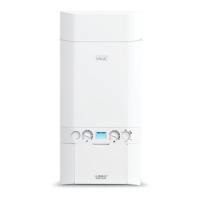
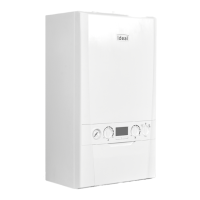
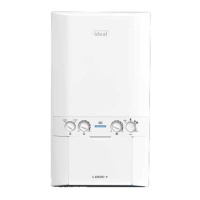
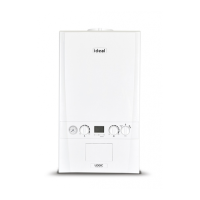
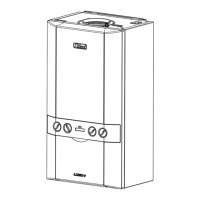
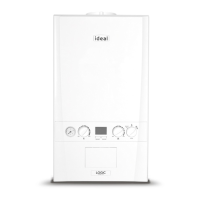
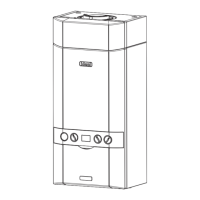
The Ideal Logic Code Combi ES is a wall-mounted, room-sealed, condensing combination boiler designed to provide both central heating and instantaneous domestic hot water. It features a full-sequence automatic spark ignition and fan-assisted combustion system. A key component of its design is a recuperator, which preheats incoming cold domestic hot water (DHW) to enhance energy savings. Due to its high efficiency, the boiler produces condensate from the flue gases, which is drained through a plastic waste pipe at the base of the unit. A visible condensate 'plume' may also be observed at the flue terminal during operation.
For safe and economical operation, it is crucial to follow the instructions provided in the user manual. The appliance must be earthed and requires a 230 V ~ 50 Hz supply, with a recommended fusing of 3A. It is imperative that the boiler is not operated without its casing correctly fitted and forming an adequate seal. If installed in a compartment, that space must not be used for storage purposes. In the event of a suspected fault, the boiler should not be used until the issue has been corrected by a Gas Safe Registered Engineer (in the UK) or a Registered Gas Installer (RGII) (in Ireland). Users are strictly warned against incorrectly using or tampering with any sealed components of the appliance. This appliance is not intended for use by individuals with reduced physical, sensory, or mental capabilities, or lack of experience and knowledge, unless they are supervised or instructed by a responsible person. Children should also be supervised to ensure they do not play with the appliance.
To light the boiler, first ensure the electricity supply to the boiler is OFF. Set the mains mode knob control (D) to 'Off'. Both the Domestic Hot Water temperature control (B) and Central Heating temperature control (C) should be set to 'max'. Confirm that all hot water taps are turned off. Switch ON electricity to the boiler and verify that all external controls, such as the programmer and room thermostat, are ON. Finally, set the mode knob control to winter (Ⅲ). The boiler will then initiate its ignition sequence to provide hot water or central heating as needed. During normal operation, the boiler status display (E) will show specific codes. For instance, '0' indicates standby, 'C' signifies central heating being supplied, 'd' means DHW is being supplied, and 'F' indicates boiler frost protection, where the boiler will fire if the temperature drops below 5 degrees Celsius. The burner on indicator (F) will remain illuminated when the burner is active. If the boiler fails to light after five attempts, the fault code L-2 will be displayed.
The reset procedure involves turning the mode control knob (D) to the reset position and immediately returning it to the required setting. The boiler will then repeat the ignition sequence. If it still fails to light, a Gas Safe Registered Engineer or RGII should be consulted.
For winter conditions, when both central heating and DHW are required, the mode knob control (D) should be set to winter (Ⅲ). The boiler will prioritize DHW on demand while supplying heat to the radiators. For summer conditions, when only DHW is needed, the mode knob control should be set to summer ( ). The CH external controls should be set to OFF. The pump will perform a brief self-check every 24 hours, irrespective of system demand.
The DHW temperature is limited by the boiler controls to a maximum of 64°C at low draw-off rates, adjustable via the DHW temperature control (B). The approximate flow temperatures for the boiler thermostat settings range from 40°C (104°F) at minimum to 64°C (147°F) at maximum. Due to system variations and seasonal temperature fluctuations, DHW flow rates and temperature rise may vary, requiring adjustment at the draw-off tap. Lower flow rates generally result in higher temperatures.
For central heating, the boiler controls the radiator temperature to a maximum of 80°C, adjustable via the CH temperature control (C). The Logic Code Combi ES is a high-efficiency boiler that operates most efficiently in condensing mode. This mode is achieved when the CH temperature control (C) is set to the 'e' position (economy mode). For very cold periods, this control should be set to maximum. Further energy savings can be achieved by setting the CH thermostat below halfway.
If a Weather Compensation option is fitted, the CH Temperature Control (C) functions as a room temperature control. Turning the knob clockwise increases room temperature, and anti-clockwise decreases it. Once the desired setting is achieved, the system will automatically maintain the room temperature regardless of outside weather conditions.
To shut down the boiler, simply set the mode knob control to OFF. To relight it, follow the procedure detailed in 'To light the boiler'.
For frost protection, if no system frost protection is provided and frost is anticipated during a short absence, leave the heating controls (if fitted) at a reduced temperature setting. For longer periods, the entire system should be drained. If the system includes a frost thermostat, during cold weather, the boiler should only be turned OFF at the time switch (if fitted). The mains supply should remain ON, with the boiler thermostat in its normal running position.
The boiler controls include an overheat protection feature that will shut down the boiler in case of overheating, displaying fault code L-1. In the event of flame failure, fault code F-2 will be displayed. Refer to the fault chart for details on these codes.
The pressure gauge (G) indicates the central heating system pressure. If the pressure drops below the original installation pressure of 1-2 bar over time, it may indicate a water leak. In such cases, the re-pressurizing procedure should be followed. The boiler will not operate if the pressure falls below 0.3 bar.
To re-pressurize:
The appliance is fitted with a siphonic condensate trap system to reduce the risk of the condensate pipe freezing. However, if the condensate pipe freezes, follow these instructions: a. If you are not competent to defrost the pipe, contact your local Gas Safe Registered installer. b. If you are competent, proceed with care, especially when handling hot utensils. Do not attempt to thaw pipework above ground level. If a blockage occurs in the condensate pipe, condensate will build up, causing a gurgling noise before locking out with an "L2" fault code. Resetting the appliance will result in gurgling before locking out on a failed ignition "L2" code.
To unblock a frozen condensate pipe:
Preventative solutions for condensate pipe freezing: During cold weather, set the boiler thermostat to maximum (return to original setting after the cold spell). Place the heating on continuous and turn the room thermostat down to 15°C overnight or when unoccupied (return to normal after the cold spell).
In case of a suspected gas leak or fault, immediately contact the National Gas Emergency Service at 0800 111 999. DO NOT search for gas leaks with a naked flame.
For normal cleaning, simply dust the appliance with a dry cloth. To remove stubborn marks and stains, wipe with a damp cloth and finish with a dry cloth. DO NOT use abrasive cleaning materials.
The appliance should be serviced at least once a year by a Gas Safe Registered Engineer or an RGII. The Benchmark Service Interval Record must be completed after each service.
The troubleshooting guide helps users identify problems external to the boiler before requesting a service engineer's visit. If the problem is found to be external to the appliance, a charge may be levied for the visit.
For "NO HOT WATER" or "NO CENTRAL HEATING" issues:
The display codes on the boiler indicate its operational status:
Fault codes provide specific information about detected issues:
 General
| Output Rating | 26 kW |
|---|---|
| Dimensions (H x W x D) | 700 x 395 x 278 mm |
| Fuel Type | Natural Gas |
| Mounting | Wall Mounted |
| Heating Flow Temperature Range | 30 - 80°C |
| Type | Combination Boiler |
| CH Output | 26 kW |


 To Next Page
