D-0114042-D – 2020/03
Sera™ - Additional Information Page 25
DPOAE
About the DPOAE module
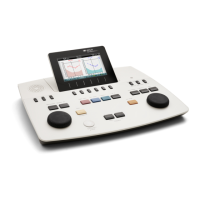
The Sera
TM
with DPOAE is intended for use in the audiologic evaluation and documentation of ear disorders
using Distortion Product Otoacoustic Emissions. The target population for Sera
TM
with DPOAE includes all
ages.
The DPOAE is to be used by trained personnel only, such as audiologists, ENT surgeons and doctors,
hearing healthcare professionals or personnel with a similar level of education. The device should not be
used without the necessary knowledge and training to understand its use and how results should be
interpreted.
DPOAE testing
Distortion Product Otoacoustic Emissions (DPOAEs) are commonly used for infant hearing screening and in
diagnostic testing as they screen patients for cochlear hearing loss.
DPOAE technology uses pairs of pure tones presented in sequence to assess the status of the outer hair
cells within the cochlea. Responses from the outer hair cells to the stimulus are predictable and therefore
can be measured via a sensitive microphone placed in the patient’s ear canal.
It is ideal for testing newborns and infants as the patient does not need to be awake or respond in any way to
the test stimulus. Responses from the cochlea (outer hair cells) are recorded and results are automatically
analyzed and displayed as either PASS or REFER.
Automated DPOAE with Sera™
The DPOAE module with Sera
TM
uses a predefined protocol together with a detection algorithm to assess
the presence or absence of an OAE response. Prior to the start of the measurement, the stimulus level is
adjusted with reference to the ear canal volume to ensure the correct stimulus level is presented to the test
ear. Various frequencies are then tested by simultaneous presentation of two pure tones (also knowns as
primaries) and the corresponding distortion product at the frequency mathematically expressed by 2f
1
- f
2
is
recorded. The recorded response is averaged using an averaging technique called Bayesian weighting in
order to obtain a sufficient signal to noise ratio (SNR). For every test frequency, a minimum of 3 seconds of
data is collected. Data epochs which exceed the noise threshold are excluded from this total of 3 seconds of
data. After this time the decision algorithm assesses whether the SNR of the DP meets the protocol SNR
criteria as well as whether the signal level is more than 2.3 standard deviations above the mean noise level
before it is flagged as being detected. Once the test frequency meets the protocol requirements for
detected, this test frequency is not revisited. This allows the data collection phase of the algorithm to
concentrate on trying to obtain a good quality signal at those test frequencies which have not yet established
the presence of a DP. When the minimum number of frequencies required for the test to pass (as defined by
the protocol) have been detected, the test automatically stops, and the test result is labelled a PASS. If the
minimum number of frequencies required for a PASS is not met during the maximum test time, the test ends
with a REFER result. If the test is stopped before a PASS is detected or before the maximum test time is
exceeded, the test is labelled as INCOMPLETE.





 To Next Page