Panther Instrument User Manual V1.0
Pioneering Gas Sensing Technology. Page 20 of 24 ionscience.com/usa
To refit the short or the long probe follow the steps above but in reverse order.
When using the box spanner to tighten the probe nut, ensure the nut is firmly tightened
however do not use additional tools as the tread may become damaged.
Should a probe become blocked, use dry, clean compressed air to blow out the blockage
from the instrument end of the probe. Ensure probe has been removed first.
The instrument has been factory calibrated using the standard short capillary which sets a
certain flow rate into the detector.
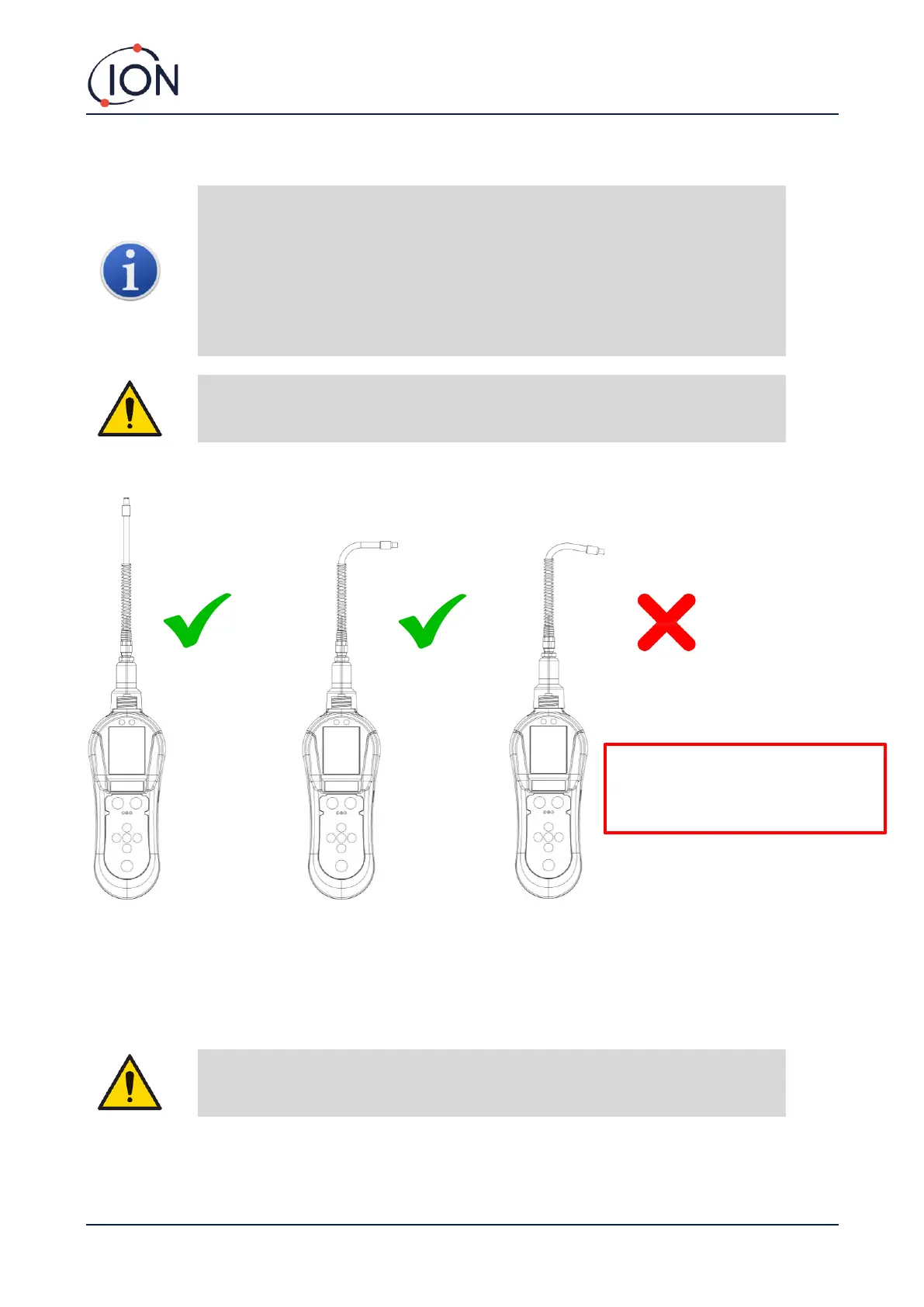
Do not bend the flexible probe more than 90 degrees as this pushes the internal tube
outside the protective sleeve.
The long capillary by nature of its construction has a different flow to improve the time response in detection. This will
change the calibration of the instrument when the long probe is used instead of the short capillary. Thus, the long
probe is only to be used in finding leaks in difficult places where the standard short probe cannot reach. The readings
given by the long probe are only qualitative and the reading given by the display is only to be taken as being relative to
another value given by another leak site while using the long probe.
Ensure safety guidelines are adhered to when using compressed air.
(ION Science Ltd takes no responsibility for injury or damage caused by misuse of
compressed air equipment)
DO NOT BEND FLEXIBLE PROBE
MORE THAN 90 DEGREES



 To Next Page