How Panther works
Thermal Conductivity
All gases conduct heat but by varying amounts, if an object is heated and then the source of heat is removed, the
object will eventually cool down to match ambient air temperature. This action occurs because the ambient air
surrounding the object carries the excess heat into the surrounding atmosphere.
This principal is also the same for objects that are cooler than the surrounding ambient air.
Dissipation of heat into an air atmosphere is known and is a predictable rate, however, if the ambient air is replaced
with an alternative gas like Helium the rate at which an object cools down changes.
If the object mentioned above had its environment replaced with pure Helium it would cool down to the environment
temperature about 6 times faster.
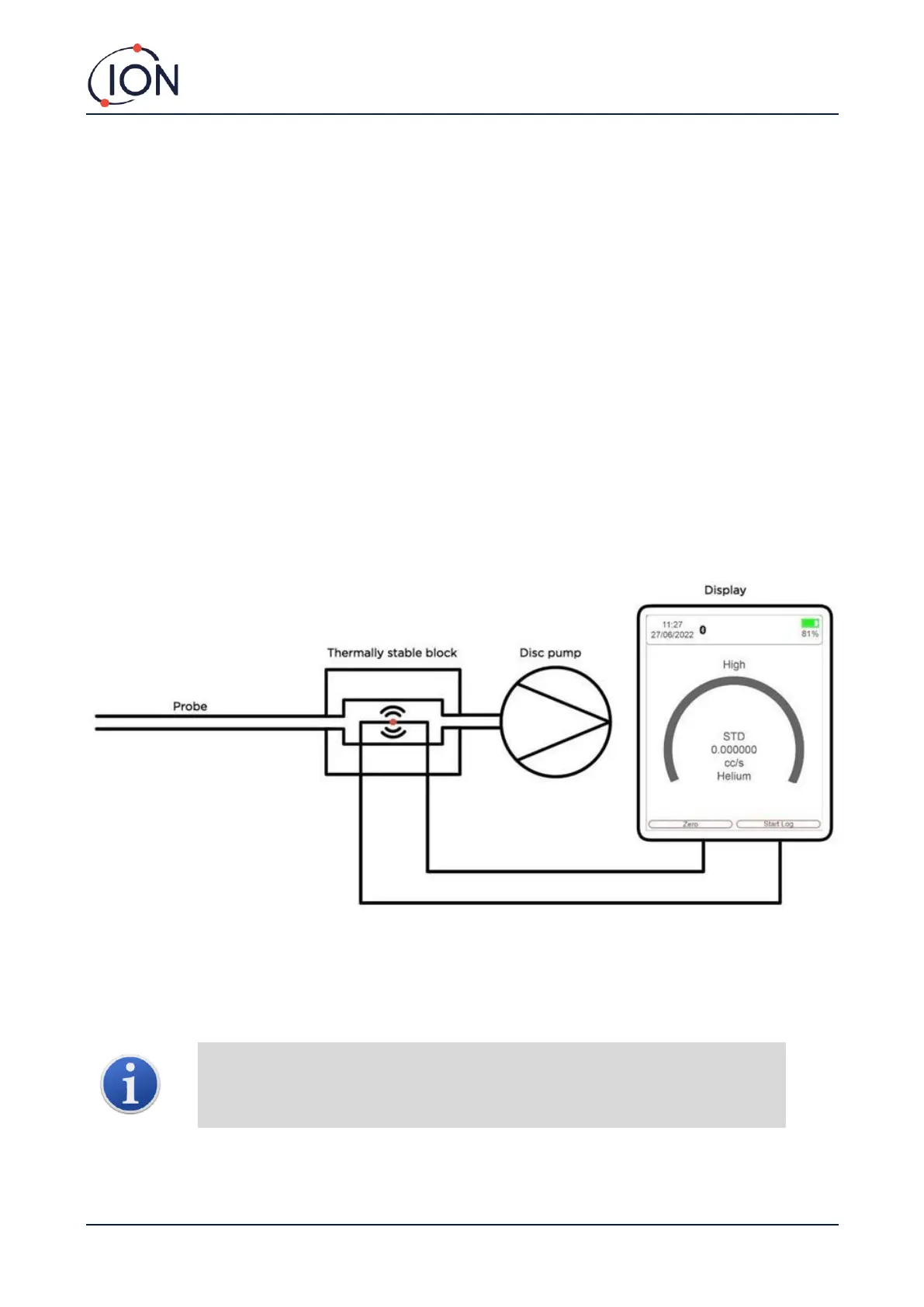
Panther contains a heated thermistor bead that transmits heat into the sensing chamber. On the other side of the
sensing chamber there is a block of material that remains at a constant temperature helping to stabilize the signal. As
air passes through the detector chamber a constant amount of heat passes from the bead to the air. Gases that are
different to air will affect the rate at which heat transmits, these rates of change are measured and displayed as leak
rates.
Panthers Thermal Conductivity sensor
A piezo pump draws a small flow of gas through the probe and into the sensing chamber. The thermistor bead heats
up when electrical power is applied. As air passes through the chamber a constant level of heat is transmitted to the
air, this rate of heat transmission is used to 'Zero' the instrument.
When gases with different thermal qualities pass through the chamber, the amount of heat being transmitted
changes. These changes are measured and used to calculate a display reading on Panther for leak rates or gas
concentrations.
Some gases have similar thermal properties to that of air; therefore, Panther can only
detect larger concentrations of these gases.
Panther can NOT differentiate between gases, selecting a specific gas on Panther allows
the instrument to calculate concentrations of that gas only if that gas is being detected.



 To Next Page