4-6 Configuring Ethernet Models 640e & 650e 947291 640 & 650 Series
LAN with no DHCP Server
(Local Area Network with no Dynamic Host Configuration Protocol server)
This scenario looks the same as that shown in the previous illustration, except there is no Dynamic Host
Configuration Protocol (DHCP). In this type of setup, one or more computers are connected to a network;
and each computer has a static IP address.
STEP 3 – Connect the System Components
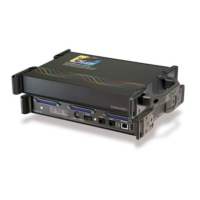
What you will need to connect a 640e or a 650e to the Ethernet:
An available connection to the Ethernet. The connection can be either
- an Ethernet jack on a computer or
- an Ethernet jack on a hub that is connected to the Ethernet.
An Ethernet patch cable, e.g., a CA-242 (1.5 foot cable) or a CA-242-7 (7-foot cable).
1. Connect the Ethernet cable to the Ethernet jack on the 640e or the 650e.
2. Connect the other end of the Ethernet cable to the Ethernet jack on the host computer or
network hub.
STEP 4 – Power-up the System Components
What you will need:
A power supply with a range of 6 to 16 VDC. We recommend the TR-2U power supply.
How to make the connection:
1. Connect the power supply cable, e.g., from the TR-2U, to the External Power connector on the
rear panel of the 640e or 650e.
2. Connect the power supply’s plug to a standard AC outlet.
3. If you are using a power supply with a power switch, position it to “ON.”
When the unit is initially powered on:
Both the Power LED and Active LED will light up solid.
If you have a DHCP server on your network or, if you have specified a user IP, after about
5 seconds the Active LED will begin blinking.
If you have no DHCP server on your network and not specified a user IP, after a period of
about 25 seconds the Active LED will begin blinking.
After 10 rapid blinks the Active LED will go out. The unit is now ready to be accessed over
the network.


 To Next Page