DOC. MIE91093 Rev. 1.34 Page 136 of 145
restored. Confirm save results pressing the multi-function
knob, and proceed.
1.18.4. Intervention curve
Now we can measure trip timings, following the I-t curve with
as many points as desired.
Now, press ON and pre-adjust the first test current: if the CB
trips, don’t save test result; go OFF. Select ON+TIME: as the
CB trips, test goes OFF; pressing the multi-function knob,
tripping values can be saved. Confirm save results pressing
the multi-function knob, and proceed with other test currents,
until all points to be tested are measured.
1.19 CT SATURATION KNEE TEST
1.19.1. Introduction
The saturation knee test of a CT is performed applying a
voltage to the CT secondary side, and slowly increasing it
while measuring the current sunk by the CT. When the
saturation approaches, the current increases sharply: this is
the saturation knee.
More precisely, the IEC standard C.57.13, paragraph 6.10.2
defines the knee point as “the value of the voltage for which a
voltage increase of 10% causes a current increase of 50%”.
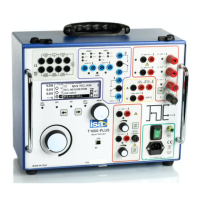
T1000 allows to measure and save the applied voltage and the
absorbed current. Repeating the measurements at various
voltage values it is possible to record the I vs. V curve; then,
applying the definition, the knee point can be located
graphically.
NOTE: the test set T3000 performs the measurement in an
automated way.
The voltage to be applied to perform the test is up to 250 V
(500 V for the T1000E model). Before performing the test, you
can compute the nominal knee as follows.


 To Next Page