screen systems. Measurements made at the Goldwyn Theater of the Academy of Motion Picture Arts
and Sciences in Beverly Hills, California, show that, over most of the frequency range, front-to-back
levels in the house are maintained within a range of 5
dB.
By contrast, aiming the high-frequency
elements toward the audience would produce front-to-back level variations of up to 10 to 12
dB.
An
important requirement here is that the back wall of the cinema be as absorptive as possible. If the rear
wall is not highly absorptive, then tilt the high frequency loudspeakers down, with the horn’s axis
pointing at the seating area two-thirds of the way back in the house.
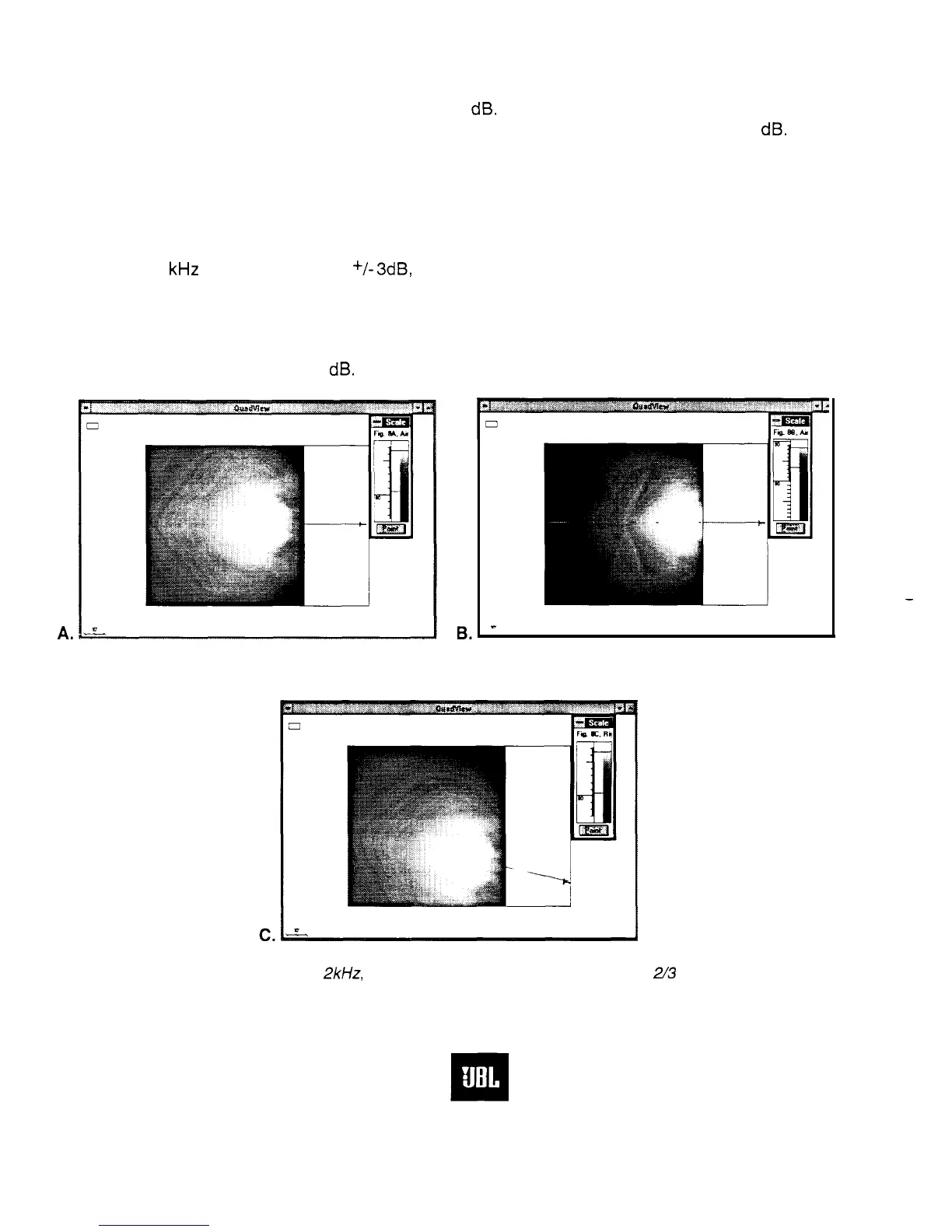
This performance is seen in Figure 8. At A, we show in plan view the direct field coverage
given by a JBL 2360 horn aimed at the absorptive back wall of a large theater with sloped floor.
Coverage at 2
kHz
is within a range of
+/-
3dB,
front to back. If the horn is aimed downward to a point
two-thirds the distance from front to back, the coverage is as shown at B, and coverage at the rear of
the house is compromised. The coverage given by one of the outside horns, aimed at the rear wall, is
shown at C. It is customary to toe in the left and right systems toward the center, whether or not the
screen itself is curved, and the aim is to provide adequate coverage for all patrons, with response
maintained within a total range of 6
dB.
n
-
Figure
8.
(A) Direct field coverage at
2kHz,
aimed at rear wall; (B) Same, horn aimed 2/3 distance front to back;
(C) Coverage of single outside horn.
page
11




 To Next Page