Both systems are capable of the same acoustical output, inasmuch as they are both limited by
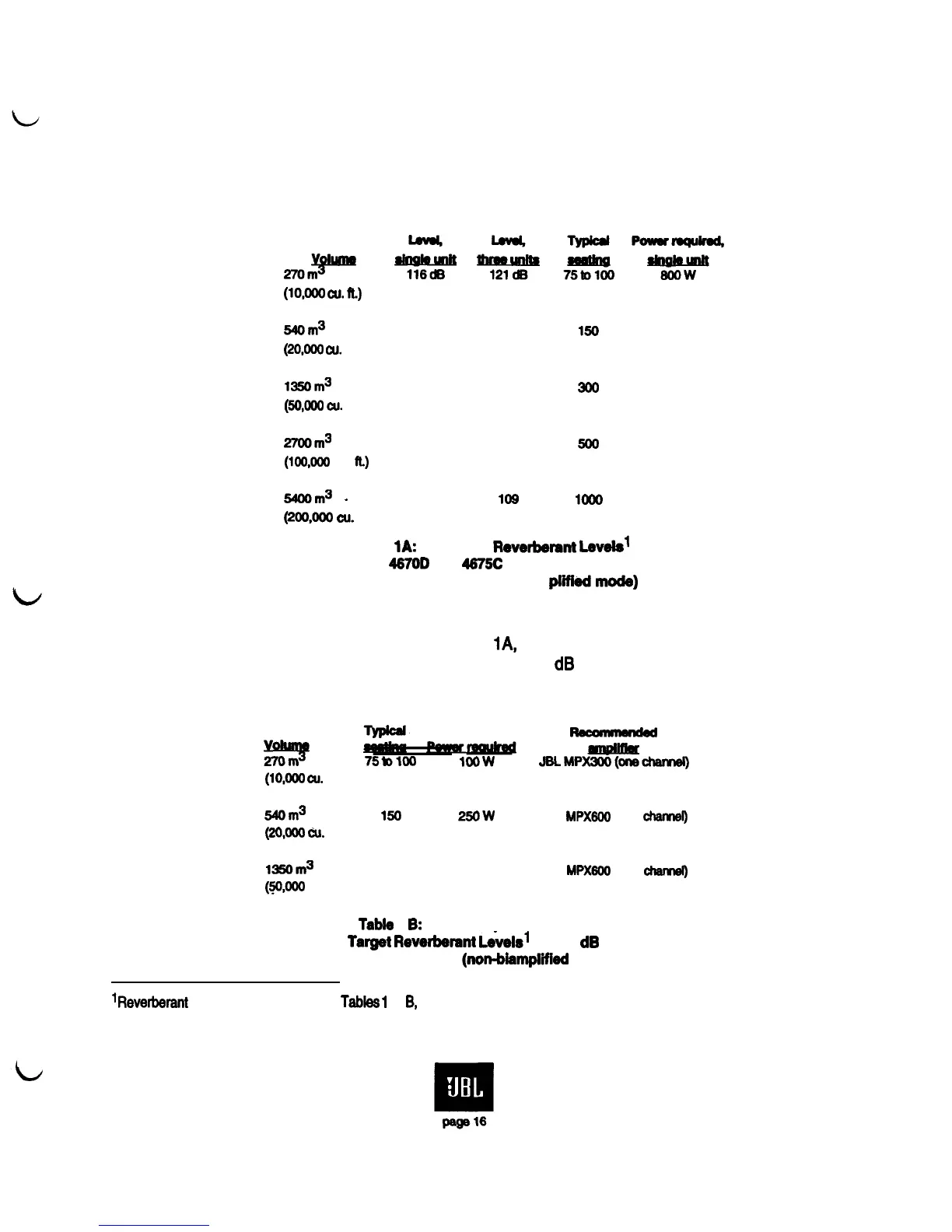
the power handling capabilities of their identical low-frequency sections. Table 1 indicates the
sustained maximum sound pressure level in the reverberant field which these systems can produce,
based on room volume. Levels for a single unit, as well as for the three units, are given. Median
reverberation times as given in Figure 11 are assumed in these calculations, as are system directivity
index and estimated room surface area.
27omp
++7zT
(10,ooo
al.
L)
540m3
113
118 150
800W
(20,ooo
cu.
ft.)
13SOm3
108
113
300
800W
(!5o,ooo
cu.
ft.)
2700m3
108
111
500
800W
(100,ooo
cu. R)
5400m3
-
104
109
loo0
800W
(200,ooo
al. ft.)
Table
1A:
Maximum
Reverbwant
Levels1
for
JBL
467OD
and
467%
Systems in Cinsmas
of various sizes
(non-b&m
plifiedmode)
Taking the information presented in Table lA, we can now determine the actual power
requirements to produce target levels in the house of 105
dB
per channel:
g$!f
=
7510100
1oow
JBLMPX3oo(onechamel)
(10,ooo
cu.
ft.)
540m3
(20,aoo
al.
It.)
150
25ow
JBL
MPX800
(one
chamd)
13SOm3
300
400W
JBL
MPX800
(one
chard)
(!yJ.ooo
al. ft.)
Tabls
1
B:
Power Requirements for
Targst
Revebmnt
Levels’
of 105
dB
in Smaller Houses
(nowbiam~lifisd
mode)
lReverberant
levels, as calculated in
Tables
1
A,
6, and C, represents the maximum level that would exist at a point
about
two-thirds from the front
of the house to the back.




 To Next Page