Need help?
Do you have a question about the Juniper SRX345 and is the answer not in the manual?
Overview of Juniper Networks SRX345 Firewall features, capabilities, and connectivity.
Detailed steps for physically installing the SRX345 firewall unit into a standard equipment rack.
Instructions for connecting power to the SRX345 firewall and verifying its initial startup status.
Explores various methods for provisioning and managing the SRX345, including CLI, J-Web, and cloud services.
Step-by-step guide to performing initial configuration of the SRX345 firewall via the Command Line Interface (CLI).
Suggestions for next steps after initial setup, including advanced security and management options.
Links to additional documentation, licensing, and guides for configuring the SRX345 using Junos OS CLI and J-Web.
Resources for learning more about Juniper technologies, including web-based training and video tutorials.
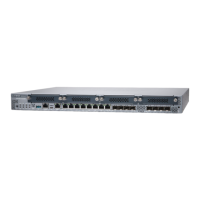
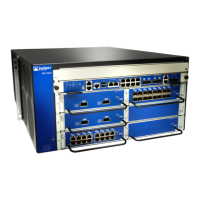
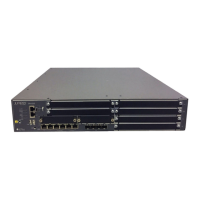
The Juniper Networks SRX345 Firewall is a robust and versatile security appliance designed to consolidate security, routing, switching, and WAN connectivity within a compact 1-U chassis. It caters to the needs of midsize, distributed-enterprise locations by offering high firewall throughput and IPsec VPN capabilities. This device is engineered for secure and efficient network operations, providing a comprehensive solution for branch offices and distributed environments.
The primary function of the SRX345 Firewall is to provide secure network connectivity and advanced threat protection. It acts as a central point for managing network traffic, enforcing security policies, and ensuring data integrity across various network segments. The device integrates multiple functionalities, including firewall services, routing capabilities, network switching, and WAN connectivity, into a single platform. This consolidation simplifies network architecture and reduces the need for multiple discrete devices, thereby lowering operational costs and management complexity.
The SRX345 supports high-performance firewall throughput, making it suitable for environments with significant data traffic. Its IPsec VPN capabilities enable secure communication channels over untrusted networks, facilitating secure remote access and site-to-site connectivity. This is crucial for businesses with multiple branch offices or remote workers who need secure access to corporate resources.
Beyond basic firewall functions, the SRX345 is designed to work seamlessly with Juniper Sky™ Enterprise and Contrail Service Orchestration (CSO). This integration enables fully automated SD-WAN (Software-Defined Wide Area Network) capabilities, which are beneficial for both enterprises and service providers. SD-WAN optimizes network performance by intelligently routing traffic across various WAN connections, improving application experience, and reducing operational overhead. The device also features zero-touch provisioning (ZTP), which significantly simplifies the initial deployment and ongoing management of branch network connectivity. ZTP allows for automatic configuration and onboarding of the device, minimizing manual intervention and accelerating deployment times.
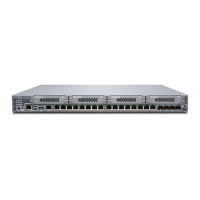
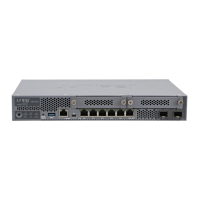
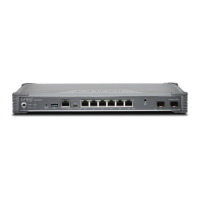
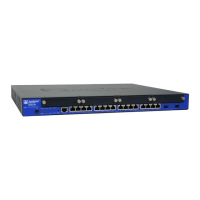
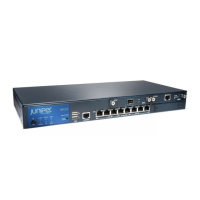
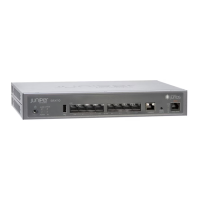
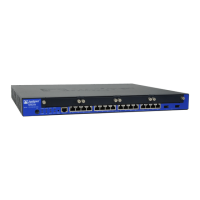
The SRX345's architecture includes various ports to support diverse network requirements. It features multiple 1 Gigabit Ethernet (GbE) RJ-45 ports and 1 GbE SFP ports, many of which are MACsec capable, ensuring secure data transmission at the link layer. Additionally, it includes a management port and a console port for local administration, along with Mini-Physical Interface Module (Mini-PIM) slots for expanding connectivity options. The device can be equipped with either a single AC power supply or dual AC power supplies for redundancy, ensuring continuous operation in critical environments.
The SRX345 offers flexible provisioning and management options to suit different operational preferences and network complexities. Users can choose from several configuration tools:
The initial configuration process typically involves connecting to the serial console port, logging in as the root user, and entering configuration mode. Users can then set up essential parameters such as the root authentication password, hostname, and enable necessary services like SSH for remote access. The device is designed to provide secure Internet access to devices attached to its LAN ports immediately after initial setup. The default configuration includes DHCP server functionality for LAN clients, source NAT (S-NAT) for outbound traffic, and predefined security zones (trust and untrust) with appropriate traffic policies.
Maintaining the SRX345 involves several key aspects, including software upgrades, security updates, and ongoing monitoring. The device is designed to facilitate these tasks to ensure optimal performance and security posture.
The SRX345 is designed for ease of installation and maintenance. It includes physical features like mounting brackets and screws for rack installation, and clear instructions for connecting power and grounding. The device's LEDs provide visual indicators of its operational status, such as power and system health, allowing for quick assessment of its condition. The emphasis on simplified installation, comprehensive management options, and continuous support makes the SRX345 a reliable choice for securing distributed enterprise networks.

 To Next Page


 General