Need help?
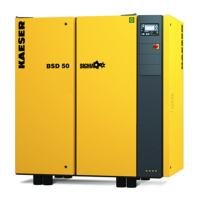
Do you have a question about the KAESER BSD 40 and is the answer not in the manual?
Instructions on how to use and maintain the service manual.
Lists additional documents provided with the service manual.
Information regarding the copyright of the service manual.
Explains symbols and warnings used in the manual.
Explains symbols for important information, materials, and precautions.
Information found on the machine's nameplate.
Lists available options for the machine with their codes.
Provides weight specifications for different BSD models.
Details operational temperatures for the airend and machine.
Specifies permissible ambient conditions for operation.
Provides guide values for ventilation and exhaust duct dimensions.
Details maximum working pressure and safety relief valve settings.
Specifies the free air delivery (FAD) in cfm for different models.
Discusses the importance of lubrication and recommends KAESER lubricants.
Explains the role of lubricants in compressor operation and potential issues.
Details KAESER's synthetic and specialty lubricants for screw compressors.
Specifies the required cooling oil volume based on machine options.
Details specifications for motors and their power requirements.
Technical specifications for the drive motor, including power and speed.
Technical specifications for the fan motor in Option K1.
Technical specifications for the fan motor in Option K2.
Details sound pressure levels and measurement conditions.
Outlines basic requirements and further considerations for the electrical power supply.
Provides detailed specifications for power supply connections and wire sizing.
Details design data for water-cooling systems, including temperatures and flow rates.
Specifies design parameters for water-cooling systems, including temperature rise.
Specifies the required quality parameters for cooling water.
Details specifications for heat recovery systems, including heat capacity.
Information on preparing the machine for external heat recovery systems.
Details on internal heat recovery systems using plate-type heat exchangers.
Provides fundamental safety information and warnings regarding machine operation.
Defines the intended industrial use of the machine and limitations.
Lists actions that constitute improper use and potential risks.
Outlines the responsibilities of the user for safe operation and compliance.
Stresses adherence to relevant safety and accident prevention regulations.
Defines qualifications required for authorized operators and maintenance personnel.
Emphasizes compliance with local inspection schedules and regulations.
Introduces various forms of danger that can arise during machine operation.
Provides guidance on safely handling electricity, compression, air quality, springs, and rotating components.
Covers safe practices for transport, installation, and disposal of the machine.
Outlines organizational measures for safety, including responsibilities and reporting.
Identifies areas around the machine that are dangerous to personnel.
Describes the importance and function of safety devices, emphasizing they must not be modified.
Explains the meaning and location of safety signs used on the machine.
Provides guidance on handling emergencies, including fire fighting.
Lists suitable and unsuitable extinguishing agents and basic fire fighting steps.
Instructions for immediate action in case of cooling oil contact with eyes or skin.
Details warranty conditions and exclusions, emphasizing original parts and maintenance.
Guidelines for storing and disposing of materials in compliance with environmental regulations.
Describes the machine's enclosure, its functions, and limitations.
Provides a functional overview of the machine, using an air-cooled model as an example.
Explains the purpose and behavior of floating relay contacts.
Details various available options for the machine.
Describes machine mountings for anchoring the unit firmly to the floor.
Explains the function of the cooling air filter mat.
Details the water-cooling system using plate heat exchangers.
Describes heat recovery systems, including combination and thermostatic valves.
Information on preparing for external heat recovery systems.
Details on internal heat recovery systems using plate-type heat exchangers.
Explains operating modes and control modes for efficiency.
Explains the different operating modes: LOAD, IDLE, STANDSTILL, and MODULATING CONTROL.
Details control modes like DUAL, QUADRO, VARIO, and MODULATING for energy efficiency.
Describes the importance and function of safety devices, emphasizing they must not be modified.
Identifies keys and indicators on the SIGMA CONTROL panel and their functions.
Safety instructions for installation, including fire prevention and ambient conditions.
Requirements for the installation environment, including location and clearances.
Guidance on selecting a suitable machine location and required clearances.
Emphasizes the need for sufficient ventilation and specifies air volume requirements.
Details considerations for designing exhaust ducts to maintain airflow.
Guidelines for connecting the compressor to a compressed air system and maintaining air quality.
Basic safety instructions for performing installation work on the machine.
Procedure for checking and reporting any damage incurred during transport.
Steps for connecting the machine to the compressed air system.
Detailed instructions for safely connecting the machine to the electrical power supply.
Details various options related to installation.
Guidance on anchoring the machine securely to the floor.
Instructions for connecting the cooling water supply lines.
Instructions for connecting heat recovery systems, including warnings about oil contamination.
Specifics for connecting external heat recovery systems.
Instructions for connecting internal heat recovery systems.
Safety precautions to be followed before commissioning the machine.
Important points to consider before the initial commissioning of the machine.
Checklist for verifying installation and operating conditions before starting the machine.
Instructions for setting the overload protection cut-out for the machine.
Guidance on setting the motor overload protection switch for the fan motor.
Procedure for manually adding cooling oil to the airend before initial start-up.
Steps to verify the correct direction of rotation for the drive motor and cooling fans.
Detailed steps for starting the machine for the very first time.
Instructions for adjusting the setpoint pressure based on operating conditions.
Procedure for changing the display language on the SIGMA CONTROL.
General instructions for switching the machine on and off using the control panel keys.
Steps to power on the machine and start the compressor motor.
Procedure for safely shutting down the machine through normal operation.
Instructions for using the EMERGENCY STOP button and restarting the machine.
Details on operating the machine remotely via a control center.
Instructions for programming and using the clock function for automatic operation.
Explains how to acknowledge and reset alarm and warning messages displayed on the SIGMA CONTROL.
Introduces fault types (alarm, warning, other) and general troubleshooting guidelines.
Lists alarm messages, their possible causes, and recommended remedies for machine shutdowns.
Lists warning messages, their potential causes, and recommended remedies.
Addresses faults that do not trigger specific alarms or warnings, with causes and remedies.
Safety instructions to be followed before performing any maintenance tasks on the machine.
Outlines the maintenance schedule and intervals based on operating conditions.
Instructions for keeping a log of all maintenance and service work performed.
Procedure for resetting maintenance interval counters after tasks are completed.
Lists required regular maintenance tasks and their corresponding chapters.
Provides recommended intervals for changing the cooling oil based on lubricant type.
Lists essential service tasks to be performed by authorized technicians.
Instructions for cleaning or replacing the cooling air filter mat.
Procedure for cleaning or replacing filter mats in the control cabinet.
Details on performing regular cleaning and maintenance of the cooler.
Maintenance procedures for the water-cooling system, including checking for leaks.
Guidance on maintaining heat recovery systems to ensure efficient heat transfer.
Specific maintenance advice for external heat recovery systems.
Maintenance procedures for internal heat recovery systems.
Instructions for maintaining the air filter, emphasizing the use of correct elements.
Details on motor bearing lubrication and maintenance using specific grease.
How to identify a defective coupling by its running noise or appearance.
Procedure for checking the safety relief valve's operation by raising working pressure.
Instructions on verifying the machine's automatic shutdown function based on airend discharge temperature.
Method for checking the cooling oil level, noting accuracy on running machines.
Steps for safely venting the machine to remove pressure before maintenance.
Procedure for topping up the cooling oil, including venting and test runs.
Details on venting the machine before topping up oil.
Steps for filling cooling oil and performing a test run, with cautions about oil types.
Comprehensive guide to draining and replacing cooling oil from various machine components.
Instructions for replacing the oil filter, including post-replacement checks.
Procedure for replacing the oil separator cartridge, noting it cannot be cleaned.
Provides a logbook for documenting maintenance and service tasks performed.
Emphasizes the importance of the machine's nameplate for service and ordering parts.
Lists KAESER consumable parts and operating materials, with part numbers.
Outlines the services offered by KAESER AIR SERVICE for maintenance and operation.
Indicates that KAESER representative addresses are provided at the end of the manual.
Guidance on using parts lists to plan material requirements for service and repair.
Procedures for temporarily or long-term decommissioning of the machine.
Instructions for short-term shutdown to ensure protection against corrosion.
Steps for safely shutting down the machine for extended periods.
Guidelines for packing the machine for transport, including materials and precautions.
Advice on preventing corrosion and damage during storage.
Covers safe methods and precautions for transporting the machine.
Safety precautions for transporting the machine, considering weight and center of gravity.
Instructions for safely transporting the machine using a forklift.
Guidance on using a lifting cradle and slings for crane transport.
Procedures for draining liquids, removing filters, and disposing of the machine and contaminated parts.
Contains pipeline and instrument flow diagrams for the compressor package.
Illustrates the P+I diagram for the MODULATING control mode.
Provides dimensional drawings of the machine, showing key measurements and layouts.
Contains the electrical diagrams for the machine's wiring and components.
 General
| Model | BSD 40 |
|---|---|
| Category | Compressor |
| Type | Rotary Screw Compressor |
| Free Air Delivery | 2.95 m³/min |
| Working Pressure | 7.5 bar |
| Weight | 650 kg |

 To Next Page