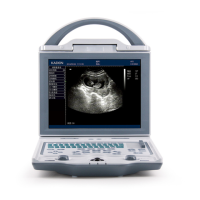
The KAIXIN MSU2 is a full digital mechanical sector scanning ultrasonic diagnostic instrument designed for veterinary use. This user's manual provides comprehensive information on its operation, maintenance, and technical specifications.
Function Description
The MSU2 is a portable ultrasonic diagnostic instrument primarily used for veterinary imaging. It employs full digital mechanical sector scanning technology to provide clear and detailed images for various diagnostic purposes. The device supports multiple imaging modes, including B mode, B/B mode, 4B mode, B/M mode, and M mode, allowing for versatile diagnostic applications. Key functions include:
- Image Acquisition and Processing: The instrument captures ultrasonic images and offers various processing functions such as magnification, depth range selection, local zoom, image left/right and up/down reversal, color selection, and image filtering. It also includes automatic backfat measurement, ruler functions, and image freeze/unfreeze capabilities.
- Measurement Functions: The MSU2 provides comprehensive measurement tools for distance, circumference/area/volume, heart rate/cycle, and slope. It also includes obstetric measurement capabilities with specific parameters for various animals (bovine, equine, ovine, canine, feline, goat, llama, swine).
- Image Management: Users can save and recall images, delete images, and input text annotations. The device supports obstetric lists for managing patient data.
- System Control: The instrument allows for time setting, TV mode setting (PAL and NTSC), energy saving setting, character brightness adjustment, hospital name setting, key sound setting, and Chinese-English language switching.
- Connectivity: It features a power input interface, video output interface, USB interface, and a probe connector. It can connect to a video recorder for recording images and a USB interface for data transfer.
Important Technical Specifications
- Display: 5.7" LED monitor with 256 gray scales.
- Power Supply: Adapter rating: 100-240V~, 1.2-0.6A, 50-60Hz. Output of adapter: DC12.8V 3.0A.
- Main Device Rating: DC12V 3.0A.
- Main Unit Size: Approx. 212 * 154 * 50 mm³.
- Weight of Main Unit: Approx. 1.1kg (excluding accessories).
- Probe: 3.5MHz mechanical sector probe.
- Battery: Rechargeable lithium-ion battery pack, rated capacity 5200mAh.
- Operating Environment:
- Ambient temperature: 10℃-40℃
- Relative humidity: 30%-75% (without condensation)
- Atmospheric pressure: 700hPa-1060hPa
- Storage and Transport Environment:
- Ambient temperature: -20℃-55℃
- Relative humidity: 30%-93% (without condensation)
- Atmospheric pressure: 700hPa-1060hPa
- Safety Classification:
- Class I, internally powered equipment.
- Type B applied part.
- Degree of protection against ingress of liquid: Main unit belongs to IPX0 equipment.
- Operation safety in condition of existence of flammable anesthetic mixture with air or oxygen or nitrous oxide: It is neither of category AP equipment nor of category APG equipment.
- Mode of operation: Continuous operation equipment.
- Protection of radio services: Group I Class A equipment.
Usage Features
- Portability: The compact size and lightweight design make the MSU2 highly portable for field use.
- User-Friendly Interface: The device features a keyboard with clearly labeled keys for various functions, simplifying operation. The main unit sketch map and parts of the probe diagram aid in understanding the physical components.
- Installation: The manual provides detailed instructions for installing the instrument on the arm or chest using a hood and adjustable strap, ensuring comfortable and secure use.
- Battery Management: Instructions are provided for installing and removing the battery, as well as for charging. The device can also be powered by an adapter.
- Video Recording: The MSU2 supports connection to a video recorder (Goggle06) for capturing and storing examination videos.
- Probe Installation: Clear steps are outlined for connecting and disconnecting the probe, emphasizing safety precautions to prevent damage or injury.
- System Reset: The instrument can be reset to factory settings if needed, which can help resolve minor operational issues.
- Warning Symbols: The manual includes a comprehensive list of safety symbols and their meanings, ensuring users are aware of potential hazards and proper handling procedures.
- Image Optimization: Various image adjustment features allow users to fine-tune image quality for optimal diagnostic clarity, including brightness, contrast, gain, dynamic range, and frame correlation.
Maintenance Features
- Cleaning and Disinfection: Detailed instructions are provided for cleaning and disinfecting the probe and the main unit using specific chemical agents (Glutaraldehyde, Cidex Glutaraldehyde disinfectant, Cidex OPA). Emphasis is placed on proper immersion times and rinsing procedures to prevent damage and ensure hygiene.
- Battery Care: Guidelines for proper battery usage, storage, and charging are given to maximize battery life and prevent damage. This includes warnings against extreme temperatures, physical damage, and improper disposal.
- Troubleshooting: A troubleshooting section helps users identify and resolve common issues, such as power supply problems, probe connection issues, and image display malfunctions.
- Periodic Safety Checks: The manual outlines periodic safety checks that should be performed at least every 12 months by qualified personnel. These checks include inspecting equipment and accessories, verifying compliance with rated current, checking insulation resistance, and testing earth leakage current.
- Storage and Transportation: Instructions for proper storage and transportation are provided to protect the instrument from damage due to environmental factors or physical impact. The device should be stored in a dry, well-ventilated area with controlled temperature and humidity.
- Manufacturer Information: Contact details for Xuzhou Kaixin Electronic Instrument Co., Ltd. are provided for support, including address, phone, fax, website, and email. This ensures users can easily reach out for technical assistance or spare parts.
- Warranty Information: The manual specifies a one-year warranty period for the product, covering damage or loss caused by error or rough usage. It also outlines conditions that may void the warranty, such as unauthorized repairs or modifications.
- Software and Hardware Maintenance: Users are advised not to modify the software or hardware of the equipment without authorization from the manufacturer. Medical personnel are qualified to use the system, but maintenance should be performed by trained engineers or by Kaixin Electronic Instrument Company Ltd.

 Need help?
 General

 To Next Page