46
Operation of the KAM Plus
This section of the manual describes KAM Plus operation. Each operational mode of the KAM Plus
is described including an example of that mode. You will benefit most from this section if you read
from it while you are at your station with your KAM Plus connected to your computer and radio;
therefore you may follow the examples and experiment with the unit. Start with your KAM Plus in
the Command Mode. When you first turn the KAM Plus on, it sends its sign-on message
(KANTRONICS ALL MODE...) and then the prompt cmd:. This is the Command mode of your
KAM Plus. Anytime you want to operate the KAM Plus in a non-packet mode, you must start from
this cmd: prompt and give the command indicated in this section to enter the new mode.
The operational examples we use to explain these modes assume a standard terminal communica-
tions program such as the PACTERM program provided with the KAM Plus, or a telephone commu-
nications program such as PROCOM PLUS is in use. If you are using a specialized ham-radio pro-
gram, or a Host mode program (Host Master), the examples will not apply. Host programs typically
communicate with the KAM Plus for you, simplifying your operation. Refer to your software manual
if you are using these specialized programs.
Digital mode operation on HF amateur bands is usually accomplished using the Lower Sideband
(LSB) mode of your radio and applying your transmitted signal to the microphone input. It is also
possible to operate the HF modes with FSK if your radio supports this mode.
Tuning in the Signals
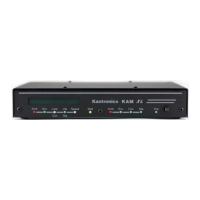
When operating any of the HF modes, use the bargraph on the front of the KAM Plus as your tun-
ing indicator. For RTTY, ASCII, AMTOR, PACKET and PACTOR operation, a properly-tuned signal will
light the two outside LEDs on the bargraph. The left end of the bargraph is the MARK LED and the
right end is the SPACE LED. As signals are received, these two LEDs should light with approxi-
mately the same brilliance.
When operating CW, the MARK LED will light when no signal is present, and when a tone is re-
ceived, the bargraph should move quickly and completely to the SPACE LED. Slow movement to-
ward the SPACE LED indicates that you are not tuned properly on the CW signal.


 To Next Page