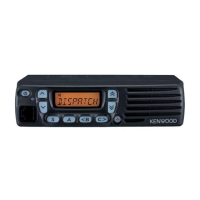
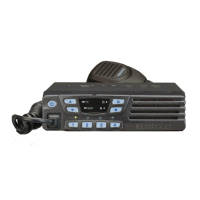
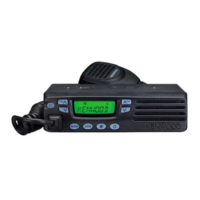
TK-7160/7162
14
Control Circuit
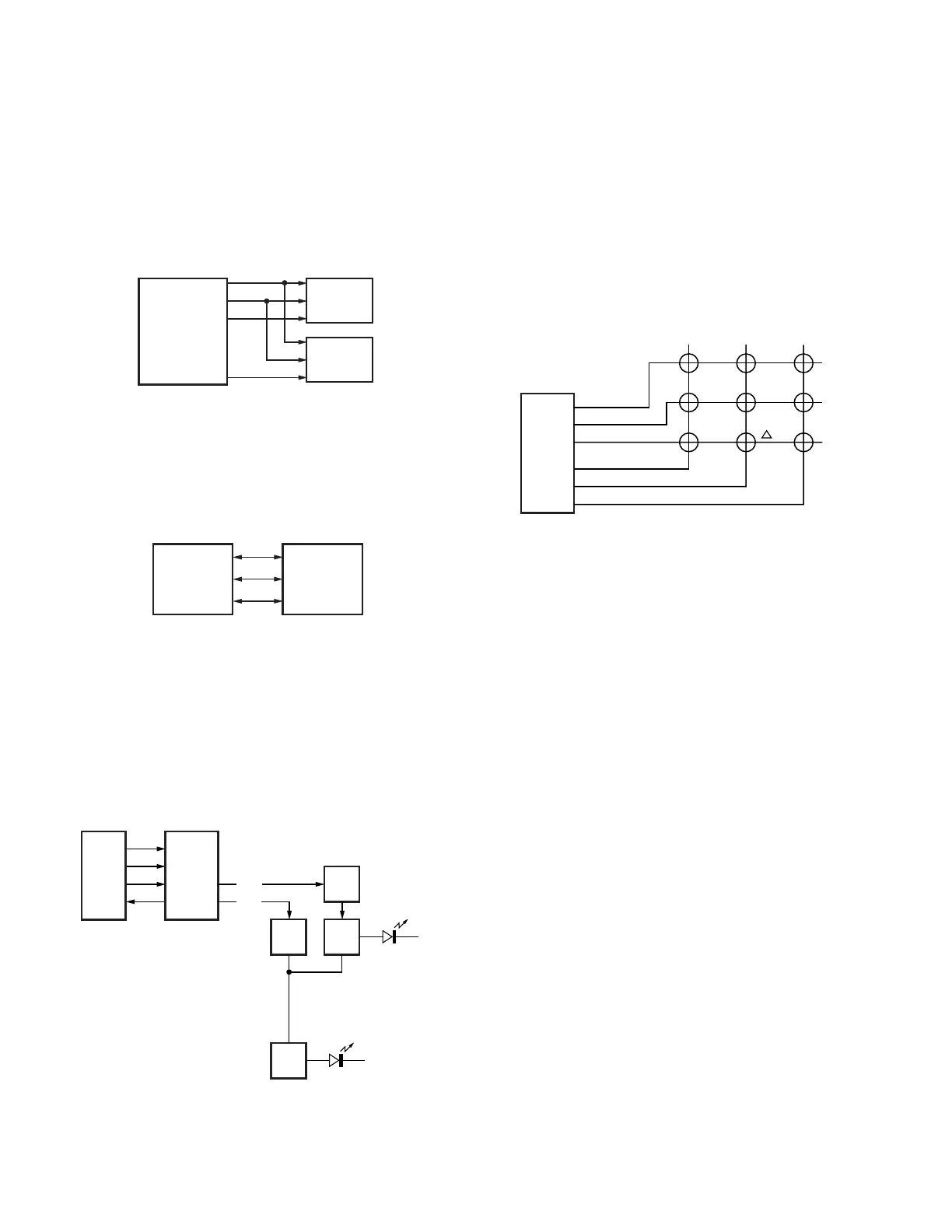
The CPU carries out the following tasks:
1) Controls the WIDE, NARROW, TX/RX outputs.
2) Controls the AQUA IC (IC241).
3) Controls the PLL (IC401).
4) Controls the D/A converter (IC201) and adjusts the vol-
ume, modulation and transmission power.
Fig. 10 Control circuit
Fig. 11 Memory circuit
Fig. 13 Key matrix circuit
IC201
D/A
converter
IC401
PLL
IC101
CPU
LD
DT
CK
PLLE
■ Memory Circuit
The transceiver has an 64k-bit EEPROM (IC81). The
EEPROM contains adjustment data. The CPU (IC101) con-
trols the EEPROM through three serial data lines.
EEPCK
IC101
CPU
IC81
EEPROM
EEPDT
EEPWP
■ Display Circuit
The CPU (IC101) controls the display LCD and LEDs.
When power is on, the CPU will use the MBL line to control
the LCD illumination and key backlight LEDs.
The dimmer function is controlled by the switch Q1*. The
LCD controller (IC1) controls the functions of the LCD
through the DO, CE, CL, DI lines from the CPU.
■ Key Matrix Circuit
The TK-7160/7162 front panel has function keys. the TK-
7162 terminal name are parenthese inside. Each of them is
connected to a cross point of a matrix of the KMI1 (KI3) to
KMO3 (KS4) ports of the IC1 LCD driver. The KMO1 (KS2) to
KMO3 (KS4) ports are always high, while the KMI1 (KI3) to
KMI3 (KI1) ports are always low.
The microprocessor monitors the status of the KMI1 (KI3)
to KMO3 (KS4) ports. If the state of one of the ports
changes, the microprocessor assumes that the key at the
matrix point corresponding to that port has been pressed.
IC101
CPU
Q3
SW
D1~D6
Key backlit
Q2
SW
Q1
SW
D7~D18
(TK-7160)
D7~D12
(TK-7162)
LCD
illumination
Q4
SW
IC1
LCD
driver
CE
CL
DI
DO
BRI
BL
*
* TK-7160 only
Fig. 12 Display circuit
IC1
LCD
driver
KMI1 (KI3)
KMI2 (KI2)
KMI3 (KI1)
KMO3 (KS4)
KMO2 (KS3)
KMO1 (KS2)
VOL
UP
VOL
DN
CH
UP
CH
DN
S
A
<B
C>
Signaling Circuit
■ Encode
• Low-speed data (QT, DQT)
Low -speed data is output from pin 1 of the CPU (IC101).
The signal passes through a low-pass CR filter. The signal is
mixed with the audio signal and goes to the VCO and TCXO
(X401) modulation input after passing through the D/A con-
verter (IC201) for BAL adjustment.
• High-speed data (5-tone, DTMF)
High-speed data (HSD) is output from pin 2 of the CPU.
The signal passes through a low-pass CR filter. TX deviation
making an adjustment by microprocessor is passed through
the switch (IC213) and then applied to the audio processor
(IC241). The signal is mixed with the audio signal and goes to
the VCO and TCXO.
The RX tone is passed a summing amplifier (IC241). The
D/A converter (IC201) for audio control, audio power amplifier
and then to the speaker.
• MSK
MSK signal is output from pin 6 of IC241. The signal
passes through the D/A converter (IC201) for the MSK devia-
tion adjustment, and is routed to the VCO. When encoding
MSK, the microphone-input signal is muted.
CIRCUIT DESCRIPTION



 To Next Page