Need help?
Do you have a question about the Kewtech KT63 and is the answer not in the manual?
Read this manual for important safety information before operating the tester.
Warning about live circuits and personal safety during continuity tests.
Steps to connect leads and perform continuity measurements.
Feature to null test lead resistance for accurate measurements.
Warning about energised probes and live circuits during insulation tests.
Warning regarding potential accuracy loss if the unit overheats.
2-wire test for Ze, PSC, PFC at distribution boards.
Low current test for Zs on RCD protected circuits without tripping.
Steps to perform the No-Trip Loop test.
Details the RCD test types (x1, x½, x5) and requirements.
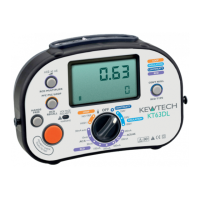
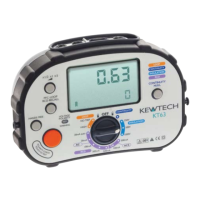
The KT63 is a multifunction installation tester designed for comprehensive electrical testing, offering a range of features to ensure both convenience and safety for the user. It is capable of performing continuity, insulation, loop, and RCD tests, making it a versatile tool for electricians and installers.
The KT63 is engineered to test both live and dead circuits, providing accurate measurements for various electrical parameters. Its core functions include:
Continuity Test Function: This function measures the resistance of a circuit, ensuring that conductors are continuous and have low resistance. It includes a lead nulling feature to automatically deduct the resistance of the test leads from the measurement, providing a more accurate reading of the circuit itself. The tester can operate in a "Hands Free" mode for continuous testing, allowing the user to focus on probe placement.
Insulation Test Function: Designed for use on dead circuits, this function measures the insulation resistance to ensure that conductors are properly isolated. It offers selectable test voltages (250V, 500V, 1000V) to suit different testing requirements. Like continuity testing, it also features a "Hands Free" mode for convenience during prolonged testing.
Loop Test Functions: The KT63 offers two primary loop test modes:
RCD Test Function: The KT63 is capable of testing a wide range of standard (AC) and selective (ACS) type RCDs, complying with the requirements of the 17th Edition wiring regulations. It performs various tests, including x½, x1, and x5 rated current tests, to ensure the RCD operates within specified disconnection times and does not trip unnecessarily. The tester can conduct these tests at both 0° and 180° phase polarities. An "Automatic test" feature simplifies the process for 30mA RCDs, performing all six required tests with a single button press. The device also provides a "Pass or Fail" result in addition to the trip time.
Ramp Test: This diagnostic feature gradually increases the fault current to identify the exact level of additional leakage at which an RCD trips. This is particularly useful for diagnosing nuisance tripping issues and distinguishing between over-sensitive RCDs and excessive leakage from poor insulation or equipment.
Special Polarity Test Function: The KT63 includes a unique feature to detect reverse wiring of Line (Phase) to earth/neutral and earth/neutral to Line (Phase), a potentially dangerous condition that conventional loop testers might miss. If this condition is detected, testing is inhibited, and an alarm sounds.
The KT63 is designed with user convenience and safety in mind:
Large Auto-Backlit LCD: The large display ensures clear visibility of test results, even in poorly lit environments. A primary display shows the main test result, while a secondary display provides supporting information, such as applied voltage during insulation tests.
Audible Tones: A selection of intuitive audible tones provides feedback during testing, indicating measurement in progress, test completion, warnings for dangerous conditions (e.g., live supply connection during insulation test), and alerts for results likely to be considered a failure (e.g., insulation resistance below 2 MΩ).
Auto Shut Down: To conserve battery life, the KT63 automatically powers down after three minutes of inactivity. A single press of any function button will power it back up.
Hands Free Mode: Most test functions can utilize a "Hands Free" mode, where the tester automatically starts the test as soon as the probes are connected to a circuit, freeing the user's hands to hold the probes.
Socket Wiring Check: Upon connection to a live supply, the tester automatically checks for correct polarity. If incorrect wiring is detected, testing is inhibited, and an alarm sounds with a flashing LED.
Test Lead Inputs: The test lead input/output terminals are clearly separated by a sliding interlock cover, ensuring that only the correct leads for the selected function can be connected. This enhances safety by preventing incorrect lead configurations. The tester uses specific lead sets (ACC063 for continuity, insulation, and distribution board tests; KAMP12 for 13A mains socket tests).
Battery Check: A dedicated battery check function is available on the rotary selector switch. In addition to an LCD indicator, a red warning LED lights up when battery power is very low, signaling the need for replacement.
Easy to Locate: The test lead inputs are positioned on the top of the case, allowing the tester to stand vertically or lie flat. A neck strap is also provided for portability.
Fuse Protection: The KT63 is fuse-protected against damage from accidental connection to an over-voltage supply. The fuse (F 500mA fast blow ceramic 600V) is located inside the battery compartment and can be accessed by removing two small screws on the back of the case. Users are advised to disconnect test leads before removing the battery cover.
Battery Replacement: The tester is powered by four conventional AA (LR6) alkaline batteries. Users are instructed to observe correct polarity and not mix old and new batteries. Alkaline batteries are recommended over zinc-carbon batteries for extended life.
Cleaning: The tester can be cleaned with a damp cloth and mild soap solution, taking care to prevent water ingress into the input terminals. Solvents should not be used, and the unit should not be immersed in water. It should be allowed to dry completely before use.
Calibration and Repair: For repair and calibration services, the manual directs users to return the device to Express Cal. The test lead sets are considered an integral part of the tester's setup and should accompany the unit when returned for service.
 General
| Type | Multifunction Tester |
|---|---|
| RCD Trip Current | 10mA, 30mA, 100mA, 300mA, 500mA |
| Frequency Range | 45Hz to 65Hz |
| Display Type | Digital |
| Insulation Test Voltages | 250V, 500V, 1000V |
| Continuity Buzzer | Yes |
| Insulation Resistance Range | 0.01MΩ to 199.9MΩ |
| Continuity Range | 0.01Ω to 200Ω |
| Loop Impedance Range | 0.01Ω to 1999Ω |
| RCD Trip Time Test | 0 - 2000ms |
| PSC/PFC Range | 0.1kA to 19.99kA |
| Power Supply | 6 x 1.5V AA batteries |

 To Next Page