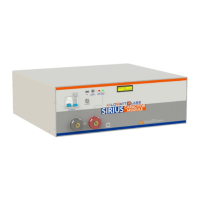
Sirius Capacitor Module – User Manual Model Number - 3550-48-B-1.7C-M-SD-A-G
This manual is subject to change without notice and at the sole discretion of Kilowatt Labs, Inc.
Kilowatt Labs, Inc. | www.kilowattlabs.com
36
A. It is possible but not recommended. Make sure the total voltage of each battery is the same as the
Module and the charging voltage does not exceed the Module’s maximum voltage. The possible
drawback is that you will not get the total capacity of the chemical battery because extreme voltages
are not the same.
Q. If we set the cutoff voltage on the charge controller systems /inverter end to 45V, will that allow
the Module to sit at idle for longer periods of time to avoid an undervoltage situation.
A. Yes.
Q. Which is most compatible charge controller systems/ inverter, and whether any charge
controllers have been integrated with Sirius in this application?
A. All charge controllers that are compatible with our Module specification (please refer to user
manual of Module) can be used with Sirius Module, however you must follow the charging curve of
Sirius module.
Also, Kilowatt labs can provide Centauri Energy Server for microgrid system for more information
please visit www.kilowattlabs.com.
Q. How to check charging/discharging energy of Module?
A. Please refer to “Overview of SiriusVIEW Application” section in SiriusVIEW application manual.
Q. How to reach the rated capacity of Module?
A. The display shows the total delivered energy (discharged) from the time the Module started till
current time, and the Module has ~70A at 1C and 125A at 1.7C(Max. charging current). So, to obtain
the standard energy 3.55kWh, start the charging cycle from minimum voltage 44V to maximum
voltage 54V with constant current of 70 A as shown in charging curve of Sirius module, then for
discharging cycle start from maximum voltage 54V to minimum voltage 44V with 70 A constant
current. (Please refer to SiriusVIEW application manual for Round trip efficiency).
Q. What would be the effect on energy when charge/discharge the Module at different C-ratings?
A. When the charge rate increases, the time for charging/discharging decreases, which means that
maximum energy can be obtained in a short period of time as shown in the table below.


 To Next Page
 Loading...