In case the water to be treated contains:
•
High concentrations of iron and manganese (Greater
than 1ppm measured in the rejection of the machine). •
Prolonged hyperchlorination in time. Sludge or turbidi-
ty greater than 3 NTUs.
•
A nitrate concentration greater than 100 ppm.
•
A sulphate concentration greater than 250 ppm.
3.
EQUIPMENT
INSTALLATION
•
In the event that the Commercial installation has to be
modified in order to install the equipment in the plan-
ned place, it must be carried out in accordance with
the national regulations for indoor installations of water
and electrical supplies.
•
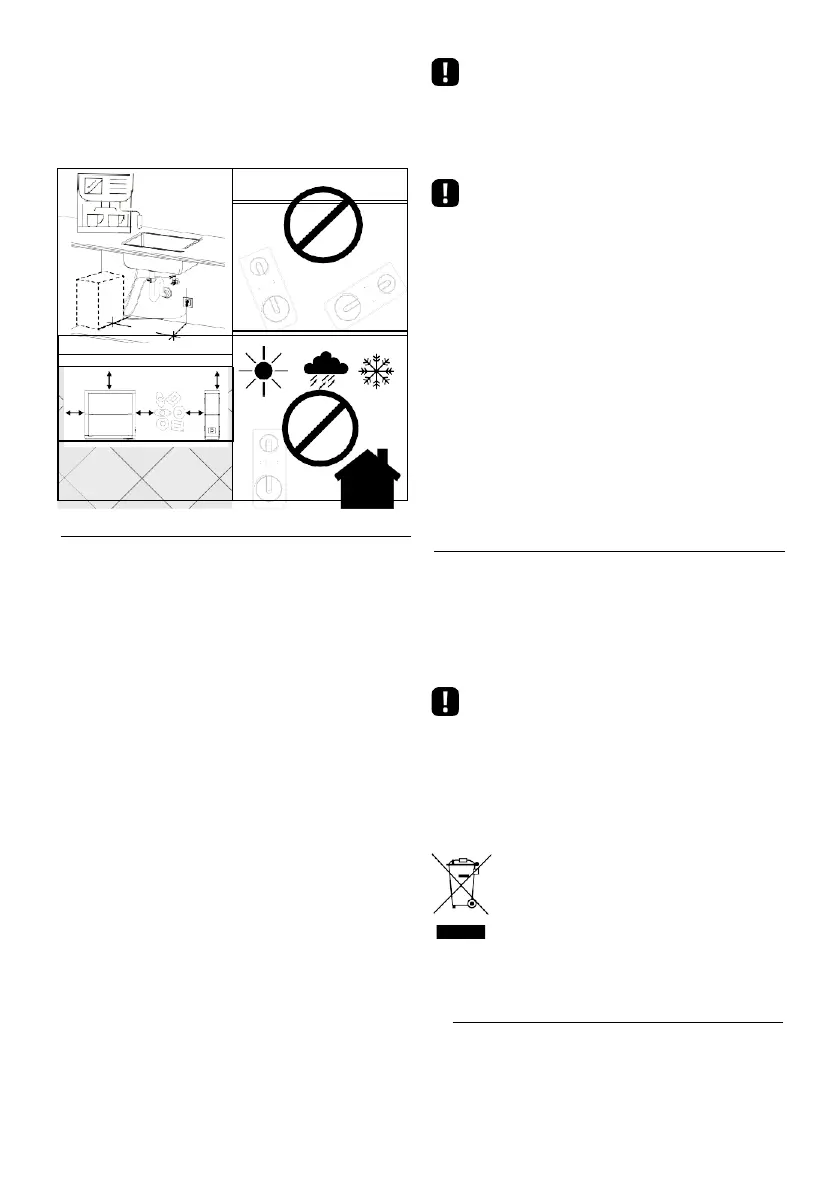
This equipment requires an electrical outlet less than
1 meter away (1).
•
This equipment must not be installed either lying down
or inclined (2), otherwise the leaking sensor will be disa-
bled.
•
The equipment when filled with water weighs more,
the distribution of weight in the installed position could
cause some connection element to be under strain
which could cause a malfunction, damage to equipment
components, or loss of water.
•
The place planned for its installation must have enou-
gh space for the appliance itself, its accessories, con-
nections and for conveniently carrying out maintenance
(3).
•
Under no circumstances should the equipment be ins-
talled outdoors (4).
•
The environment where equipment is installed must
be kept to adequate hygienic-sanitary conditions.
•
The appliance must only be powered at a 100-240 VAC
50/60 Hz.
•
Avoid external drips on the equipment coming from
pipes, drains, etc.
ATTENTION: The equipment must not be installed
next to a heat source or directly receiving a flow of
hotairover it .
· The new hose-sets supplied with the appliance are be
used and that old hose-sets should not be reused.
3.1.
COMMISSIONING AND MAINTENANCE
ATTENTION: This water treatment equipment
needs periodic maintenance carried out by qua-
lified technician, in order to guarantee the quality of
the water produced and supplied.
•
New tubes supplied with the appliance must be insta-
lled and old tubing must not be reused.
•
Consumable items must be replaced with the fre-
quency indicated by the manufacturer.
•
The equipment must be sanitized periodically and
prior to commissioning.
•
After commissioning, water quality may vary during the
first 30 minutes of use.
•
Maintenance must be carried out by qualified techni-
cal personnel with appropriate hygienic conditions and
knowledge, in order to reduce the risk of internal con-
tamination of the appliance and its hydraulic system.
4.
UNPACKING
•
It is important that before installation and start-up,
you check the box and the condition of the equipment,
in order to ensure that it has not been damaged during
transport.
Remove the equipment and accessories from their car-
dboard packaging, removing the corresponding protec-
tions.
ATTENTION: Properly dispose of and keep plastic
bags out of reach of children, as they can be a
danger to them.
•
Inside you will find: Water treatment equipment, insta-
lla- tion accessories and documentation. The materials
used in the packaging are recyclable and must be dis-
posed of in the appropriate selective collection contai-
ners or in the specific local centre for the recovery of
waste materials.
•
This product cannot be disposed of along
with common urban waste. When the useful
life of the equipment has ended, it must be
delivered to a specific local clean-up point
or centre for the recovery of materials, in-
dicating that it has electrical and electronic
components. The correct collection and treatment of
unusable appliances contribute to preserving natural
resources and to avoid potential risks to public health.
5.
INSTALLATION
•
The installation of your osmosis equipment must be
carried out by personnel who are sufficiently qualified
to do so. Read this manual beforehand.
•
The most frequent place for the installation of the
equipment is usually under the kitchen counter or in


 To Next Page
 Loading...