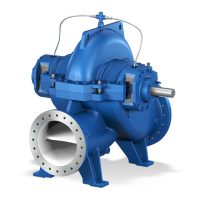
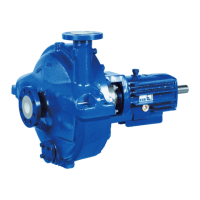
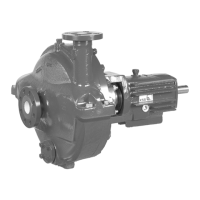
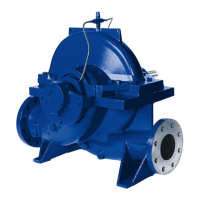
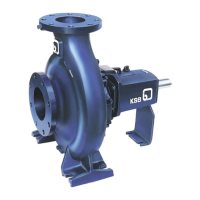
This document provides operating instructions for the KSB RDL axially split volute casing pump, compliant with Directive 98/37/EC.
Function Description
The KSB RDL pump is a robust and reliable device designed for handling various liquids. It is an axially split volute casing pump, meaning the casing is split along the axis of the shaft, allowing for easy access to internal components like the impeller without disturbing piping connections. This design facilitates maintenance and inspection. The pump is suitable for a wide range of applications, including water supply, drainage, irrigation, chemical and petrochemical industries, air conditioning, and paper and cellulose industries.
Important Technical Specifications
The pump is available in various sizes, with impeller diameters ranging from 250 mm to 800 mm, and discharge nozzle diameters from 125 mm to 500 mm. The pump operates at a nominal speed of 2900 1/min (revolutions per minute).
Performance Characteristics (based on the provided pump curve for 2900 1/min):
- Head (H): The pump can achieve heads up to approximately 130 meters (426 ft) at lower flow rates, decreasing to around 70 meters (230 ft) at higher flow rates.
- Flow Rate (Q): The flow rate can range from 0 to over 180 l/s (648 m³/h or 2850 U.S.gpm).
- NPSH (Net Positive Suction Head): The required NPSH varies with flow rate, starting from less than 2 meters (6.5 ft) at low flow rates and increasing to around 10 meters (33 ft) at higher flow rates.
- Power (P): The power consumption (kW or h.p.) increases with flow rate and head. For example, at a flow rate of 100 l/s with a 300 mm impeller, the power is around 150 kW (200 h.p.).
- Efficiency: The pump exhibits high efficiency, with peak efficiency reaching 84% for certain operating points. Efficiency curves are provided for different impeller diameters (e.g., 270 mm, 280 mm, 300 mm, 320 mm).
Materials:
The pump is manufactured from robust materials to ensure durability and long service life. The specific materials for components like the casing, impeller, shaft, and bearings are selected based on the application and operating conditions. For instance, the shaft is typically made of steel, and bearings can be bronze or other suitable alloys.
Operating Conditions:
- Temperature: The maximum permissible fluid temperature depends on the temperature class and can be up to 120°C. The maximum permissible operating temperature of the pump is indicated on the data sheet.
- Pressure: The maximum permissible operating pressure is also specified on the data sheet.
- Speed: The pump is designed for a nominal speed of 2900 rpm.
Usage Features
Installation:
- Foundation: The pump requires a strong and level concrete foundation designed to DIN 1045 or equivalent standards. Shims are used to achieve precise alignment.
- Piping: Proper alignment of suction and discharge piping is crucial to prevent stress on the pump casing. Suction piping should be designed to minimize pressure losses and avoid air pockets.
- Rotation Direction: The pump's rotation direction can be clockwise or counter-clockwise, determined by the shaft side and the flow through the pump. The direction can be reversed by disassembling and reassembling the impeller.
- Alignment: Precise radial and axial alignment of the pump and motor coupling is critical for smooth operation and long service life. Misalignment can lead to vibrations and premature wear.
Commissioning and Startup:
- Priming: Before startup, the pump, suction line, and (if applicable) the thermosiphon tank must be fully filled with liquid.
- Ventilation: All air must be expelled from the pump and suction line.
- Lubrication: The bearings must be properly lubricated with the specified oil or grease.
- Direction of Rotation Check: Before full operation, the direction of rotation must be checked to ensure it corresponds to the arrow on the pump.
- Monitoring: During startup, monitor for unusual noises, vibrations, and temperature changes.
Operation:
- Continuous Operation: The pump is designed for continuous operation within its specified operating range.
- Minimum Flow: Ensure the pump operates above the minimum required flow rate to prevent overheating and cavitation.
- Shut-off Element: The discharge shut-off element should be fully open during operation.
- Ejector System: For applications requiring an ejector system, ensure it is properly configured and maintained.
Maintenance Features
General Maintenance:
- Regular Inspections: Regular inspections are essential to identify potential issues early. This includes checking for leaks, unusual noises, vibrations, and temperature changes.
- Cleaning: Keep the pump and surrounding area clean.
- Lubrication: Bearings require periodic lubrication with the specified grease or oil. Lubrication intervals depend on operating hours and conditions.
- Spare Parts: KSB recommends keeping a stock of essential spare parts, such as impellers, bearing sets, neck rings, lantern rings, packing, and wear rings.
Specific Maintenance Tasks:
- Shaft Seal Maintenance:
- Packing: If the pump uses packing, it requires periodic adjustment and replacement. New packing rings should be cut to the correct length and installed properly.
- Mechanical Seals: Mechanical seals require less maintenance but should be inspected regularly for leaks and wear.
- Disassembly and Reassembly: The axially split casing design allows for easy disassembly of the upper casing, providing access to the impeller, shaft, and bearings without disturbing piping.
- Impeller Removal: The impeller can be removed by loosening the nuts and extracting it from the shaft.
- Bearing Removal: Bearings can be removed after disassembling the bearing housing.
- Shaft Removal: The shaft can be lifted and extracted from the lower casing.
- Storage and Preservation:
- Short-term Storage: For short-term storage, the pump should be stored indoors, and the rotor should be rotated once a month.
- Long-term Storage: For longer periods, the pump should be preserved with suitable protective liquids (e.g., TECTYL 506, RUSTILO DW301) to prevent corrosion. Bearings should be protected with a suitable grease (e.g., MOBILARMA 524).
- Troubleshooting: The manual provides a comprehensive troubleshooting guide to diagnose and resolve common pump faults, such as failure to deliver liquid, excessive leakage, and abnormal noises.
Safety:
- Safety Instructions: Always adhere to the safety instructions provided in the manual to prevent personal injury and damage to equipment.
- Qualified Personnel: Only trained and qualified personnel should perform installation, operation, and maintenance tasks.
- Hazardous Areas: For pumps operating in hazardous areas, additional requirements for electrical connection and explosion protection must be followed.
This KSB RDL pump is a versatile and robust solution for various liquid handling needs, designed with ease of maintenance and long-term reliability in mind.

 Need help?
 General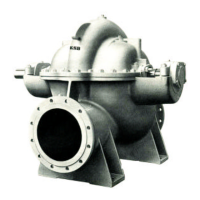

 To Next Page