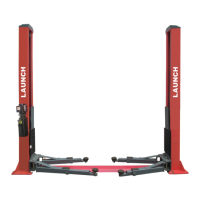
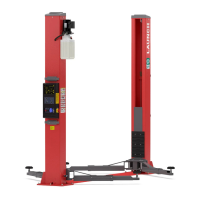
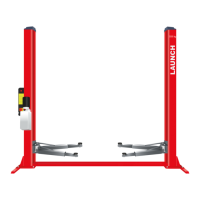
This document serves as the User's Manual for the TLT235SC (U), TLT235SC, TLT235SB, TLT240SC, and TLT240SB Economical Two-Post Lifts. It provides essential information regarding the device's function, technical specifications, usage, and maintenance.
Function Description:
The TLT235SC (U), TLT235SC, TLT235SB, TLT240SC, and TLT240SB are economical two-post lifts designed for raising vehicles to facilitate repair and maintenance. These lifts are primarily used in garages and workshops for small and medium-sized vehicles with a total weight below 3.5t/4.0t. The lifting mechanism is hydraulic, utilizing two hydraulic cylinders to drive the carriage upward through leaf chains. The system incorporates a safety locking mechanism to secure the vehicle at the desired height. For lowering, the safety locks are disengaged, and hydraulic oil flows back, allowing the carriage to descend. The lifts are equipped with a power unit that includes a gear pump and motor to supply hydraulic oil. Electrical systems for both single-phase and three-phase motors are detailed, including safety features like limit switches and emergency stop buttons.
Important Technical Specifications:
The manual provides basic parameters for different models:
- TLT235SC (U) (Symmetric installation): Rated load 3500 kg (7875 lb), lifting height 1850 mm (72.8 in), rising time ≤50s, descending time ≥20s and ≤40s, net weight 660 kg (1455 lb). Passing width 2424 mm (95.4 in), machine width 3392 mm (133.5 in), machine height 3840 mm (151.2 in).
- TLT235SC (Asymmetric installation): Rated load 3500 kg (7875 lb), lifting height 1850 mm (72.8 in), rising time ≤50s, descending time ≥20s and ≤40s, net weight 660 kg (1455 lb). Passing width 2436 mm (95.9 in) or 2390 mm (94.1 in), machine width 3400 mm (133.9 in) or 3551 mm (139.8 in), machine height 3840 mm (151.2 in).
- TLT240SC (Symmetric/Asymmetric installation): Rated load 4000 kg (9000 lb), lifting height 1850 mm (72.8 in), rising time ≤50s, descending time ≥20s and ≤40s, net weight 690 kg (1521 lb). Passing width 2486 mm (97.9 in) or 2415 mm (95.1 in), machine width 3420 mm (134.6 in) or 3563 mm (140.3 in), machine height 3840 mm (151.2 in).
- TLT235SB (Floor-plate 2-post lift): Rated load 3500 kg (7875 lb), lifting height 1850 mm (72.8 in), rising time ≤50s, descending time ≥20s and ≤40s, net weight 610 kg (1345 lb). Passing width 2486 mm (97.9 in), machine width 3370 mm (132.7 in), machine height 2860 mm (112.6 in).
- TLT240SB (Floor-plate 2-post lift): Rated load 4000 kg (9000 lb), lifting height 1850 mm (72.8 in), rising time ≤50s, descending time ≥20s and ≤40s, net weight 645 kg (1422 lb). Passing width 2486 mm (97.9 in), machine width 3370 mm (132.7 in), machine height 2860 mm (112.6 in).
Electrical parameters for the motor are provided:
- Single phase: 110V/60Hz, 2.2kW; 220V/50Hz, 2.2kW.
- Single phase: 200V/60Hz, 2.2kW.
- Three phase: 380V/50Hz, 2.2kW.
Environmental requirements include:
- Working temperature: -5°C to +40°C.
- Transport/storage temperature: -5°C to +40°C.
- Relative humidity: Temperature +30°C, relative humidity 80%.
- Height above sea level: No more than 2000m.
Usage Features:
- Safety First: The manual emphasizes reading all instructions, proper maintenance, and using the lift only for its designed purpose. It warns against overloading, operating with people in the vehicle, or using damaged parts.
- Vehicle Positioning: Correct positioning of the swing arms and lifting pads at the manufacturer-recommended lifting points is crucial. The center of gravity of the vehicle should be between the two arms. For vehicles with severe center of gravity deviation due to part dismantling/installation, additional support is required.
- Operation Steps:
- Lifting: Keep the work area clean, lower the carriage to the lowest position, reduce swing arm length, position the vehicle between columns, adjust swing arms and lifting pads to contact lifting points, press the UP button to slowly lift and confirm load balance, then raise to the required height. Release the UP button and press DOWN to engage the safety lock.
- Lowering: Clean the work area, press the start button to slightly raise the vehicle, pull the steel ropes on both carriages to disengage safety locks, then press the lowering handle to lower the vehicle. Release the handle once swing arms are clear of the chassis.
- Trained Operators Only: Only qualified personnel who have undergone special training are permitted to operate the machine.
- Installation Requirements: The lift must be installed on a horizontal concrete slab with a minimum thickness of 250mm, aged at least 7 days, and reinforced with steel bars. The installation area must be free from overhead obstructions.
- Hydraulic Oil: The recommended hydraulic oil is N32 or N46.
Maintenance Features:
- Daily Inspection:
- Inspect for damaged parts and use original components for replacement.
- Ensure the lifting area is free from obstacles and debris.
- Check the safety mechanism, electromagnet suction/release, and safety plate condition.
- Verify steel cable connection and tension.
- Check the connection between the hydraulic cylinder and carriage, and ensure the connecting nut is tight.
- Lubricate contact surfaces of the carriage with general-purpose lithium grease (GB7324-87).
- Check all hydraulic lines for wear and oil leakage.
- Lubricate chains/cables and inner side of the column with high-quality heavy lubrication grease.
- Monthly Maintenance: Retighten all anchor bolts.
- Six-Month Maintenance:
- Check all movable parts for wear, interference, or damage.
- Inspect and lubricate all pulleys.
- Check and adjust balancing tension for horizontal lifting and lowering.
- Check the verticality of the columns.
- Clean the hydraulic oil tank and replace the oil.
- Annual Maintenance: Clean the hydraulic system and replace the oil.
- Seal Replacement: If oil leakage occurs due to worn sealing materials, replace them immediately with original specifications.
- Air Bleeding: After new installation, the hydraulic system may contain air. Repeat lifting and lowering several times to bleed the air.
- Storage: For long-term storage, disconnect power, lubricate all moving parts, empty oil/liquid storage units, and cover the equipment for dust protection.
- Scrap: At the end of its service life, disconnect power and dispose of the equipment according to local regulations.

 Need help?
 General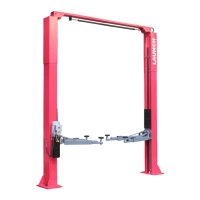

 To Next Page