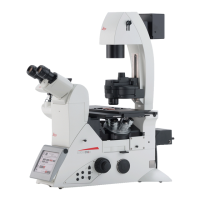
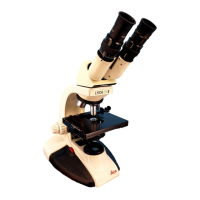
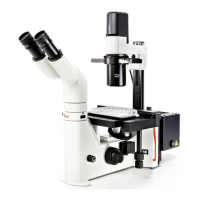
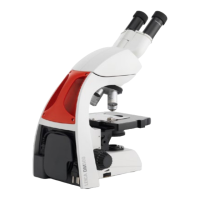
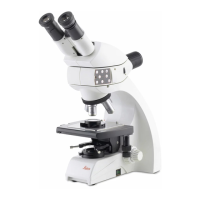
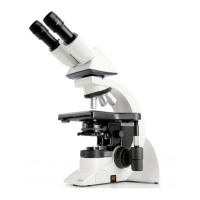
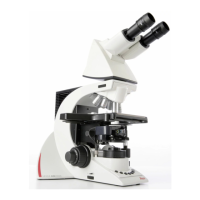
Petrographic microscope
• Leica DM2500 with polarized transmitted and reflected light
• Objectives: 2.5x, 5x, 10x, 20x, and 50x
• Beneath the stage are the polarizer, daylight filter, aperture diaphragm, and condenser.
• Use the condenser for 10x mag and above; it provides diffusive illumination known as
Kohler illumination. The height of the condenser is adjustable, but should not need to be
moved. To properly position the condenser:
1. Focus on sample with analyzer in or out and using an intermediate objective (10x or 20x).
The position of the condenser should be approximately the same for all objectives. Close
the field diaphragm down until it falls just within the field of view. Adjust the height of
the condenser until the diagram edges are in sharp focus. (The field diaphragm always
shows the conjugate image planes, so the edges can be visible, whereas the aperture
diaphragm shows the image plane and cannot be seen.)
2. Check the centering using the 2 set screws located by the aperture diaphragm. One screw
moves the position NW-SE and the other moves NE-SW. The field diaphragm should
again be closed down so that the ring is just inside. Move the set-screws until the aperture
diaphragm is centered.
• Smith reflector - part of the reflected light path that directs light down and maintains the
polarization of the light. The turret containing the Smith reflector has 4 positions but the
others are empty and the turret should always be left in position 4.
• The condenser path for reflected light is aligned and focused in a similar manner to
transmitted light. In this case, the field diaphragm in the reflected light path is aligned using 2
set screws. Centering of this is similar to centering the transmitted light using the field
diaphragm. However, in reflected light there is no focusing that is done.
• The aperture affects the contrast of the image seen in the microscope. The aperture
diaphragm in transmitted light has color-coded markings that indicate the optimal setting for
each of the objectives. It should be closed down at higher magnification. The aperture
diaphragm in reflected light can also improve image contrast.


 To Next Page
 Loading...