VARIABLY SPACED HALF-BLIND DOVETAILS
38
Chapter 10 D4R Pro User Guide
10-32
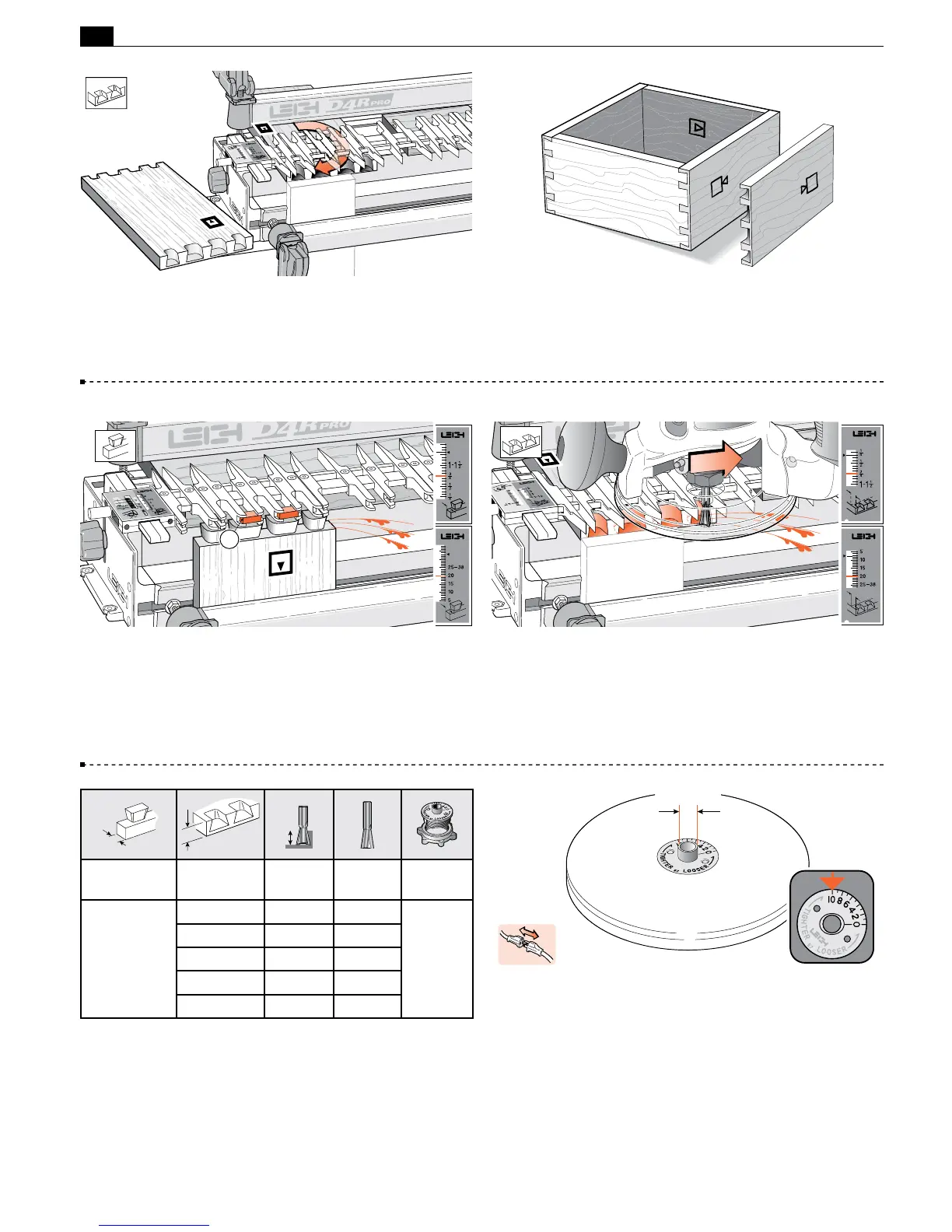
Rout all four ends of the pin boards keeping the inside
face
i
of the boards away from the jig.
Note: When making drawers you may prefer to use through dovetails
on the rear corners.
10-33 Assemble the box. As with through dovetails, it doesn’t
matter which edge of any of the boards are at the top or bottom,
the box will still fit together e.g. pin board “A” can be up either way.
X
A
A
X
Y
Y
QUICK REFERENCE REMINDERS
1
10-34 Half-blind (HB) tails: Drawer sides (tailboards) are clamped
vertically in the jig. The inside face
i
of the drawer side goes away
from the jig body. The finger assembly is in the
H
HB TAILS
mode, set to the thickness of the drawer side. Use bridge pieces
where required
➀
.
10-35 Half-blind (HB) pins: Drawer fronts (pinboards) are
cut with the board clamped horizontally in the jig. The inside
face
i
of the drawer front faces away from the jig body. The
finger assembly is in the
h
HB PINS mode, and again set on
the thickness of the drawer side (but adjusted for a flush fit, see
10-28 to 10-30).
10-36 On the Leigh D4R Pro, all half-blind dovetails are routed
using the Leigh e7-Bush set at No.10 or standard
7
⁄
16
"[11,1mm]
diameter bush (min. depth
1
⁄
4
" [6,35mm] see Appendix I ). For
instructions to rout end-on-end dovetails see Chapter 13.
■
7/16"
[11,1mm]
Thickness of
Tail Board
Thickness of
Pin Board
Depth of
Cut
Dovetail
Bit
Guidebush
Diameter
1
/4"-1
1
/2"
[6-40]
min.
7
/8" [22] ~
3
/4" [19] No.80-8
Leigh e7
or
7
/16" [11,1]
min.
3
/4" [20] ~
5
/8" [16] No.101-8
min.
5
/8" [16] ~
1
/2" [13] No.112-8
min.
9
/16" [14] ~
7
/16" [11] No.120-8
min.
1
/2" [12] ~
3
/8" [9] No.128-8
Numbers in brackets are millimeters



 To Next Page