38
6.3 Physical Interface Verication
Serial Setup Verication
In a multi-drop serial network, the host data format settings are typically known
or specied, and the slave is adjusted to match. If you have long wiring runs,
experiment to determine the fastest allowable baud rate for the wiring conguration
(change BOTH the host and slave devices). Congurations other than 8N1 are rare,
and it is advised to use this conguration for Data Bits, Parity, and Number of
Stop bits.
LAN Ethernet Network Verication
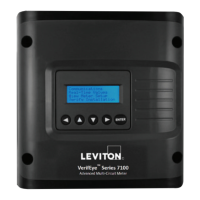
The VerifEye
®
meter uses IEEE 802.3 Ethernet connectivity (running at a 10/100
Mbps) to communicate. Verication of the meter settings over Ethernet includes
that the IP address of the meter is within a range that supports communication with
a host (if static) or is set for DHCP. This allows the meter to be assigned an address
by a DHCP server, as described below.
DHCP
If the VerifEye
®
meter is congured for DHCP when the meter is powered ON, or
the Ethernet cable is inserted, the meter is assigned an IP address by the DHCP
server. This address appears on the meter's LCD screen, or found in Power Meter
Viewer Utilities software or the VerifEye
®
Web App. The IP address assigned to the
meter is a temporary address, as the address may change between power cycles,
which makes it difficult for the host system to nd the meter on the network. It is
best to congure the meter for DHCP so that the address assigned by a DHCP
server can change that IP address to static one when the connection is made.
VerifEye
®
meters are set to use DHCP as a default setting.
Static IP
If the VerifEye
®
meter is set to a static IP, then its address is assigned by an IT
department to avoid multiple devices with the same IP address on the same
network. Use static IPs when an RTU expects to nd the meter at a specic
IP address.
6.4 Protocol Verication
Specify the network protocol when you install the meter. BACnet MS/TP and
Modbus RTU are the two communication protocols that operate over an RS-485
serial network and BACnet IP and Modbus TCP are the protocols over Ethernet.
Each combination of interface and protocol require specic register settings
described in the next section. The scope of this section is to use either the LCD
interface or software tools to quickly conrm or change settings to match an
existing specication. Further information and optimization tips are covered in the
section on RTU programming.
6 COMMUNICATION AND VERIFICATION



 To Next Page