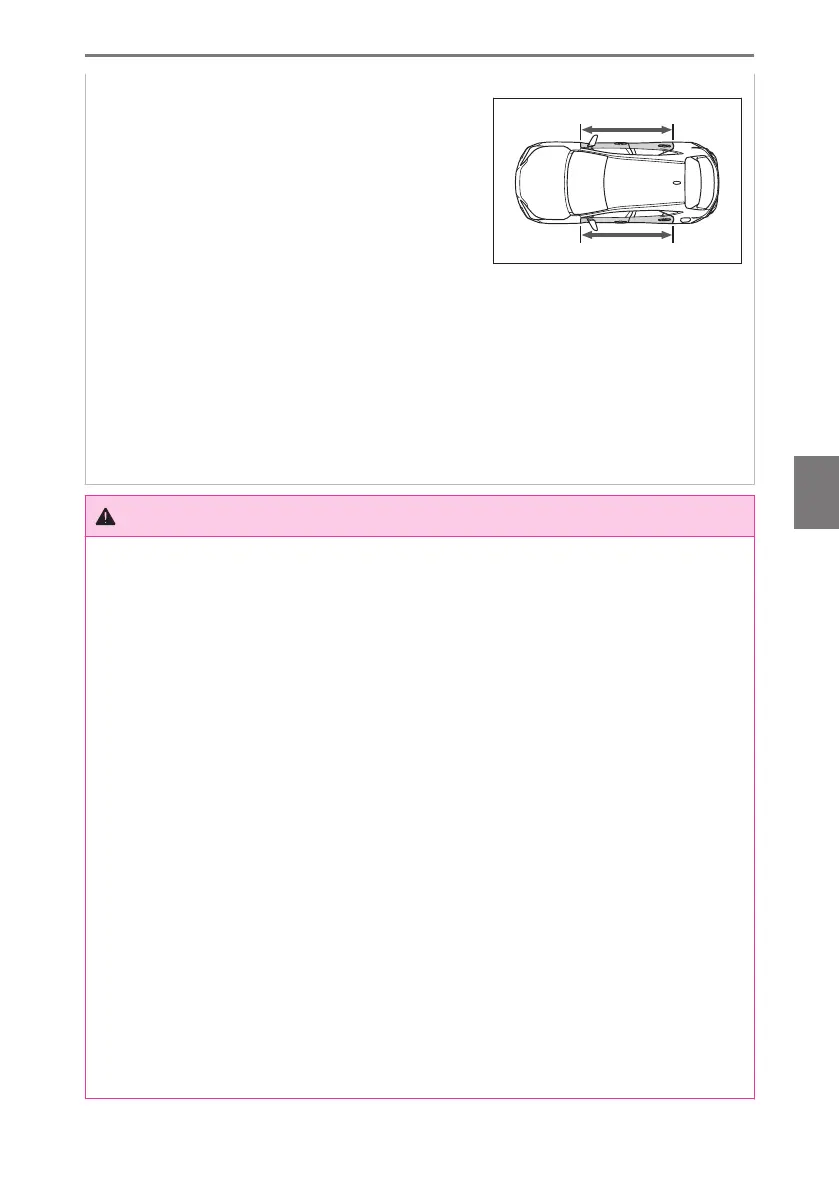
● When a door or its surrounding area is damaged,
deformed or has had a hole made in it, or was in-
volved in a collision that was not severe enough to
cause any of the following SRS airbags to deploy:
• SRS side airbags
• SRS curtain shield airbags
• SRS front center airbags
● When the pad section of the steering wheel, the dashboard near the front passenger
SRS airbag or the lower side of the instrument panel is scratched, cracked, or other-
wise damaged.
● When the surface of a seat with an SRS side airbag or SRS front center airbag is
scratched, cracked, or otherwise damaged.
● When the part of a front pillar, rear pillar or roof side rail garnish (padding) which
covers a SRS curtain shield airbag is scratched, cracked, or otherwise damaged.
WARNING
■ SRS airbag precautions
Observe the following precautions. Failure to do so may result in death or serious injury.
● The driver and all passengers must wear their seat belts correctly.
The SRS airbags are supplemental devices to be used with the seat belts.
● The SRS driver airbag deploys with considerable force, and can cause death or
serious injury, especially if the driver is very close to the airbag.
Since the risk zone for the driver’s airbag is the first 50-75 mm (2-3 in.) of inflation,
placing yourself 250 mm (10 in.) from your driver airbag provides you with a clear
margin of safety. This distance is measured from the center of the steering wheel to
your breastbone. If your current driving position places you less than 250 mm (10 in.)
away from the driver airbag, you can change your driving position in several ways:
•
Move your seat to the rear as far as possible while still being able to reach the
pedals comfortably.
•
Slightly recline the seatback. Although vehicle designs vary, many drivers can
achieve the 250 mm (11 in.) distance, even with the driver seat all the way forward,
simply by reclining the seatback somewhat. If reclining the seatback makes it hard
to see the road, raise yourself by using a firm, non-slippery cushion, or raise the seat
if your vehicle has that feature.
• If your steering wheel is adjustable, tilt it downward. This points the airbag toward
your chest instead of your head and neck. The seat should be adjusted as recom-
6-3. Reducing impact to the occupants in a collision
563
6
Driving support system



 To Next Page