Installation
40 GA02411_002_C0 - 10/2016 - © Leybold
3.3.1 Connections at the Intake Side
Remove protection foil and desiccant from the intake port.
The connecting flanges must be clean and undamaged so as to ensure a
leaktight vacuum system
At the intake side of the pump, lines which are as short as possible having a
minimum nominal width of DN 100 should be used. The same applies also to
components like valves fitted in the lines.
The intake line should be clean and free of oil. Dirt, like welding beads or cin-
der must be removed with care from the intake line.
Support the pipe if required, in particular in those cases when other compo-
nents like valves, separators etc. are installed upstream of the pump. The
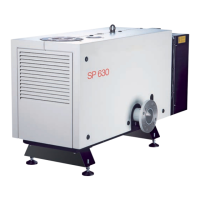
maximum permissible weight on the intake port of the SP 630/630 F is 50
kg.
Use always the intake screen built-in as standard.
Note safety information 0.6.2.
In connection with ATEX applications, the supplied intake screen alone will
be inadequate. In order to prevent the creation of mechanical sparks, an
additional dust filter with a mesh of 40 µm max. will be mandatory, if from
the side of the system it cannot be ensured that the pump will pump
exclusively gases or vapours.
3.3.2 Connections at the Delivery Side (Exhaust)
It is strongly recommended to always operate the pump with a connected
and suitable discharge line or with a silencer. The discharge line should be
laid so that it slopes down and away from the pump so as to prevent con-
densate in the discharge line from backstreaming into the pump.
Alternatively a condensate separator can be provided directly downstream of
the discharge flange. The filling level of the condensate separator needs to be
monitored regularly so that the gas may flow out of the discharge without
being obstructed.
In the case of the optionally available silencer, the condensate separator has
already been integrated.
The diameter of the discharge line should at least match the diameter of the
connection at the pump.
When connecting the discharge side to an discharge gas collecting line, the
installation of a non-return valve downstream of the discharge is recommend-
ed. This will reliably prevent any gases from flowing back through the dis-
charge into the pump.
Remove the protection foil and desiccant from the discharge flange.
The pressure in the discharge line must not exceed 200 mbar are above
the ambient pressure. The discharge line must not be blocked or constrict-
ed.
NOTICE
CAUTION
CAUTION



 To Next Page
 Loading...