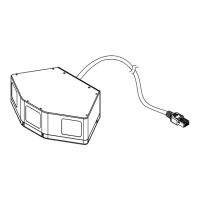
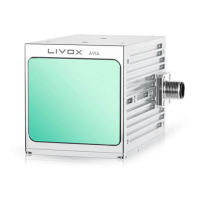
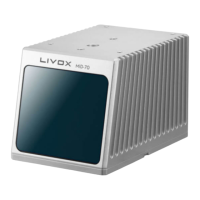
LIVOX HAP
User Manual
6
©
2022 Livox Tech All Rights Reserved.
Table 1.2.1 Point cloud specications
Laser Wavelength 905 nm
Laser Safety Class 1 (IEC 60825-1:2014) (Safe for eyes)
Detection Range (@100 klx) 150 m @ 10% reectivity
Close Proximity Blind Zone 0.5 m
FOV 120° (horizontal) × 25° (vertical)
Distance Random Error (1σ) < 2 cm @ 20 m (80% reectivity)
Distance System Erro < ± 3 cm @ 20 m
Angular Random Error (1σ) < 0.1°
Beam Divergence 0.03° (horizontal) × 0.28° (vertical)
Point Rate 452,000 points/s
Frame Rate 10 Hz
False Alarm Ratio (@ 100 klx) 0.01%
HAP (TX) cannot precisely detect objects which are less than 0.5 m away. In this
situation, the HAP (TX) will output warning message for blocking, and the serial number
of the HAP (TX) displayed on Livox Viewer 2 will change color to warn users. If used at
the time, check the SDK for more information about the warning. The point cloud may
distort to a varying extent when the target object is within the range of 0.5 to 2 m.
The HAP (TX) has a detection accuracy of 2 cm when tested at a temperature of 25° C
(77° F) with a target object that is 20 m away and has a reectivity of 80%. The actual
environment may dier from the testing environment. The gure listed is for reference
only.
The performance of the HAP (TX) may decrease in extreme environments, such as those
where the temperature is -40° C (-40° F) or 85° C (185° F) or those that cause high
vibration.
The performance of the scanning method is defined by the FOV coverage, which is
calculated as the fraction of FOV illuminated by laser beams. The FOV coverage (C) can
be calculated with the following formula:
Refer to the ocial Livox website for more information about how the FOV coverage is
calculated.
C
=
Total area in FOV
Total area illuminated by laser beams
×100%


 To Next Page