EasyManua.ls Logo

Luxman 308 - Tone Control Adjustments; Balance Control Operation; Bass Tone Control Functions; Treble Tone Control Functions

Luxman 308
20 pages
Print Icon
To Next Page IconTo Next Page
To Previous Page IconTo Previous Page
Loading...
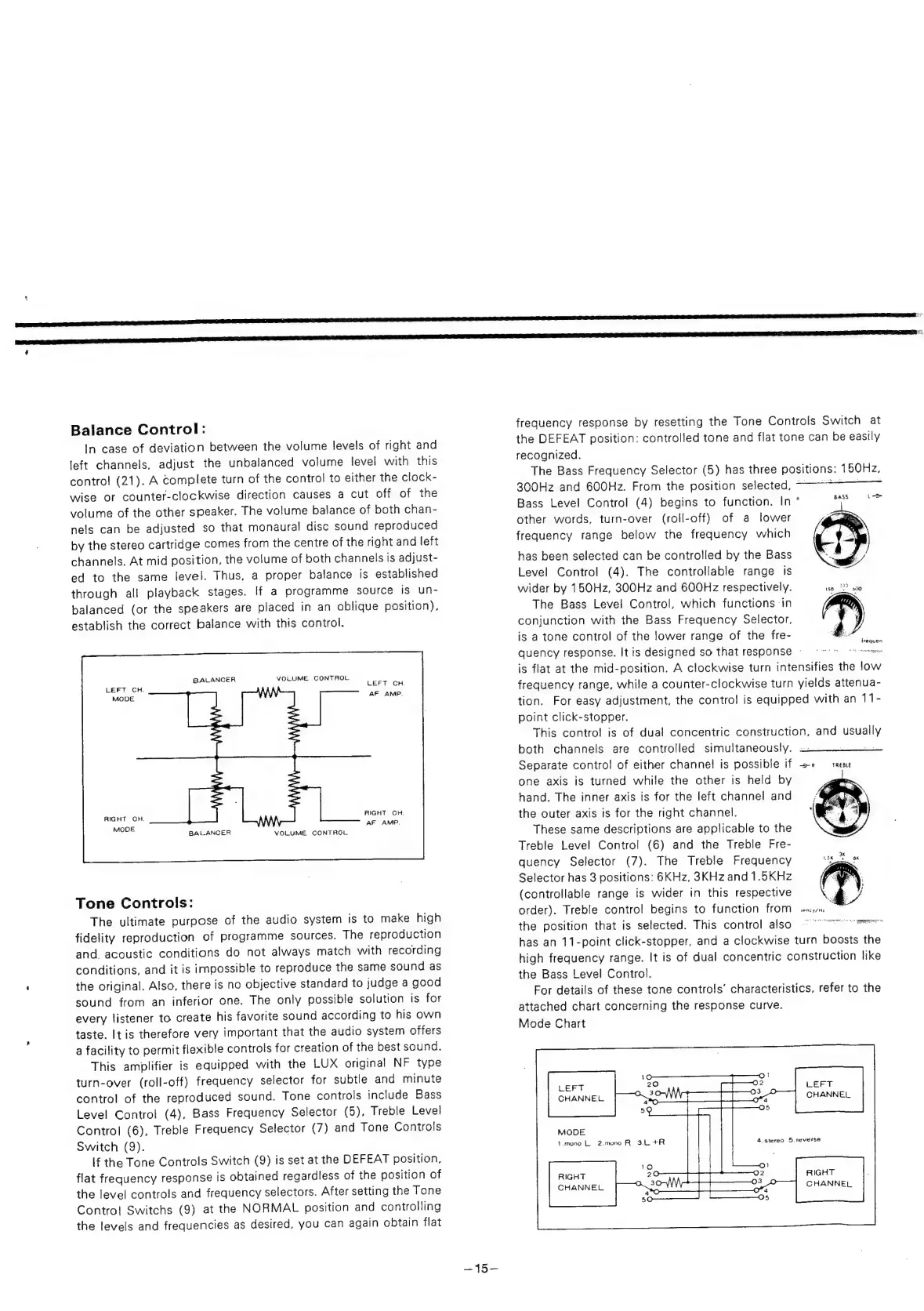
Balance
Control:
In
case
of
deviation
between
the
volume
Jevels
of
right
and
left
channels,
adjust
the
unbalanced
volume
level
with
this
contro!
(21).
A
complete
turn
of
the
control
to
either
the
clock-
wise
or
counter-clockwise
direction
causes
a
cut
off
of
the
volume
of
the
other
speaker.
The
volume
balance
of
both
chan-
nels
can
be
adjusted
so
that
monaural
disc
sound
reproduced
by
the
stereo
cartridge
comes
from
the
centre
of
the
right
and
left
channels.
At
mid
position,
the
volume
of
both
channels
is
adjust-
ed
to
the
same
level.
Thus,
a
proper
balance
is
established
through
all
playback
stages.
If
a
programme
source
is
un-
balanced
(or
the
speakers
are
placed
in
an
oblique
position),
establish
the
correct
balance
with
this
control.
BALANCER
VOLUME
CONTROL
LEFT
CH.
AF
AMP.
RIGHT
CH.
AF
AMP.
BALANCER
VOLUME
CONTROL
Tone
Controls:
The
ultimate
purpose
of
the
audio
system
is
to
make
high
fidelity
reproduction
of
programme
sources.
The
reproduction
and.
acoustic
conditions
do
not
always
match
with
recording
conditions,
and
it
is
impossible
to
reproduce
the
same
sound
as
the
original.
Also,
there
is
no
objective
standard
to
judge
a
good
sound
from
an
inferior
one.
The
only
possible
solution
is
for
every
listener
to
create
his
favorite
sound
according
to
his
own
taste.
It
is
therefore
very
important
that
the
audio
system
offers
a
facility
to
permit
flexible
controls
for
creation
of
the
best
sound.
This
amplifier
is
equipped
with
the
LUX
original
NF
type
turn-over
(roll-off)
frequency
selector
for
subtle
and
minute
control
of
the
reproduced
sound.
Tone
controls
include
Bass
Level
Control
(4),
Bass
Frequency
Selector
(5),
Treble
Level
Control
(6),
Treble
Frequency
Selector
(7)
and
Tone
Controls
Switch
(9).
lf
the
Tone
Controls
Switch
(9)
is
set
at
the
DEFEAT
position,
flat
frequency
response
Is
obtained
regardless
of
the
position
of
the
level
controls
and
frequency
selectors.
After
setting
the
Tone
Contro|
Switchs
(9)
at
the
NORMAL
position
and
controlling
the
levels
and
frequencies
as
desired,
you
can
again
obtain
flat
25s
frequency
response
by
resetting
the
Tone
Controls
Switch
at
the
DEFEAT
position:
controlled
tone
and
flat
tone
can
be
easily
recognized.
The
Bass
Frequency
Selector
(5)
has
three
positions:
150Hz,
300Hz
and
600Hz.
From
the
position
selected,
~~~"
Bass
Level
Control
(4)
begins
to
function.
In
ee
other
words,
turn-over
(roll-off)
of
a
lower
frequency
range
below
the
frequency
which
has
been
selected
can
be
controlled
by
the
Bass
Level
Control
(4).
The
controllable
range
is
wider
by
150Hz,
300Hz
and
600Hz
respectively.
The
Bass
Level
Control,
which
functions
in
conjunction
with
the
Bass
Frequency
Selector,
is
a
tone
contro!
of
the
lower
range
of
the
fre-
ae
quency
response.
It
is
designed
so
that
response
©
=
re
is
flat
at
the
mid-position.
A
clockwise
turn
intensifies
the
low
frequency
range,
while
a
counter-clockwise
turn
yields
attenua-
tion.
For
easy
adjustment,
the
control
is
equipped
with
an
11-
point
click-stopper.
This
contro!
is
of
dual
concentric
construction,
and
usually
both
channels
are
controlled
simultaneously.
Separate
contro!
of
either
channel!
is
possible
if
oe
tess
one
axis
is
turned
while
the
other
is
held
by
hand.
The
inner
axis
is
for
the
left
channel
and
the
outer
axis
is
for
the
right
channel.
These
same
descriptions
are
applicable
to
the
Treble
Level
Control
(6)
and
the
Treble
Fre-
quency
Selector
(7).
The
Treble
Frequency
Selector
has
3
positions:
6KHz,
3KHz
and
1.5KHz
(controllable
range
is
wider
in
this
respective
Gs
order).
Treble
control
begins
to
function
ffOM
sencym:
2
the
position
that
is
selected.
This
control
also
~~
™™
=m
has
an
11-point
click-stopper,
and
a
clockwise
turn
boosts
the
high
frequency
range.
It
is
of
dual
concentric
construction
like
the
Bass
Level
Control.
For
details
of
these
tone
controls’
characteristics,
refer
to
the
attached
chart
concerning
the
response
curve.
Mode
Chart
LER
T
CHANNEL
CHANNEL
MODE
l.mono
L.
2.muoeno
R
3L+R
RIGHT
CHANNEL
RIGHT
CHANNEL

Related product manuals