Need help?
Do you have a question about the Makita DS4011 and is the answer not in the manual?
Guidelines for maintaining a clean and safe work environment.
Precautions to prevent electric shock during tool use.
Measures for operator protection and injury prevention.
Advice on correct operation, cord care, and tool maintenance.
Guidance on professional servicing and using replacement parts.
Critical safety precautions specific to operating drills.
Details on the switch mechanism for controlling rotation direction.
Instructions for securely attaching the auxiliary handle.
Steps for inserting and removing drill bits using the chuck key.
Tips for effective drilling in wood and metal, and handling torque.
Procedure for checking and replacing worn carbon brushes.
List of accessories recommended for use with the tool.
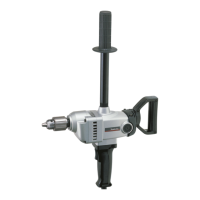
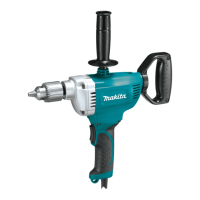
This document serves as an instruction manual for Makita Drill models DS4011 and DS5000. It provides essential safety warnings, operational guidelines, and maintenance instructions to ensure safe and effective use of the power tool.
The Makita Drill is a versatile power tool designed for drilling operations in various materials, including wood and metal. Its primary function is to create holes with precision and efficiency. The drill features a robust design, intended for hand-held operation, and is equipped with an auxiliary handle (top grip) to provide enhanced control and stability during use.
The drill is designed for ease of use, incorporating several features to optimize performance and user safety. To begin operation, the user must first ensure the drill bit is properly installed in the chuck. The chuck key is used to securely tighten the drill bit, and it is crucial to tighten all three chuck holes evenly to prevent the bit from loosening during operation. After use, the chuck key should be returned to its original position.
The drill's switch action allows for both clockwise and counterclockwise rotation, making it suitable for a variety of drilling tasks, including backing out stuck bits. To start the tool, the user pulls the lower part of the switch trigger for clockwise rotation or the upper part for counterclockwise rotation. Releasing the switch trigger stops the tool. An important safety reminder is to only change the direction of rotation when the tool has come to a complete stop, as changing it while rotating can damage the tool. Before plugging in the tool, users should always check that the switch trigger actuates properly and returns to the "OFF" position when released.
For drilling in wood, the manual recommends using wood drills equipped with a guide screw, which facilitates easier drilling by pulling the bit into the workpiece. When drilling in metal, it is advised to make an indentation with a center-punch and hammer at the desired drilling point to prevent the bit from slipping. A cutting lubricant should be used for most metals, with the exceptions of iron and brass, which can be drilled dry.
Users are cautioned against applying excessive pressure on the tool, as this will not speed up drilling but can damage the bit, decrease performance, and shorten the tool's service life. It is important to hold the tool firmly, especially during hole breakthrough, as a tremendous twisting force is exerted on the tool/bit at that moment. If a bit becomes stuck, the reversing switch can be used to back it out, but users must maintain a firm grip to prevent abrupt kickback. Small workpieces should always be secured in a vise or similar hold-down device. Users should also be careful to avoid drilling into materials that may contain hidden nails or other objects that could cause the bit to bind or break.
The auxiliary handle (top grip) is an integral part of the drill's design, providing additional leverage and control. It should be screwed onto the tool securely and used along with the switch handle to maintain a firm grip during operations.
Proper maintenance is crucial for ensuring the safety, reliability, and longevity of the Makita Drill. Users are advised to always switch off and unplug the tool before performing any inspection or maintenance tasks.
A key maintenance aspect is the regular inspection and replacement of carbon brushes. Carbon brushes should be checked regularly and replaced when they wear down to the limit mark. It is important to keep the carbon brushes clean and free to slip in their holders. Both carbon brushes should be replaced at the same time, and only identical carbon brushes should be used. To replace them, a screwdriver is used to remove the brush holder caps, after which the worn brushes can be taken out and new ones inserted, followed by securing the caps.
The manual explicitly warns against using gasoline, benzine, thinner, alcohol, or similar substances for cleaning, as these can cause discoloration, deformation, or cracks in the tool.
For any repairs, maintenance, or adjustments beyond routine user tasks, it is recommended to have the power tool serviced by a Makita Authorized or Factory Service Center. These centers use genuine Makita replacement parts to ensure the product's safety and reliability are maintained.
The manual also emphasizes general power tool safety warnings, which are critical for preventing electric shock, fire, and serious injury. These include keeping the work area clean and well-lit, avoiding explosive atmospheres, keeping children and bystanders away, and ensuring electrical safety by using appropriate plugs and extension cords. Personal safety measures like staying alert, using personal protective equipment (such as eye protection), and dressing properly are also highlighted. It is important to remove any adjusting keys or wrenches before turning the power tool on.
The document also provides guidance on proper extension cord usage, including a table for selecting the minimum gage for cords based on ampere rating and total length, to prevent loss of power and overheating.
Various accessories are recommended for use with the Makita drill, including different types of drill bits, hole saws, an angle attachment, a chuck key, Grip 36, a depth gauge assembly, and a wrench. Users are advised to consult their local Makita Service Center for assistance regarding these accessories.
 General
| Chuck type | Key |
|---|---|
| Hammer drilling | - |
| Idle speed (max) | 600 RPM |
| Drilling diameter in wood (max) | 36 mm |
| Drilling diameter in steel (max) | 13 mm |
| Output power | 750 W |
| Power source | AC |
 Weight and Dimensions
| Depth | 340 mm |
|---|---|
| Width | 83 mm |
| Height | 401 mm |
| Weight | 2800 g |

 To Next Page