DEVICE DEPENDENT COMMANDS
The
following
list describes the features of the device
dependent mnemonics for the 2040
series
signal generators together
with
simple examples of their use
within each major section
(Carrier frequency, RF
Level, etc.).
The root mnemonic is
listed first
followed
by the
lower
level mnemonics. Each group is followed by a list of requirements for
data type and suffix.
In addition to the normal listen commands the 2040 series
accept query commands
which
cause the instrument to prepare a message which will be sent to the
controller when
the
instrument is
next addressed
to talk. For each query
an example of a response is
given.
Where
responses are similar for a group of queries not all are listed. Some queries can
produce more
than one type of response
-
an example of
each is usually given.
In the list
which follows,
the
abbreviations <char>, <nrf> and <str> have the
following
meanings:
<char>
=
Character Program Data
<nrf>
=
Decimal Numeric Program Data
<str>
=
String Program Data
Where
the data
format
is Decimal
Numeric Program Data, the value may be expressed as a
signed or unsigned number in any of the following formats:
nrl: Decimal integer, e.g. 1234 or
-567
nr2:
Floating point number, e.g. 1.234 or
-56.789
nr3: Floating point
number with exponent, e.g. 1.2345E5 or -12.47E-8
DEFAULT SETTINGS
These are the settings
assigned to
instrument functions in
the following cases:
(i)
Power-up
to factory default settings.
(ii) Execution of *RST command.
(iii) Recall Full Store 50.
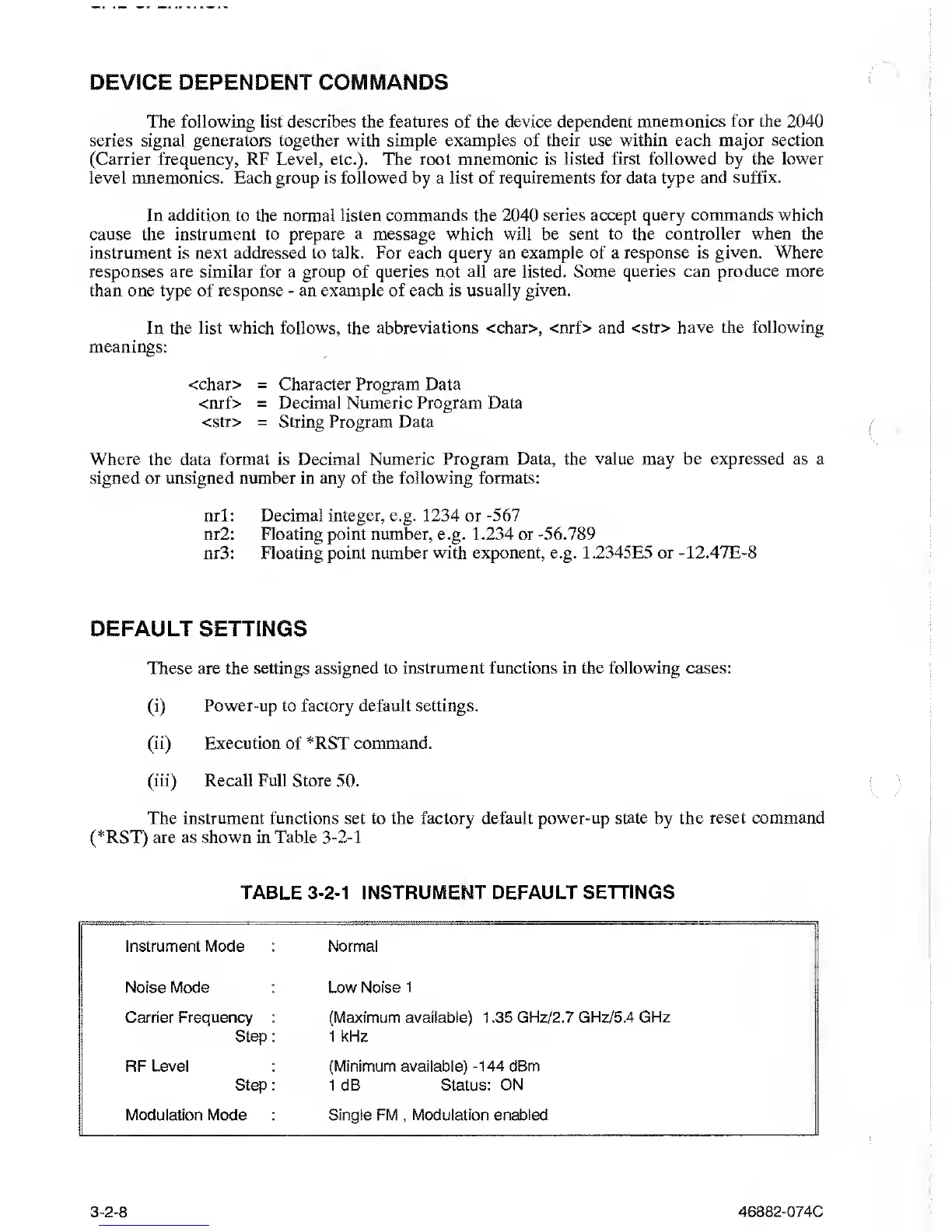
The instrument functions set to the factory default
power-up state by the reset command
(*RST) are as
shown in Table
3-2-1
TABLE
3-2-1
INSTRUMENT
DEFAULT SETTINGS
Instrument Mode : Normal
Noise Mode : Low
Noise 1
Carrier Frequency : (Maximum available) 1 .35 GHz/2.7 GHz/5.4 GHz
Step
:
1 kHz
RF Level
:
(Minimum available)
-144
dBm
Step
:
1 dB
Status: ON
Modulation Mode
:
Single FM
,
Modulation
enabled
3-2-8
46882-074C



 To Next Page