A-13
Nº502 Media Console Appendix
The lower frequencies tend to behave in predictable ways because the
wavelengths are larger than the typical objects in a room. The mid and
high frequencies generally behave differently from room to room because
the foot-by-foot and inch-by-inch details differ dramatically from room to
room. For example, no two rooms have the same placement of chairs,
tables, lampshades, bookshelves, or people.
The strength of each reflection, and the end effect of the resonance,
depends upon how the wavelength of the sound compares to the size and
shape of the reflecting object. A small wavelength will have strong
reflections from a large object, while a large wavelength will pass around a
small object with very little reflection. The surface of the reflecting object
can also have a strong effect on the reflections. For example, a smooth
surface, like a cabinet face, will reflect very differently from a sculpture
that has many different edges to scatter reflections. A good visual example
of this effect is the way light reflects from a faceted diamond, which
scatters the light from its many surfaces, versus how light reflects from a
mirror, where the light bounces back in the same path.
The strength of the sound wave reflections can also be affected by the
transmission properties of the reflector. For example, depending upon its
size and stiffness, a wall may have its own resonant frequency. This can
happen when a sound wave of sufficient amplitude hits the wall and
causes it to resonate.
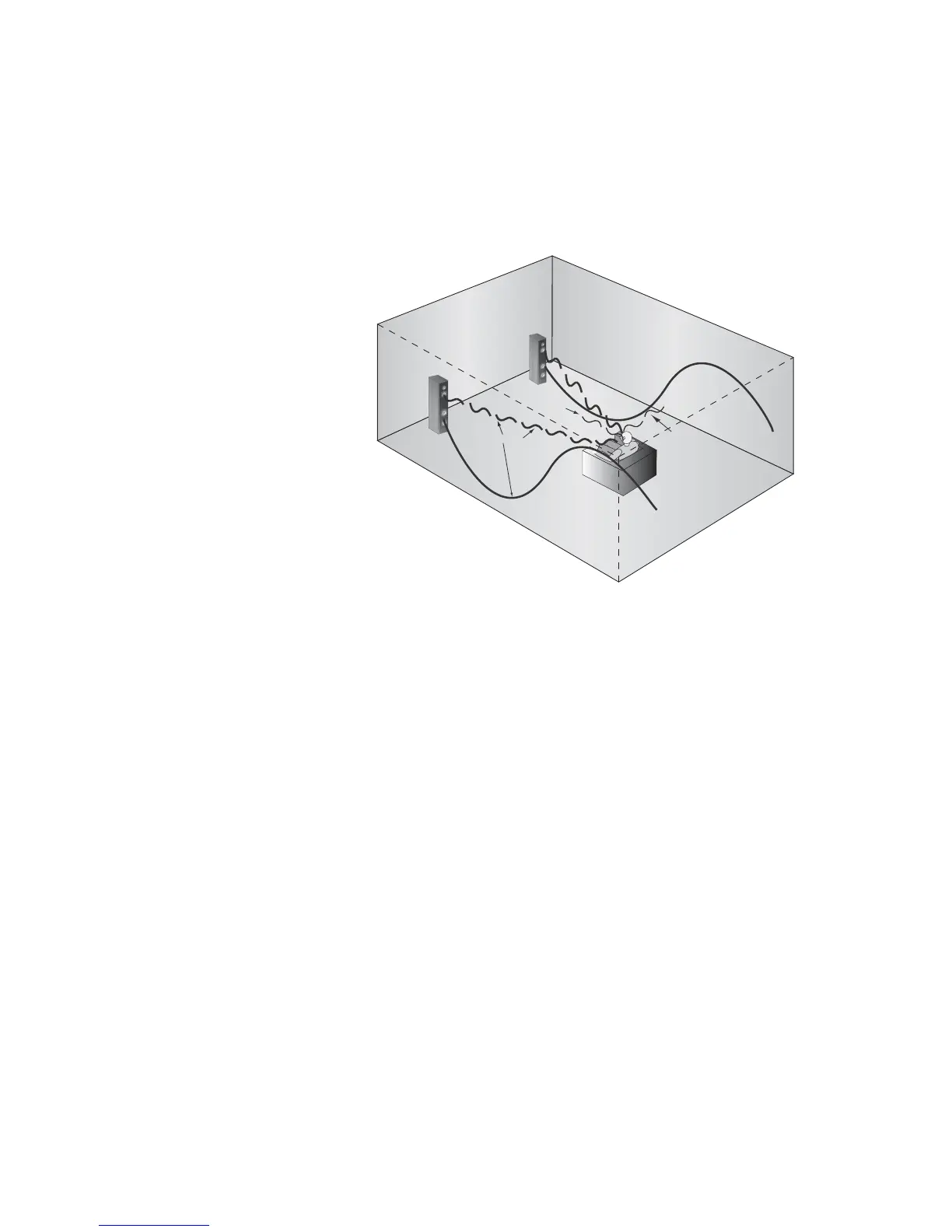
Parallel walls can create very strong reflections because the same
wavelength bounces between them multiple times. The multiple copies,
or reflections, of the same waveform are “added together” when they
reach the listener, but the phenomenom does not necessarily produce
louder sound. The relative timing between the multiple copies can
produce phase shifts, meaning that there may be delays in how long it
takes some of the reflections to reach the listener. These delays mean that
the phase of the waveform will not match exactly and hence some reflec-
tions may actually subtract instead of add to the overall sound level. The
Direct waves
Reflected waves
Reflected waves
100Hz
1K H z
DIRECTED WAVES
VERSUS
REFLECTED WAVES



 To Next Page