Page 50
INSTALLATION INSTRUCTIONS
Variable Chimney Routes
VENTING (FLUEING)
NOTE: Cold Climate Installation
When this appliance is to be installed against a non-
insulated wall or in a chase, fibreglass insulation
should be installed around the body of the fireplace.
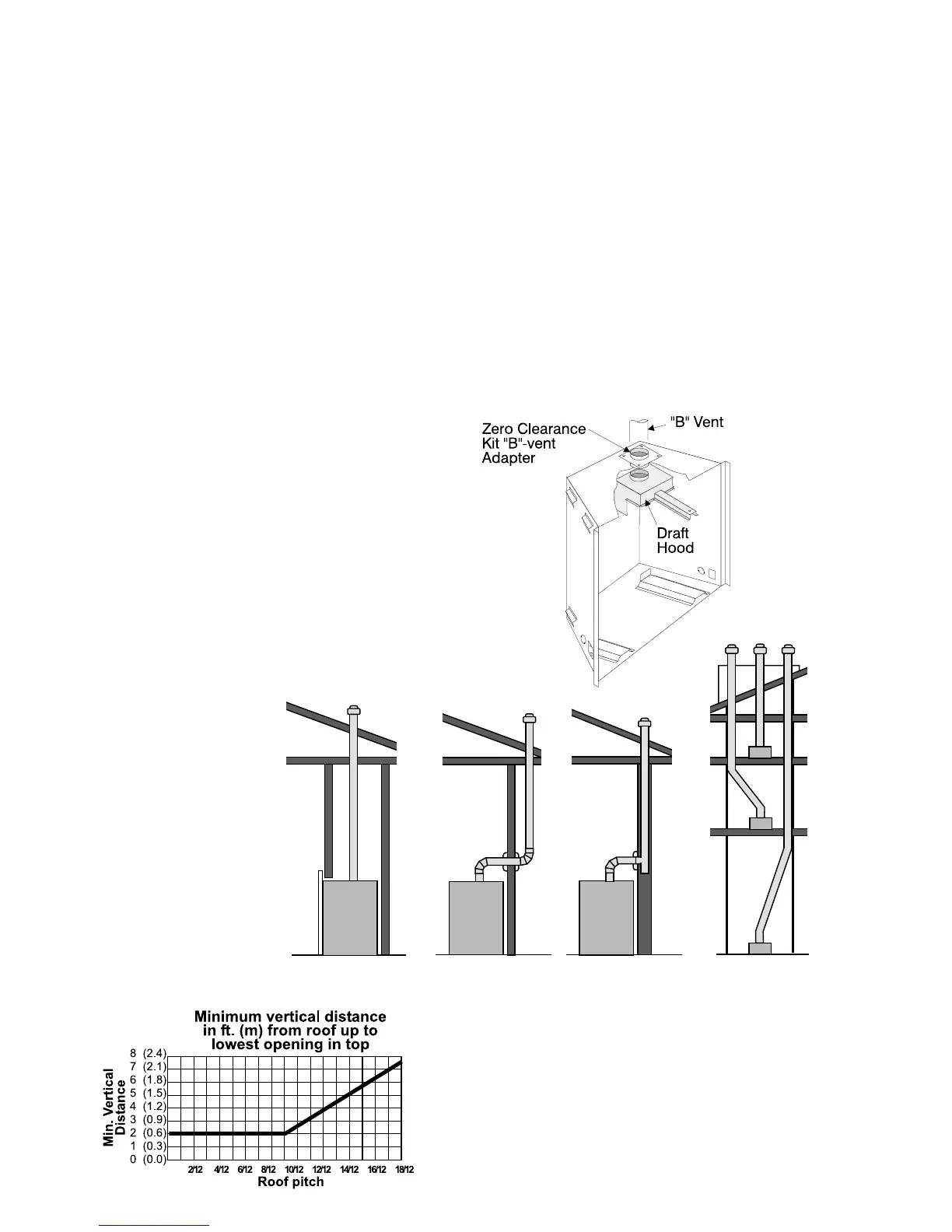
Note: The draft hood must be installed parallel to the fireplace
opening, as shown below. See Instructions in U31/I31
Installation Manual.
Install stove insert as per U31/I31 Installation Manual.
1) This fireplace must be vented (flued) with a 4"
(100mm) diameter Class “B” vent (Australia/New
Zealand: twin skin flue). The installation of the
venting (flueing) system must conform and be in
accordance with the natural gas installation code
CAN/CGA - B149 (Canada), ANSI Z223.1
(U.S.A.), AG 601 (Australia), and NZS 5261 (New
Zealand). Minimum chimney height from base of
fireplace must be at least 12 feet (3.6m).
2) Masonry Chimney Installation:
This application can be connected to a masonry
chimney flue. Make sure the masonry chimney is
clean and in good working order. When an exist-
ing masonry chimney is unlined and local experi-
ence indicates that gas condensation may be a
problem or if local codes dictate, an approved liner
should be installed. Use “B” Vent (flue) to bridge
the gap between the fireplace and the masonry
chimney. To ensure proper flue sizing and opera-
tion it is recommended that the masonry chimney
be lined with an approved aluminium chimney liner
of the same diameter as the “B” Vent (flue). Make
sure connection between “B” Vent (flue) and
masonry is completely sealed. Flue pipe exposed
to cold air should be insulated in a chase. If
condensation occurs, a trap should be installed at
the bottom of the flue.
A chimney register plate is
required above the heater
in large type registers to
assist with down drafting
and heat loss problems.
Use a maximum of two
offsets; four 45
o
elbows, or
two 90
o
elbows for exam-
ple. Slope horizontal pipe
at least 1/4" (6.4 mm) rise
per foot of run. Horizontal
runs should not exceed
the vertical rise. Keep
horizontal runs to a minimum.
See chart below.



 To Next Page