MAINTENANCE
Read all of SAFETY and this section before attempting any procedure. Pay particular attention to Notices, Cautions, Warnings and Dangers.
Connector One week
Use wrench to
check whether the
bolts and nuts are
loose
Strong connection Tighten immediately if it
gets loose.
Notice:
Removal or replacement of the battery involved in the above battery maintenance, and removal of rust on the connector or terminal
requires professional operation. Consumer operation can cause danger, please contact the supplier for maintenance.
6.3 Battery replacement and recycling
Batteries are consumables and have certain life cycle. After a period of charging and discharging cycles, the capacity will gradually
decrease, and the mileage of the electric vehicle will be shortened. However, if capacity of the battery falls below 50% of nominal
value within the warranty, the battery is deemed to have failed, please seek help from the supplier. If the capacity of the out-of-
warranty battery drops below 50%, please consider replacing it with a new battery.
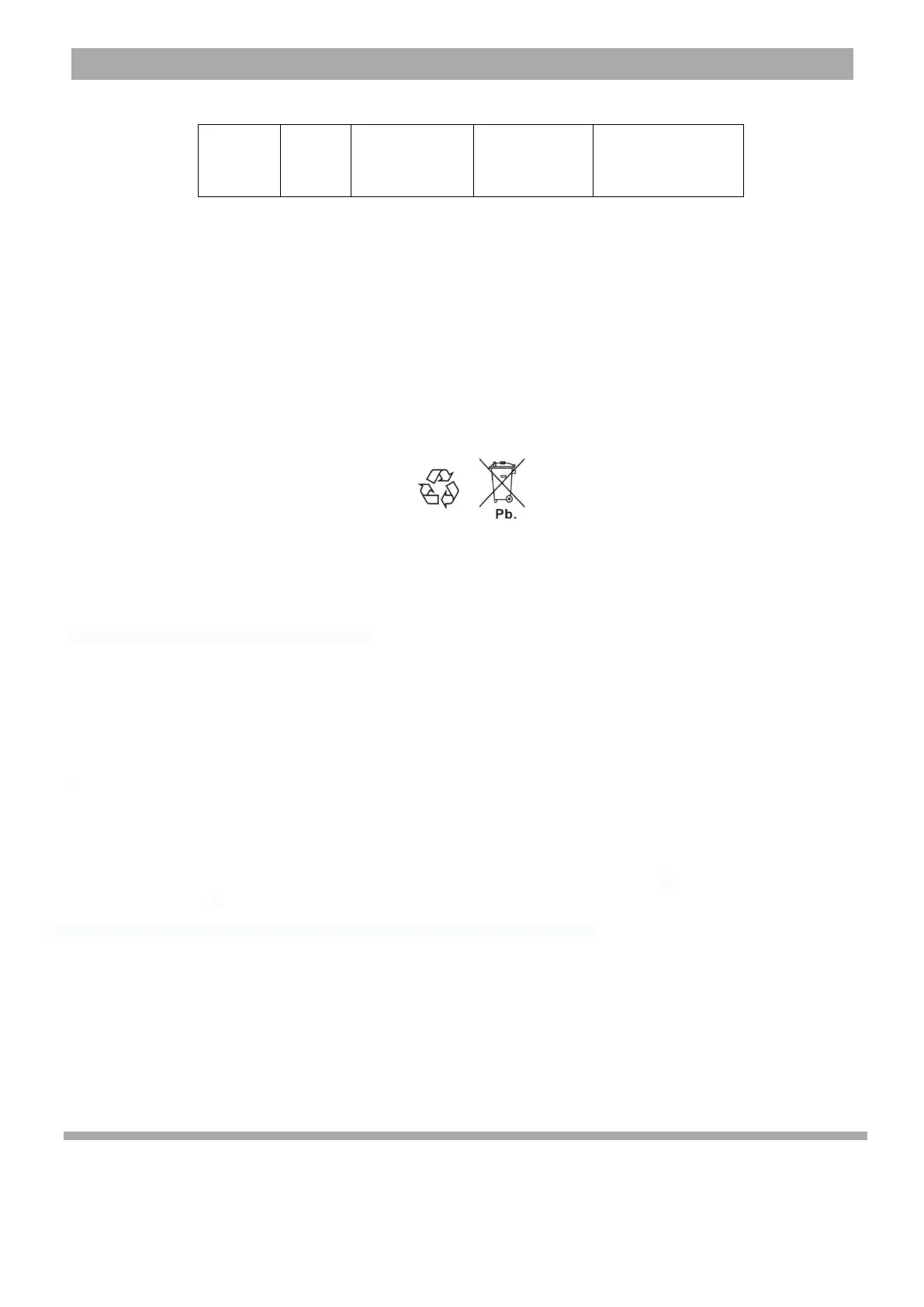
The battery is marked with recycling symbol, and the scrapped battery should be recycled by a formal recycling organization, or it
can be returned to the supplier for unified recycling. Do not throw it into the trash can or discard it at will, it will cause environmental
pollution.
7 Common Battery Failures
7.1 Battery Leakage
1)
Battery Leakage
a.
Check whether the seal between the cover and the bottom slot is cracked due to poor sealing or collision, resulting in
battery leakage.
b.
Check whether the safety valve leaks acid.
c.
Check whether there is acid leakage outside the terminal.
d.
Check whether the battery case cracked, damaged or leaked. The leaking battery can not be used and should be
replaced with a qualified battery. If you cannot determine, please seek supplier for help.
2)
Charging Heat
a.
The battery heats up during the charging process. Check the charging voltage and current of the charger. If the voltage is
too high or the current is too high, the temperature of the battery will rise during charging process, and even swollen.
b.
Check whether the battery connector is firmly connected with the terminal. Poor connection may also cause battery
heating and burn out the terminal or connector during the charging process.
If the cause of the heating is found and the temperature of the battery does not exceed 50°C, wait until the temperature of the
battery is lower than 30 °C, and there is no potential for heating problem, you can continue use the battery.
If
the
cause
of
heating
is
not
found,
seek
help
from
the
supplier.
If temperature of the battery exceeds 50°C or the battery swollen and deformed, it cannot be used anymore and should be
replaced with a qualified battery.
3)
Battery Short Circuit
If single cell short circuit appears inside the battery, the open circuit voltage is about 2V lower than normal battery. It will react
strongly to battery charging, or the heat is obvious when a single cell is charged.
If the short-circuited battery cannot be used any longer, it should be replaced by a qualified battery.
4)
Battery Open Circuit
62 Owner’s Guid
e



 To Next Page