MAINTENANCE
Read all of SAFETY and this section before attempting any procedure. Pay particular attention to Notices, Cautions, Warnings and Dangers.
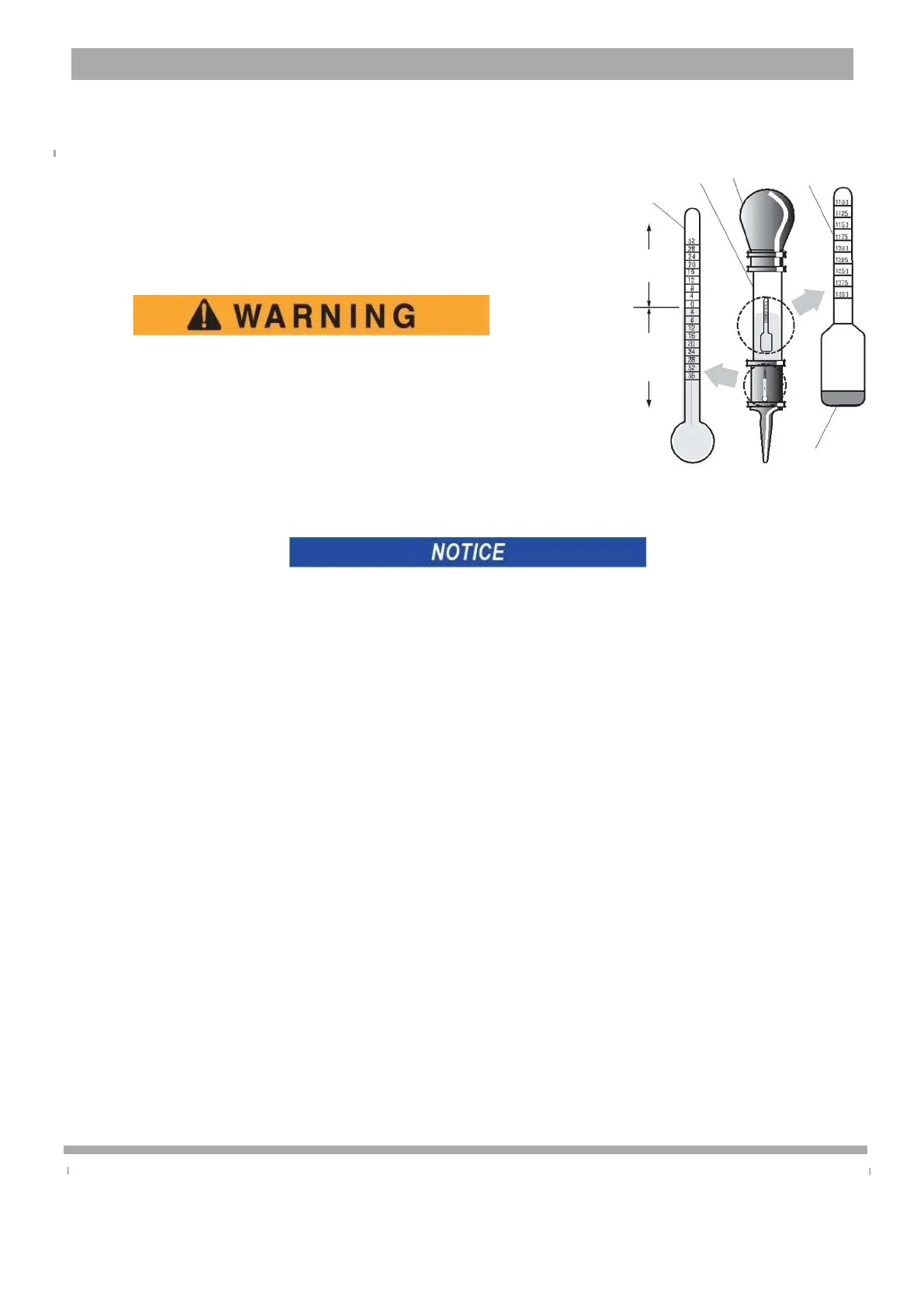
Hydrometer
A hydrometer is used to test the state of charge of a battery cell. This is
performed by measuring the density of the electrolyte, which is
accomplished by measuring the specific gravity of the electrolyte. The
greater the concentration of sulfuric acid, the denser the electrolyte
becomes.
The higher the density, the higher the state of charge.
To prevent battery explosion, never insert a metal
thermometer into a battery. Use a hydrometer with a built in
thermometer that is designed for testing batteries.
Specific gravity is the measurement of a liquid that is compared to a
baseline. The baseline is water which is assigned a base number of 1.000.
Bulb
Cylinder Float
Thermometer
Add to Float
Reading
Subtract
from Float
Reading
The concentration of sulfuric acid to water in a new golf car battery is Weight 1.280 which means that the electrolyte weighs
1.280 times the weight of
the same volume of water. A fully charged battery will test at 1.275 - 1.280 while a discharged battery will read in
the 1.140 range.
Do not perform a hydrometer test on a battery that has just been watered. The battery must go through at least one
charge and discharge cycle in order to permit the water to adequately mix with the electrolyte.
The temperature of the electrolyte is important since the hydrometer reading must be corrected to 80° F (27° C). High
quality hydrometers are equipped with an internal thermometer that will measure the temperature of the electrolyte and
will include a conversion scale to correct the float reading. It is important to recognize that the electrolyte temperature is
significantly different from the ambient temperature if the vehicle has been operated.
64 Owner’s Guid
e



 To Next Page