EasyManua.ls Logo

Maytag LAT8014 - Continuity Testing

Maytag LAT8014
184 pages
Print Icon
To Next Page IconTo Next Page
To Previous Page IconTo Previous Page
Loading...
~f
"\E
cco"
__
J-'
gg
CAUTION
----------,
Always
be
sure
the
power
has been
disconnected
before
making
resist-
ance
measurements.
Failure
to
do
so
will
result
in
damage
to
your
meter! Internal
batteries
provide
all
the
power
needed
to
make
resist-
ance
checks. They should be
checked at
least
once a
year
and
replaced
as needed.
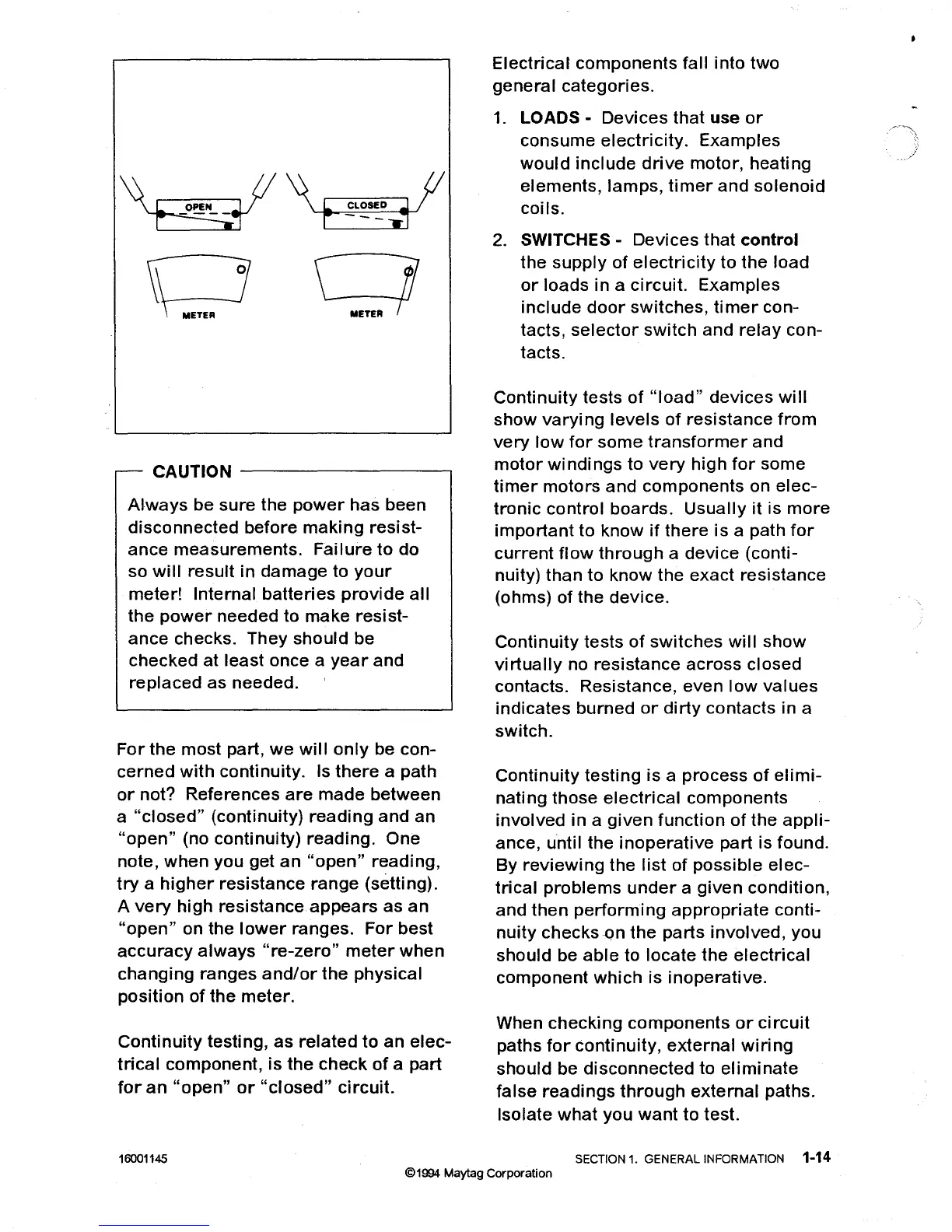
For
the
most part,
we
will
only
be con-
cerned
with
continuity. Is
there
a path
or
not? References
are
made
between
a
"closed"
(continuity)
reading
and
an
"open"
(no continuity)
reading.
One
note,
when
you get
an
"open"
reading,
try
a
higher
resistance
range
(setting).
A
very
high
resistance
appears
as
an
"open"
on
the
lower
ranges.
For
best
accuracy
always
"re-zero"
meter
when
changing
ranges
and/or
the
physical
position
of
the
meter.
Continuity
testing,
as
related
to
an
elec-
trical
component,
is
the
check
of
a part
for
an
"open"
or
"closed"
circuit.
16001145
Electrical
components
fall into
two
general
categories.
1.
LOADS -
Devices
that
use
or
consume
electricity.
Examples
would
include
drive
motor, heating
elements,
lamps,
timer
and
solenoid
coils.
2.
SWITCHES - Devices
that
control
the
supply
of
electricity
to
the
load
or
loads
in a
circuit.
Examples
include
door
switches,
timer
con-
tacts,
selector
switch
and
relay
con-
tacts.
Continuity
tests
of
"load"
devices
will
show
varying
levels
of
resistance
from
very
low
for
some
transformer
and
motor
windings
to
very
high
for
some
timer
motors
and
components
on
elec-
tronic
control
boards.
Usually
it
is
more
important
to
know
if
there
is
a path
for
current
flow
through
a
device
(conti-
nuity)
than
to
know
the
exact
resistance
(ohms) of the
device.
Continuity
tests
of
switches
will
show
virtually
no
resistance
across
closed
contacts. Resistance, even
low
values
indicates
burned
or
dirty
contacts in a
switch.
Continuity
testing
is
a
process
of
elimi-
nating
those
electrical
components
involved
in
a
given
function
of
the
appli-
ance, until the
inoperative
part is found.
By
reviewing
the
list
of
possible
elec-
trical
problems
under
a
given
condition,
and
then
performing
appropriate
conti-
nuity
checksQn
the
parts
involved,
you
should be
able
to
locate
the
electrical
component
which
is
inoperative.
When
checking
components
or
circuit
paths
for
continuity,
external
wiring
should
be
disconnected
to
eliminate
false
readings
through
external
paths.
Isolate
what
you
want
to
test.
SECTION 1. GENERAL INFORMATION 1-14
©1994 Maytag
Corporation

Table of Contents

Related product manuals