EasyManua.ls Logo

Maytag LAT8014 - No Fill Troubleshooting; Slow Fill Troubleshooting; Water Flow

Maytag LAT8014
184 pages
Print Icon
To Next Page IconTo Next Page
To Previous Page IconTo Previous Page
Loading...
should
have
a
resistance
of
between
140
and
160
ohms.
For
120
Volt
valves
500 - 900
ohms.
For
convenience,
the
analog
appliance
test
meter
scale
is
marked
open
and
closed
to
indicate
continuity
or
an
incomplete
circuit.
If
there
is
an
incomplete
circuit,
there
is a
bad
coil.
If a
coil
is bad, the
water
valve
should
be
replaced.
Note: On
microprocessor
models
the
water
valve
solenoid
coils
are
intended
for
24
volts
DC
operation.
DO
NOT
test
using
a
motor
test
cord.
Over
Fill
Put
machine
into
a
fill,
preferably
a
warm
setting.
While the
washer
is
filling,
turn
the
control
to "OFF"
or
dis-
connect
the
power
cord. If the
water
valve
does
not
stop
the
flow
of water,
the
valve
is
at
fault. If the
water
flow
of
water
stops,
the
problem
is
electrical.
Check
water
level
control,
micro-
processor
board
and
wiring.
Slow
Fill
1.
Check
screens
at
faucet
for
sediment
build-up.
2.
Check
screens
at
water
valve
for
sediment
build-up.
3.
Check
water
pressure.
The
water
pressure
should
be
between
30 p.s.i.
and
120 p.s.i. -
dynamic
(flow)
pres-
sure.
Note: If
washer
fills
(Large
setting)
in
five
minutes
or
less,
water
valve
is
operating
normally.
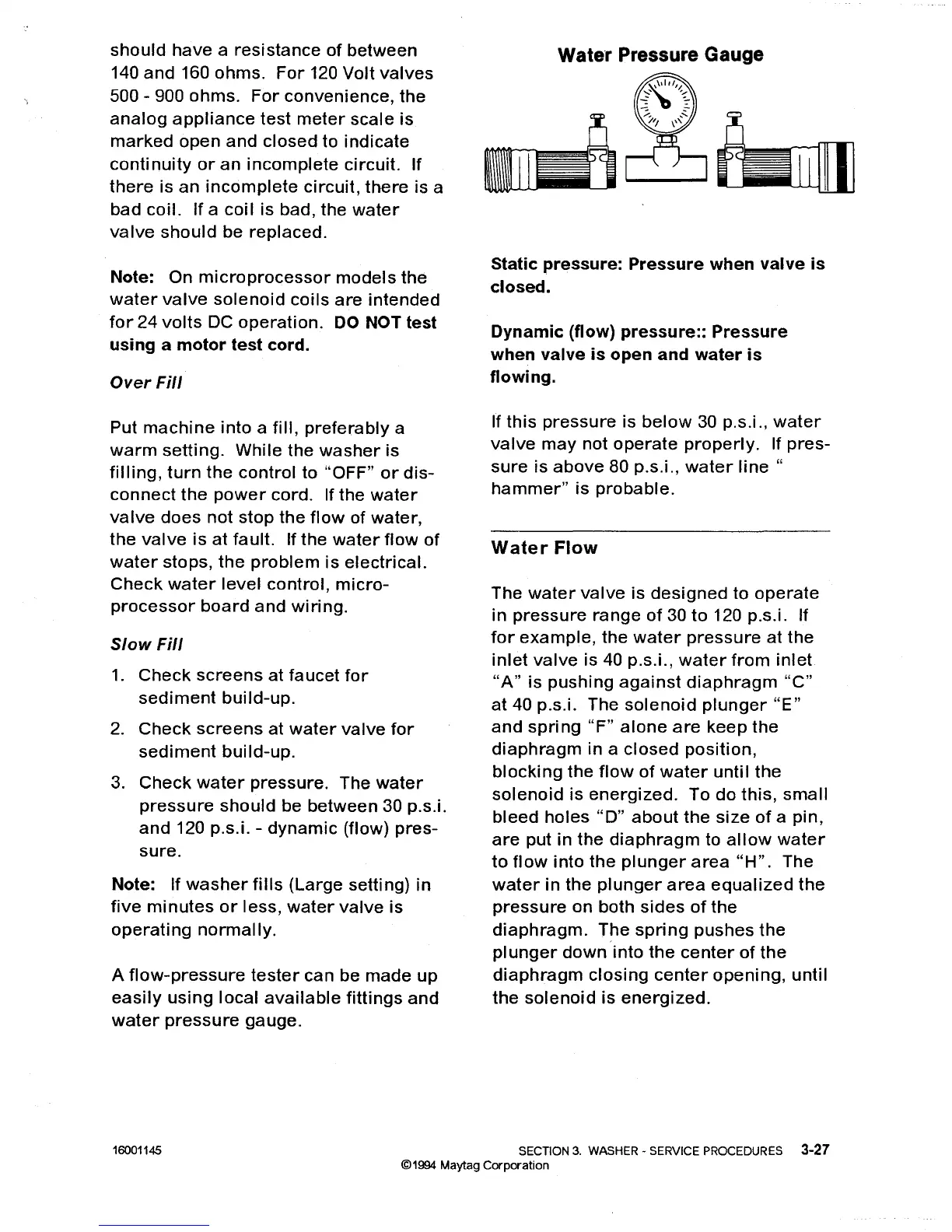
A
flow-pressure
tester
can be
made
up
easily
using
local
available
fittings
and
water
pressure
gauge.
Water Pressure Gauge
Static
pressure:
Pressure
when
valve
is
closed.
Dynamic
(flow)
pressure::
Pressure
when
valve
is
open
and
water
is
flowing.
If
this
pressure
is
below
30
p.s.i.,
water
valve
may
not
operate
properly.
If
pres-
sure
is
above
80 p.s.i.,
water
line"
hammer"
is
probable.
Water
Flow
The
water
valve
is
designed
to
operate
in
pressure
range
of
30
to
120 p.s.i. If
for
example,
the
water
pressure
at
the
inlet
valve
is 40 p.s.i.,
water
from
inlet
"A"
is
pushing
against
diaphragm
"C"
at
40 p.s.i. The
solenoid
plunger
"E"
and
spring
"F"
alone
are
keep
the
diaphragm
in a
closed
position,
blocking
the
flow
of
water
until
the
solenoid
is
energized.
To
do
this,
small
bleed
holes
"0"
about
the
size
of
a pin,
are
put
in
the
diaphragm
to
allow
water
to
flow
into
the
plunger
area
"H".
The
water
in
the
plunger
area
equalized
the
pressure
on both
sides
of
the
diaphragm.
The
spring
pushes
the
pi
unger
down
into
the
center
of
the
diaphragm
closing
center
opening,
until
the
solenoid
is
energized.
16001145
SECTION
3.
WASHER
-
SERVICE
PROCEDURES
3-27
©1994 Maytag Corporation

Table of Contents

Related product manuals