43
g
f
h
e
Synchronizing and readjusting
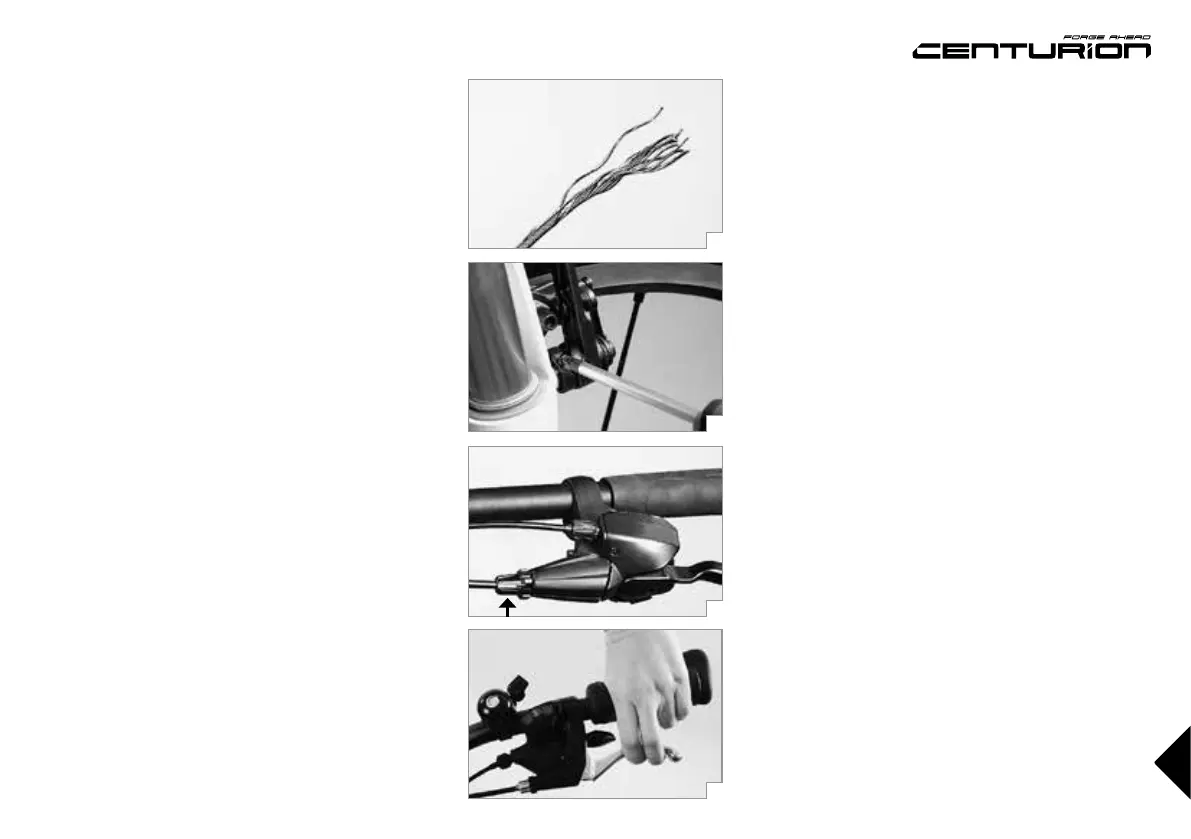
Almost all brake designs have a bolt located next to
one or both brake calipers for adjusting the spring
preload
(f)
. Turn the bolt slowly and watch how the
gap changes between brake pads and rim.
Adjust the spring in a way that with an unapplied
brake the gaps are equal on either side and the brake
pads touch the rim simultaneously during braking.
The position of the brake lever where the brake starts
to act, also referred to as the pressure point, can be
adjusted to the size of the hand as well as to indi-
vidual convenience by readjusting the brake cable.
Make absolutely sure you cannot pull the brake lever
all the way to the handlebar grip. With an unapplied
brake the brake pads should not be too close to the
rim sides, otherwise they could drag along the rim
during riding. Before doing this adjustment, observe
the notes in the chapter “Adjusting the brake lever
reach”.
To readjust the brakes, unscrew the knurled lock ring
located at the point where the brake cable enters
the brake lever on the handlebars
(g)
. Unscrew the
knurled, slotted adjusting bolt by a few turns. This
reduces the free travel of the brake lever. Keeping
the adjusting bolt firm, tighten the lock ring against
the brake lever unit. This prevents the adjusting bolt
from coming loose by itself. Ensure that the slot of the
bolt faces neither forward nor upward, as this would
permit water or dirt to enter more easily.
G
Always test the brakes’ function when
stationary
(h)
after adjusting them,
making sure the brake pads engage ful-
ly with the rim when you pull them hard.
Hydraulic rim brakes
Functioning and wear
Common hydraulic rim brakes consist of two brake
assemblies that are mounted on the left and right
side of the rim and connected by an assembly plate
and, if necessary by a brake booster. W Actuating
the brake lever compresses the hydraulic pistons
through oil pressure, pushing the brake pads against
the rims.
The friction generated by braking causes wear to the
brake pads as well as to the rims. Frequent rides in
the rain and dirt and over hilly terrain can accelerate
wear on both braking surfaces. Some rims are pro-
vided with wear indicators, e.g. grooves or circular
indentations. If the rim is worn down to the point
where the grooves or indentations are no longer
visible, it needs to be replaced.



 To Next Page