67
g
f
h
e
Suspension forks
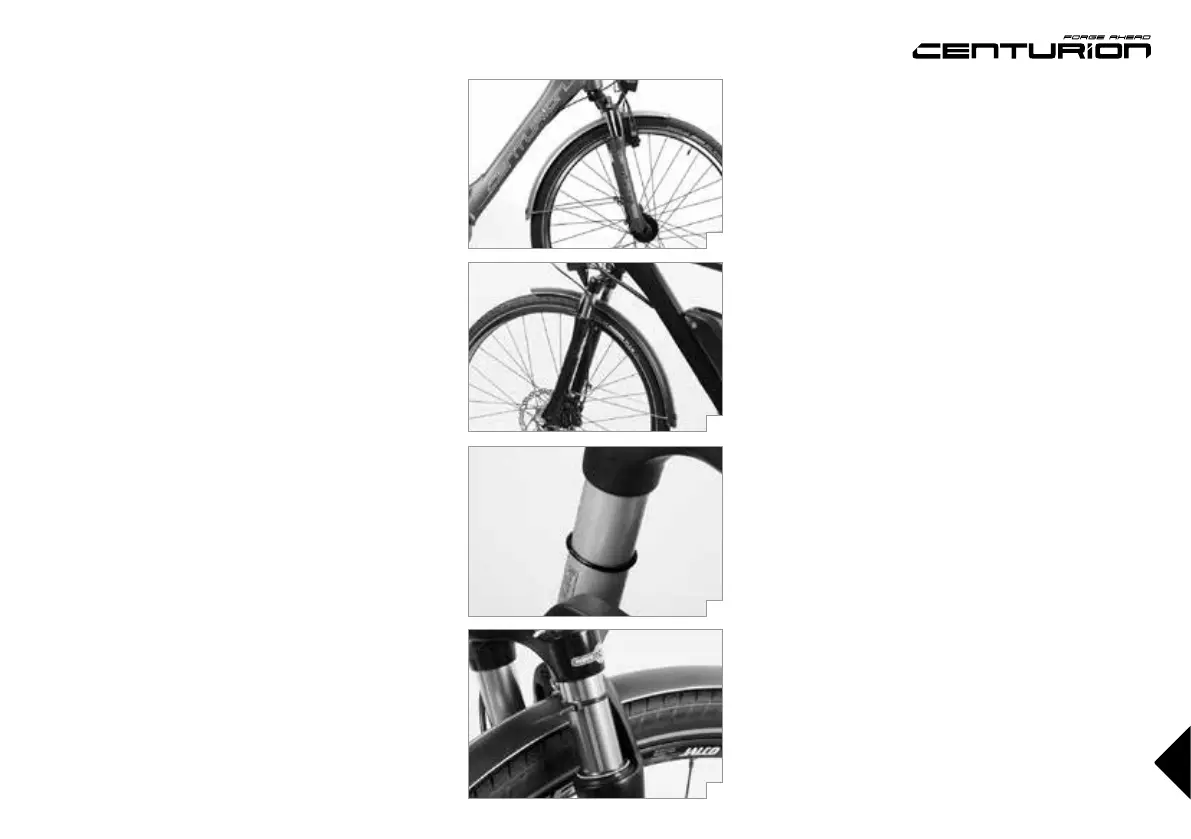
Most city/trekking bikes and pedelecs are equipped
with suspension forks
(e+f)
. This feature gives you
better control of your bike when riding cross-country
or on rough road surfaces and ensures more ground
contact for the tire. It noticeably reduces the strain on
you and your bike caused by the mechanical shocks
from the terrain.
Suspension forks differ in their types of spring ele-
ments and damping. Suspension forks normally
work with air spring elements or less often with coil
springs. Damping is usually done by oil.
i
Suspension fork manufacturers nor-
mally include instructions with their
deliveries. Read them carefully before
changing any settings or doing any maintenance
work on your suspension fork. You can find the
instruction of the suspension fork manufacturer
on this CENTURION CD-ROM.
I
Also observe the suspension glossary at
the beginning of this chapter.
Adjusting the spring rate
To work perfectly, the suspension fork has to be
adjusted to the weight of the rider, the sitting posture
and the intended use. Be sure to have this adjust-
ment carried out by your CENTURION dealer at the
time of delivery.
Note in general that the suspension fork must give in
a little even when you are just sitting on the bike – this
is the so-called negative suspension travel or sag. If
you ride over a pothole the spring is decompressed
and the suspension fork compensates for the une-
venness. If the air pressure or the spring preload is
too high, this effect is lost because the suspension
fork is already fully extended. This means that an
important comfort and safety factor is lost if the tire
briefly loses contact with the ground.
The suspension fork should yield by 10-20 % of the
maximum suspension travel.
To measure the travel you can use the rubber ring
(g)
mainly located on the thinner, plunging tube of
the suspension fork. If there is no rubber ring, tie up
a cable tie around one of the stanchion tubes
(h)
.
Make sure it is not too tight, you should still be able to
move it, it should however not slip by itself.



 To Next Page