68
a
b
c
d
Put on your usual riding clothing (including if neces-
sary a packed rucksack), sit on your bike and bring
yourself into the usual riding position. Lean against a
fixed object (railings, wall etc.) and make sure you do
not fall over. Ask a helper to move the rubber ring or
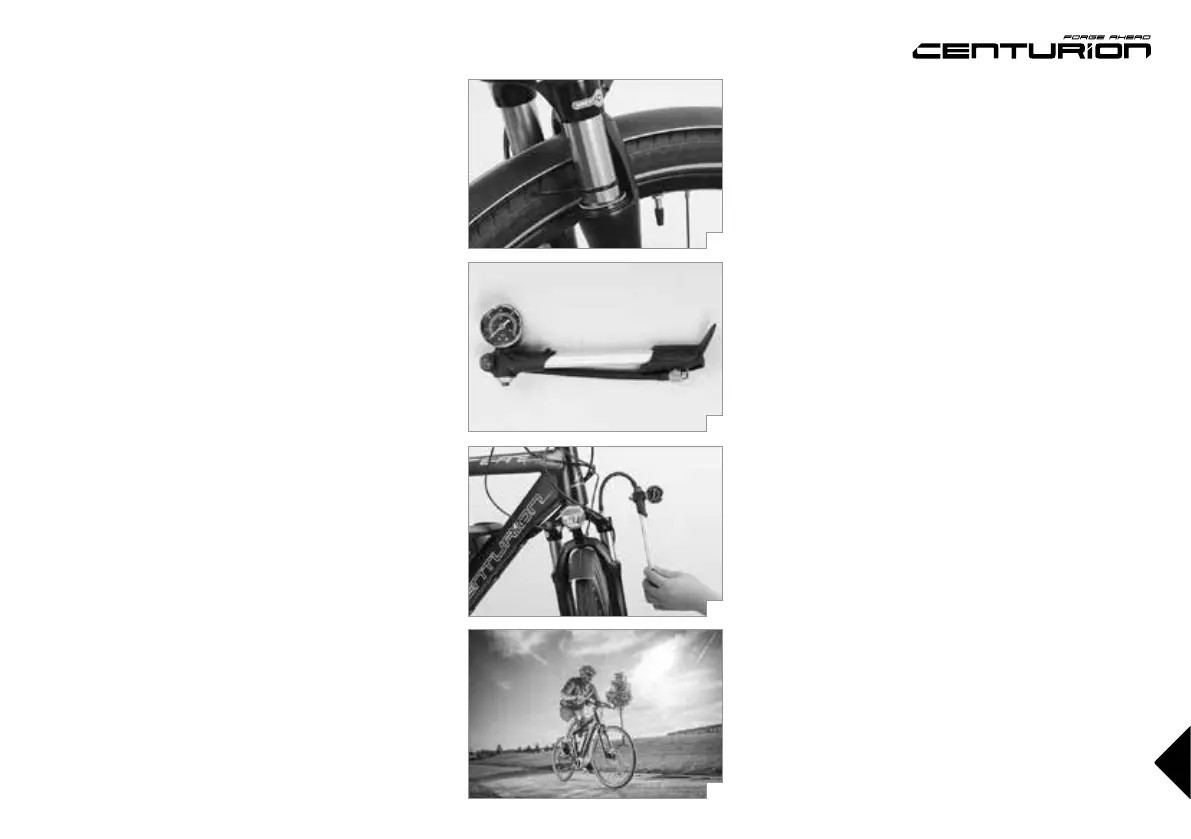
the cable tie downwards against the dust seal at the
lower leg.
Get off your bike so that the fork does not compress
any more. The distance between the rubber ring/
cable tie and the wiper is the negative suspension
travel, or sag
(a)
. Compare it against the total sus-
pension travel (as specified by the manufacturer) to
determine whether the suspension should be set to
be harder or softer.
With pneumatic suspension forks the spring rate is
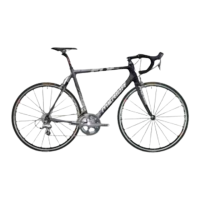
set by the air pressure in the fork. The pressure must
be set before the first ride by means of a special
high-pressure pump with pressure gauge
(b)
and
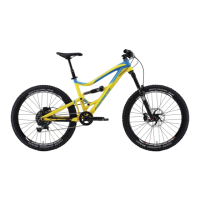
modified later as required due to changes in the
weight of the rider and/or load
(c)
.
Note the appropriate setting values and check them
subsequently at regular intervals. Always follow the
recommendations of the manufacturer and never
exceed the maximum air pressure for the suspension
fork. Always make a test ride after each change to
the settings.
In the case of most suspension forks with coil springs
a preload can be applied to the springs within tight
limits by turning a knob at the top of the fork crown.
If that is not possible and the desired negative sus-
pension travel (“sag”) cannot be set, the coil springs
must be replaced by harder or softer models. The
replacement is a job for the CENTURION dealer.
When replacing any parts, be sure to only use parts
that bear the appropriate mark and, to be on the safe
side, original spare parts. Your CENTURION dealer
will be pleased to help you.
Always make a test ride over terrain with various sur-
faces
(d)
after each change to the settings.
Check afterwards the position of the rubber ring/
cable tie. Its distance from the wiper is the maximum
suspension travel that you have used. If the rubber
ring/cable tie has moved by even a few millimeters,
the setting of the forks is too hard. Reduce the
pressure, or, in the case of coil springs, the spring
preload. If that brings no improvement, have the
springs replaced.
If the rubber ring/cable tie has shifted over the entire
length of the tube or if the fork audibly bottoms out
and hits the top repeatedly when riding off-road or
on bad roads, the setting of the springs is too soft.
In the case of air-suspension forks the pressure must
be increased. In the case of steel coils, have them
replaced by your CENTURION dealer.



 To Next Page