66
a
b
c
d
Suspension
Glossary
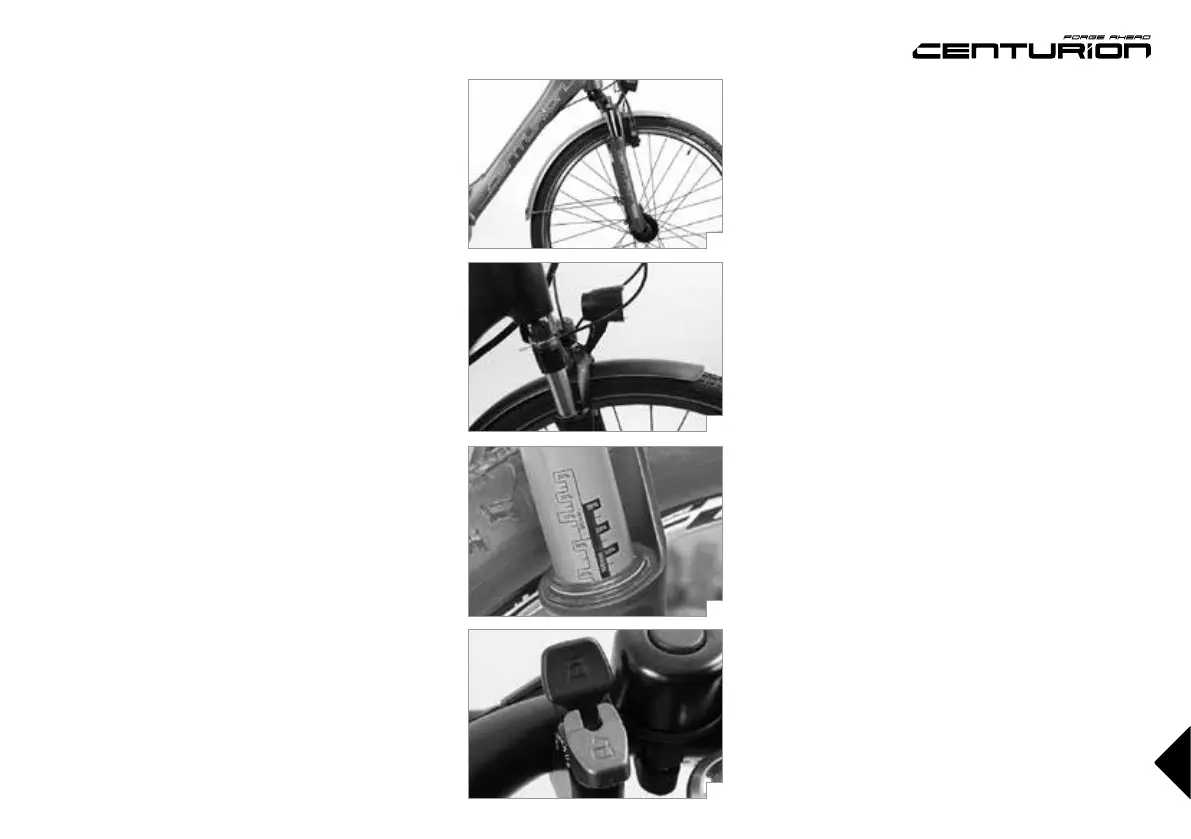
Suspension fork
(a+b)
Bicycle fork absorbing and damping shocks through
moving components. The most common among
these forks are the telescopic suspension forks.
What is designated as stanchion tubes are the thin-
ner tubes press fitted or screwed to the fork crown of
a telescopic fork. What is designated as lower leg are
the lower tubes in which the stanchion tubes slide in.
Rear shock
The rear shock is the element combining the spring
as well as the damping in the rear frame of a full sus-
pension bike. Often the rear shock is also designated
as shock absorber.
Spring rate or hardness
The force that is required to compress the spring by
a certain suspension travel – measured in Newton
per millimeter (N/mm) or pound per inch (lbs/in). A
higher spring rate requires more force for the travel.
In pneumatic spring elements this corresponds to a
higher pressure.
Spring preload
In the case of the widespread air suspension sys-
tems, the air pressure in the fork is crucial for the
spring rate and the spring preload. Observe the rec-
ommendations of the manufacturers. Within a certain
range a preload can be applied to the coil springs.
Then the suspension only reacts when a greater load
is applied. However, the spring rates are not changed
as a result. Heavy riders cannot compensate a too
low spring rate with a higher preload.
Negative suspension travel (“sag”)
(c)
The suspension travel that is taken up by the rear
structure or the fork when the rider takes up his or
her usual riding position at a standstill. This is usually
specified as a percentage of the overall suspension
travel.
Rebound damping
In most cases a red adjusting knob.
Delays or brakes the rebound. Prevents bike bob-
bing.
Lockout
(d)
In most cases a lever on the suspension element or
the handlebars.
A device to block the fork or the rear shock so that
the suspension element does not cause bob when
riding on tarred roads or smooth surfaces. Not to be
used off road.
Platform damping
Increases the (low speed) compression damping rate
and suppresses bobbing. As opposed to the lockout
function, the suspension is not blocked completely.



 To Next Page