58
a
b
c
d
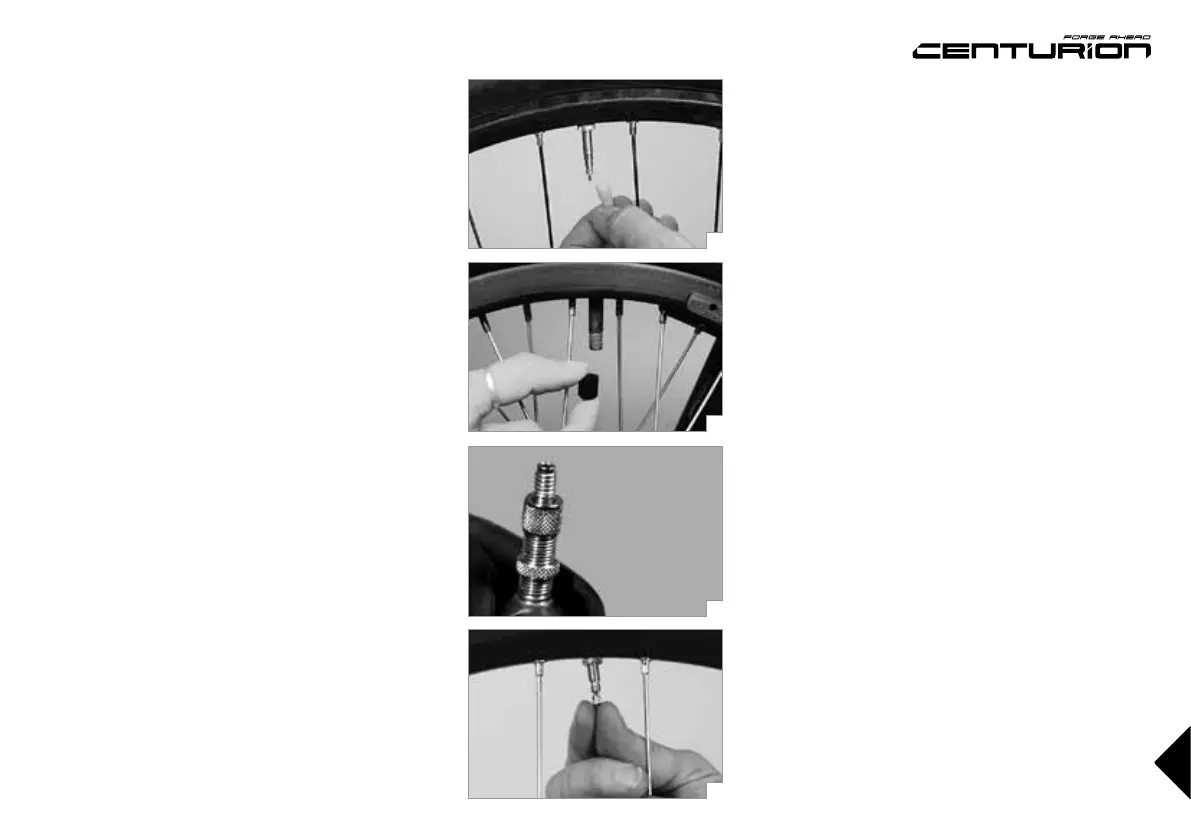
Valves
There are three valve types in general use on city and
trekking bikes:
1. Sclaverand or Presta valve
(a)
: This valve is
nowadays used on almost all types of bikes. It is
designed to withstand extremely high pressures.
2. Schrader or American valve
(b)
: This is an
adapted car tire valve.
3. Dunlop or Woods valve
(c)
: the usual valve.
All valve types come with a plastic cap to protect
them from dirt.
The Schrader and Dunlop valves can be inflated
with a suitable pump directly after removing the pro-
tective cap.
With Presta valves you first have to undo the small
knurled nut a little and depress it carefully until air
starts to escape. Check the valve core is tightened
and seated in its stem, otherwise air may slowly leak
out. Do not forget to tighten by hand the valve nut
after inflating.
Tires with Schrader valves can conveniently be
inflated at car filling stations with a compressed air
dispenser. The same applies to Dunlop and Presta
valves fitted with a special adapter. A compressed air
dispenser must be used very carefully in short bursts
as you may otherwise overinflate the tire and make
it burst.
To let out air, press the needle in the center of the
Schrader valve or the knurled nut of the Presta valve
(d)
.
In the case of the Dunlop valve unscrew the
knurled nut until air comes out of the valve. Retighten
the knurled nut subsequently. Normally, you have to
inflate the tire completely.
It can be hard to inflate tires to the necessary pres-
sure by using hand pumps. It is much easier with a
track pump equipped with a pressure gauge.
Rim trueness and spoke tension
For the true running of the wheel it is imperative
that the tension exerted by the spokes is distributed
evenly around the rim. If the tension of a single spoke
changes, e.g. as a result of riding fast over a curb or
of a loose nipple, the tensile forces acting on the rim
become unbalanced and the wheel will no longer run
true. The functioning of your CENTURION bike may
even be impaired before you notice the wobbling
appearance of a wheel that has gone out of true.



 To Next Page