40
a
b
c
d
G
Note that the bolted connections of
stem, handlebars, bar ends and brakes
have to be tightened to their specified
torques. Use a torque wrench and never exceed
the maximum torque values! You will find the
prescribed values in the chapter “Recommend-
ed torque settings”, directly on the components
and/or in the operating instructions of the com-
ponent manufacturers on this CENTURION CD-
ROM.
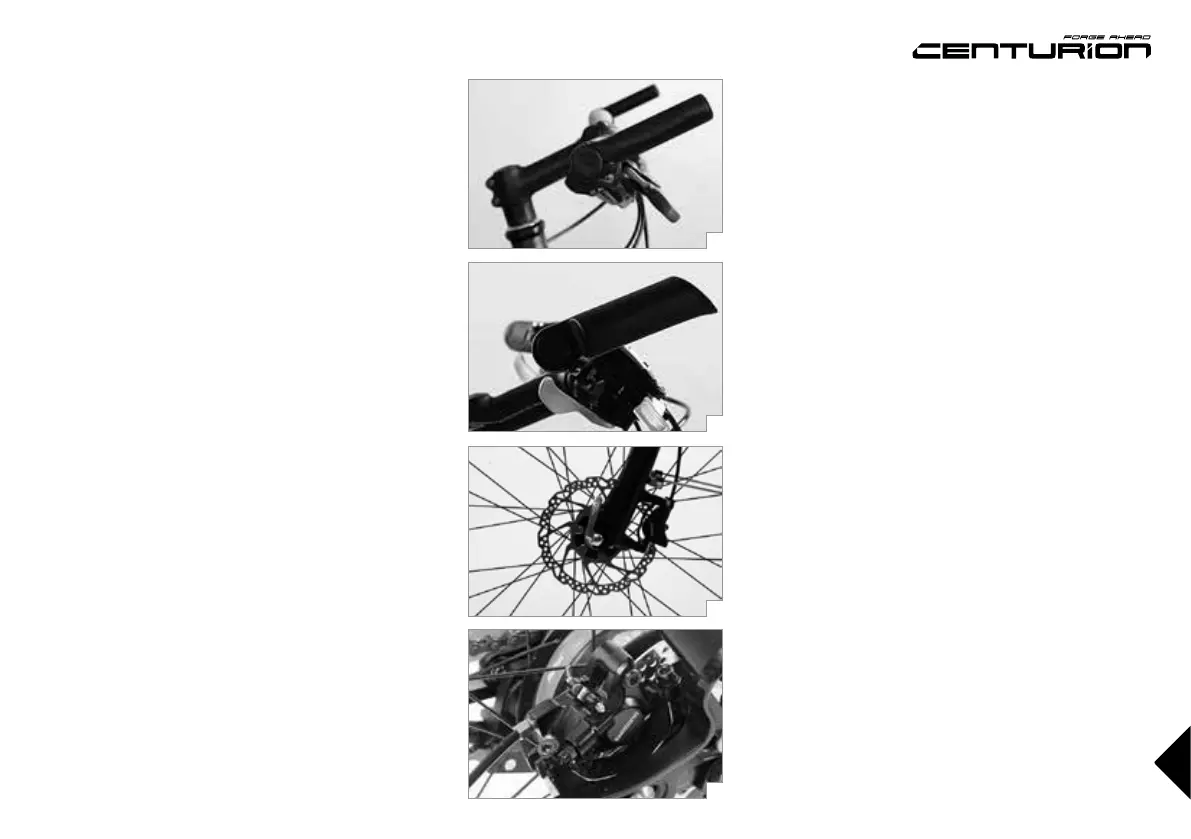
Bar ends and multi-position handlebars give you
additional ways of gripping the handlebars.
G
Be aware that the distance you need to
stop your pedelec increases, when you
are riding with your hands on bar ends
(a+b)
or on multi-position handlebars. The brake
levers are not always within easy reach.
G
Never fix bar ends in vertical position or
with their ends pointing rearwards as
this would increase the risk of injury in
the event of an accident.
A
If you want to mount multi-position han-
dlebars or bar ends to the aluminum
handlebars of your CENTURION bike,
inform yourself in advance whether these com-
ponents are permitted on your CENTURION bike.
Contact your CENTURION dealer, if necessary,
before mounting.
The brake system
Brakes
(c+d)
are used to adjust your speed to the
surrounding terrain and traffic. In an emergency situ-
ation, the brakes must bring your CENTURION bike
to a halt as quickly as possible.
In the event of such emergency brakings, the rider’s
weight shifts forward abruptly, thus reducing the load
on the rear wheel. The rate of deceleration is primarily
limited by the danger of the rear wheel losing contact
with the ground, resulting in an overturning of the
CENTURION bike and, secondly, by the grip of the
tires on the road. This problem becomes particularly
acute when riding downhill. Therefore, in case of an
emergency braking you should try to shift your weight
towards the rear and the ground as far as possible.
Actuate both brakes simultaneously and bear in mind
that, due to the weight transfer, the front brakes can
generate a far better braking effect on a surface with
good grip.
The braking conditions on unpaved surfaces differ,
i.e. overbraking the front wheel can make the wheel
slip away. Make yourself familiar with the operation
before you set off for the first time. Practice braking
on different kinds of surface in an area free of traffic.



 To Next Page