60
a
b
c
d
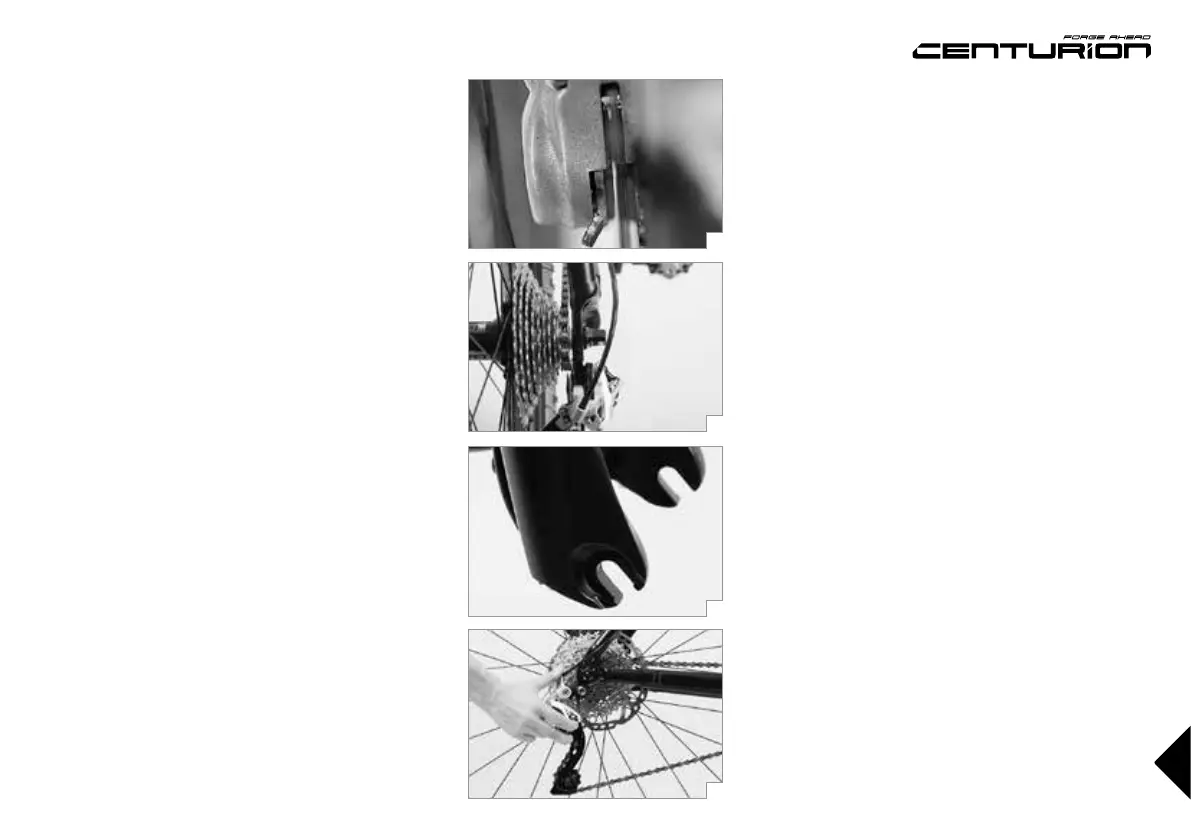
If you have disc brakes (hydraulic or mechanic),
check the position of the brake pads through the
inspection window
(a)
. In this way you will be able
to tell later whether the brake pad is still in its proper
position. Read the operating instructions of the brake
manufacturer on this CENTURION CD-ROM.
If you have derailleur gears, you should shift the chain
to the smallest sprocket before removing the rear
wheel
(b)
. This shifts the rear derailleur right to the
outside where it doesn’t interfere with the removal of
the wheel. Open the quick-release of the wheel, as
described in the chapter “How to use quick-releases
and thru axles”.
If you cannot remove the front wheel after releasing
the lever, this is due to the drop-out safety tabs
(c)
.
They come as metal catches which engage with
recesses in the drop-outs. Just release the quick-re-
lease adjusting nut a little and slip the wheel past the
tabs.
You will find it easier to remove the rear wheel, when
you pull the rear derailleur slightly backwards
(d)
. Lift
your CENTURION bike a little off the ground and give
the wheel a light blow with your hand so that it drops
out.
G
Rotors can become hot, so let them cool
down before removing a wheel.
G
If you purchased a CENTURION bike
with hydraulic disc brakes, never turn
your CENTURION bike upside down for
repair work, i.e. with the handlebars and saddle
underneath as the brakes will fail otherwise.
A
Never pull the (disc) brake lever while a
wheel is removed and always make sure
that you fit the safety locks before re-
moving the wheel.
A
In the case of drum and roller brakes as
well as of internal gear hubs you must
release the torque arm that takes up the
drive and brake forces to the frame. The Bowden
cables and the click box must also be dismount-
ed before wheel removal.
I
Observe the instructions of the brake
and gear manufacturers on this
CENTURION CD-ROM.



 To Next Page