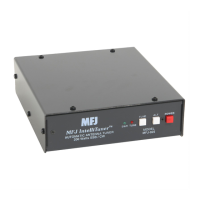
MFJ-993 IntelliTuner Automatic Antenna Tuner Instruction Manual
© 2003-2004 MFJ Enterprises, Inc.
18
Meter Needle Bounce Codes
(Meter needles bounce to the indicated mark until buttons are released.)
Forward 30 Watts Mark 100 Watts Mark 300 Watts Mark
Capacitor
Switches To
Transmitter Side
[2 beeps]
Insufficient Power to
Tune
(Forward < 5 Watts)
INCREASE POWER
[QRO]
Power Too High to Tune
(Forward > 125 Watts, or
Forward > 75 Watts and SWR > 3)
DECREASE POWER
[QRP]
Reflected 5 Watts Mark 20 Watts Mark 60 Watts Mark
Capacitor
Switches To
Antenna Side
[1 beep]
Bypass Mode
(L = 0 and C = 0)
[1 beep]
L or C at Its Limit During
Manual Adjustment
[1 beep at lower limit]
[2 beeps at upper limit]
Both Needles 30/5 Marks 100/20 Marks 300/60 Marks
Not Used Not Used Power Overload
(Forward > 300 Watts)
OVERLOAD
[QRT]
Table 3. Meter Needle Bounce Codes.
Grounding Hints
To minimize RFI, single wire feedlines (such as used with Windom or longwire antennas) should be kept
away from other wiring. Radiation will be minimized if the single wire feeder runs parallel and
reasonably close to the wire that connects the tuner to the outdoor ground. The antenna feed wire should
be adequately insulated to prevent arcing or accidental contact.
CAUTION
For operator safety, a good outside earth ground or water pipe ground should always be
installed and connected to the case of the MFJ-993. Make certain the safety ground also
connects to the transmitter and other station accessories. A wing-nut post marked GROUND is
provided for ground connections.
For safety, please use good DC and RF grounds. It is particularly important to have a good RF ground
when using a single wire feeder. When using a single wire feeder, the tuner needs something to "push"
against in order to force current into the single wire feedline. If a good RF ground is not available, RF
will usually find its way back into the power line (RFI), transmitter audio circuits (RF feedback), or the
operator (RF burns).
Metal water pipes and ground rods provide good DC and AC safety grounds, but they are often
inadequate for RF grounding because they are single conductors. Ground rods by themselves are almost
useless for dependable RF grounding.
RF grounds work much better when "spread out" over a large area, especially when they employ multiple
connections directly to the equipment ground point. Metal water pipes, heating ducts, and fences may


 To Next Page