
 Need help?
Do you have a question about the Millipore Millicell ERS-2 and is the answer not in the manual?
Explains TEER measurement using the Millicell ERS-2 system for cell health and confluence.
Details the benefits of using AC power for membrane resistance measurements over DC.
Lists the meter, STX01 electrode, STX04 electrode, and battery charger.
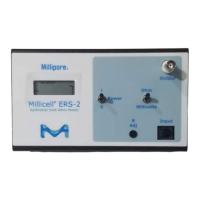
Describes the physical dimensions, battery, and output port of the Millicell ERS-2 meter.
Describes the electrode connection via a telephone-type plug to the meter's input port.
Explains symbols used throughout the user guide for safety and product information.
Instructions for unpacking, installing power, and charging the system battery overnight.
Describes periodic testing for proper operation and checks to be performed before each use.
Steps to check meter functionality by connecting the STX04 electrode and setting it to 1000 Ω.
Explains the need for STX01 electrode equilibration for accurate voltage measurements.
Steps to check electrode functionality for voltage measurements using the Millivolts mode.
Procedures for sterilizing or sanitizing/disinfecting the electrode before use.
Instructions to measure resistance across a blank cup (insert without cells).
Explains tissue resistance, unit area resistance, and provides a table of membrane areas.
An example application demonstrating measuring cell resistance in a 24-well plate.
Guidelines for maintaining and storing the meter and system.
Detailed instructions on how to replace the rechargeable battery pack.
Instructions for short-term and long-term storage of the electrode.
Steps for cleaning the electrode to maintain performance, including Tergazyme use.
Instructions on lightly sanding voltage electrodes to improve readings.
Lists common symptoms, causes, and corrective actions for system problems.
Information on product conformity with European directives and safety standards.
Lists other Millicell products, specifically single-well standing inserts.
Details of 24-well cell culture plate assemblies and their components.
Details of 96-well cell culture plate assemblies and their components.
Lists available accessories for the Millicell system.
Provides information and advice disclaimers, and subject to change notices.
The Millicell® ERS-2 Electrical Resistance System is a sophisticated device designed for accurately measuring Trans Epithelial Electrical Resistance (TEER) in cultured epithelial cells. This system comprises a meter and an electrode, working in conjunction to provide reliable indications of cell monolayer health and confluence. An increase in TEER, as detected by the electronic circuit of the Millicell® ERS-2 meter and its electrode, signifies a healthy and confluent cell monolayer. The device is intended for research use only.
A key feature of the Millicell® ERS-2 system is its use of an alternating current (AC) power source for membrane resistance measurements, offering several advantages over traditional direct current (DC) sources. These benefits include the elimination of membrane voltage and voltage electrode offset effects on resistance measurements, ensuring greater accuracy. Furthermore, the zero net charge on the cells prevents the adverse effects of DC current on the cell membrane, preserving cell integrity. The AC source also prevents electrochemical deposition of electrode metals and ensures that membrane capacitance does not affect resistance readings. Once standardized, the Millicell® ERS-2 system can be used for quantitative measurements of cell confluence.
The system's electrodes feature a silver/silver chloride (Ag/AgCl) pellet on each tip, which is responsible for measuring voltage. The compact size of the electrode is particularly advantageous, allowing users to easily measure transepithelial voltage and the resistance of cells grown on microporous membranes.
The Millicell® ERS-2 system includes a meter, an STX01 electrode, an STX04 1,000 Ω test electrode, and a battery charger. The meter itself is a portable unit, measuring 18.4 cm x 10.8 cm x 5.8 cm. It is equipped with an internal rechargeable 6 V NiMH 2,700 mAh battery pack, which can be charged via an external 12 V DC battery charger with an AC power cord. An analog output port is integrated into the meter, enabling the output of analog data to a recording device for further analysis.
The electrode connects to the meter via a wire with a telephone-type plug, which inserts into the Input port on the front of the meter during operation.
Before initial use, the system requires an overnight battery charge (at least 24 hours). It is crucial not to operate the system while the battery is charging, as this can lead to unstable readings and shorten battery life. The meter is designed to run on battery power only and should be disconnected from the AC wall charger during use. A full charge typically provides 8-10 hours of operation.
Periodic testing of the Millicell® ERS-2 meter and electrode is recommended to ensure proper operation. This includes testing upon receipt, at the beginning of a series of measurements, and as needed to confirm stability. Prior to each use, a meter functionality check for resistance and voltage measurements, and an electrode functionality check for voltage measurements only, should be performed.
For resistance measurements, the STX04 test electrode is connected to the meter, and the MODE switch is set to Ohms (Ω). The meter should display 1000 Ω, which can be adjusted using the R Adj screw if necessary.
When using the system for resistance measurements only, the electrode can be used directly from dry storage without equilibration, as the unit's design compensates for measurement asymmetry. However, for voltage measurements, the STX01 electrode requires equilibration to eliminate any offset. This involves immersing the electrode in an electrolyte solution similar to the one used for measurements (e.g., PBS, 0.15 M NaCl, or 0.1 M KCl) for a specified duration, typically 24 hours for new or dry-stored electrodes, or 2 hours for electrodes stored in solution. During equilibration, the electrode is connected to the meter with the power off and the MODE switch in the Ohms position, which internally shorts the voltage electrode pairs, allowing them to equilibrate.
To measure cell resistance, cells should be allowed to reach room temperature. The electrode is immersed with the shorter tip in the Millicell® culture plate insert and the longer tip in the outer well, ensuring neither tip contacts the cells or the bottom of the outer well. The electrode should be held steady at a 90° angle to the plate insert for stable and reproducible results. If rinsing is needed between measurements to prevent sample carryover, culture media should be used instead of distilled water.
To determine true tissue resistance, the blank resistance (measured across a cell culture insert without cells) is subtracted from the resistance measured across the tissue (cell culture insert with cells). For unit area resistance, the meter reading is multiplied by the effective surface area of the filter membrane.
For voltage measurements, after equilibration and testing, the electrode is immersed in the same manner as for resistance measurements. The voltage reading is recorded, and the voltage of the culture media alone is subtracted to obtain the true voltage value of the cultured cell monolayer. A positive reading indicates the basal side of the cellular tissue is positive relative to the apical side, while a negative reading indicates the basal side is negative relative to the apical side.
The Millicell® ERS-2 meter requires regular battery charging, ideally monthly or when the "BATT" indicator appears on the digital display. To prevent damage, the meter automatically shuts off when the battery runs low. It is important to power off the meter when charging the battery.
To prevent corrosion, users should avoid splashing or spilling saline solution or culture media on the meter. To prevent the digital LCD display from darkening, the meter should not be left in direct sunlight for extended periods.
The meter is equipped with a rechargeable NiMH battery pack, designed for approximately 500 charge cycles. The battery pack can be charged at any point in its discharge cycle and can be continuously charged without damage using the supplied charger. Only the supplied charger should be used to prevent battery damage. NiMH batteries self-discharge, so monthly charging is recommended to prevent damage.
Battery replacement involves removing four screws from the meter case, lifting the instrument cover, and then accessing the battery pack mounted to the base. The battery pack is secured by a metal cover with two screws. After removing the cover, the battery pack can be disconnected from the circuit board, ensuring correct polarity when connecting the new battery pack. Incorrect polarity can result in personal injury or equipment damage. After replacement, the new battery should be charged for at least 12 hours.
For electrode maintenance, short-term storage (overnight) involves immersing the electrode tip in electrolyte solution and keeping the electrode cable plugged into the meter's electrode port to maintain internal short-circuiting and electrode symmetry. For long-term storage, the electrode should be rinsed with Milli-Q® water or equivalent, dried, and stored in the dark. It is crucial to rinse the electrode before drying to remove salts and proteins.
Regular cleaning of the electrodes is necessary to prevent protein or foreign material build-up, which can degrade performance. After each use, electrodes should be rinsed with Milli-Q® water. Periodically, electrodes should be cleaned with a 1% solution of Tergazyme® detergent. The electrode tips should be fully immersed in the solution, and if desired, brushed with a soft brush. Soaking times vary depending on the cleaning schedule: 12 hours for electrodes not routinely cleaned, 30-60 minutes for weekly cleaning, and 5 minutes for daily cleaning. After cleaning, rinse thoroughly with Milli-Q® water and store as recommended.
For voltage measurements, the voltage electrodes (the two silver pellets on the inner surfaces near the electrode tips) can be lightly rubbed with 600-grade ultrafine sandpaper or an ink eraser. It is important not to sand the silver pellets on the outside of the electrode tips. Only a very thin surface layer should be removed, as repeated rubbing will eventually remove the Ag/AgCl pellet, necessitating electrode replacement when voltage readings no longer improve.
The Millicell® ERS-2 electrode is supplied non-sterile. To sterilize, standard sterilizing gas mixtures can be used. For sanitizing/disinfecting, a low-temperature chemical solution such as ethanol, isopropanol, or 5% sodium hypochlorite is recommended. Autoclaving or flaming the electrode is strictly prohibited, as it cannot withstand high temperatures. Exposure to ultraviolet light should also be avoided, as UV light decomposes silver/silver chloride electrodes. When sanitizing/disinfecting with alcohol or sodium hypochlorite, the electrode tips should be immersed for 15 minutes, then air-dried for 15 seconds. Continuous soaking in alcohol for more than 30 minutes should be avoided, as it can weaken the electrode's protective coating and shorten its lifespan. After sanitizing, the electrode should be rinsed in a sterile electrolyte solution similar to the cell culture media or in 0.1-0.15M KCl or NaCl. For voltage measurements, allow the electrode to equilibrate in the sterile electrolyte solution for 15 minutes after rinsing.
 General
| Model | Millicell ERS-2 |
|---|---|
| Accuracy | ±1% of reading |
| Display | Digital LCD |
| Power Supply | 9V battery or AC adapter |
| Electrode Material | Ag/AgCl |
| Electrode Compatibility | Compatible with Millicell culture plate inserts |
| Relative Humidity | 20% to 80% non-condensing |
| Measurement Range | 0.1 Ω·cm² to 100 kΩ·cm² |


 To Next Page