00108103w REV 0421 4 of 10
Measuring Cell Resistance
The preferred application for the Millicell
®
ERS-2
system is measuring electrical resistance in cells.
To measure resistance, follow these steps.
NOTE: Although the meter can read up to 13,000 Ω,
accuracy is only guaranteed up to 9,999 Ω.
1. Allow cells to come to room temperature.
2. Test the Millicell
®
ERS-2 system as described
on page 4.
3. Make sure that the meter is disconnected from
the charger.
4. Set the MODE switch to Ohms and turn the POWER
switch On.
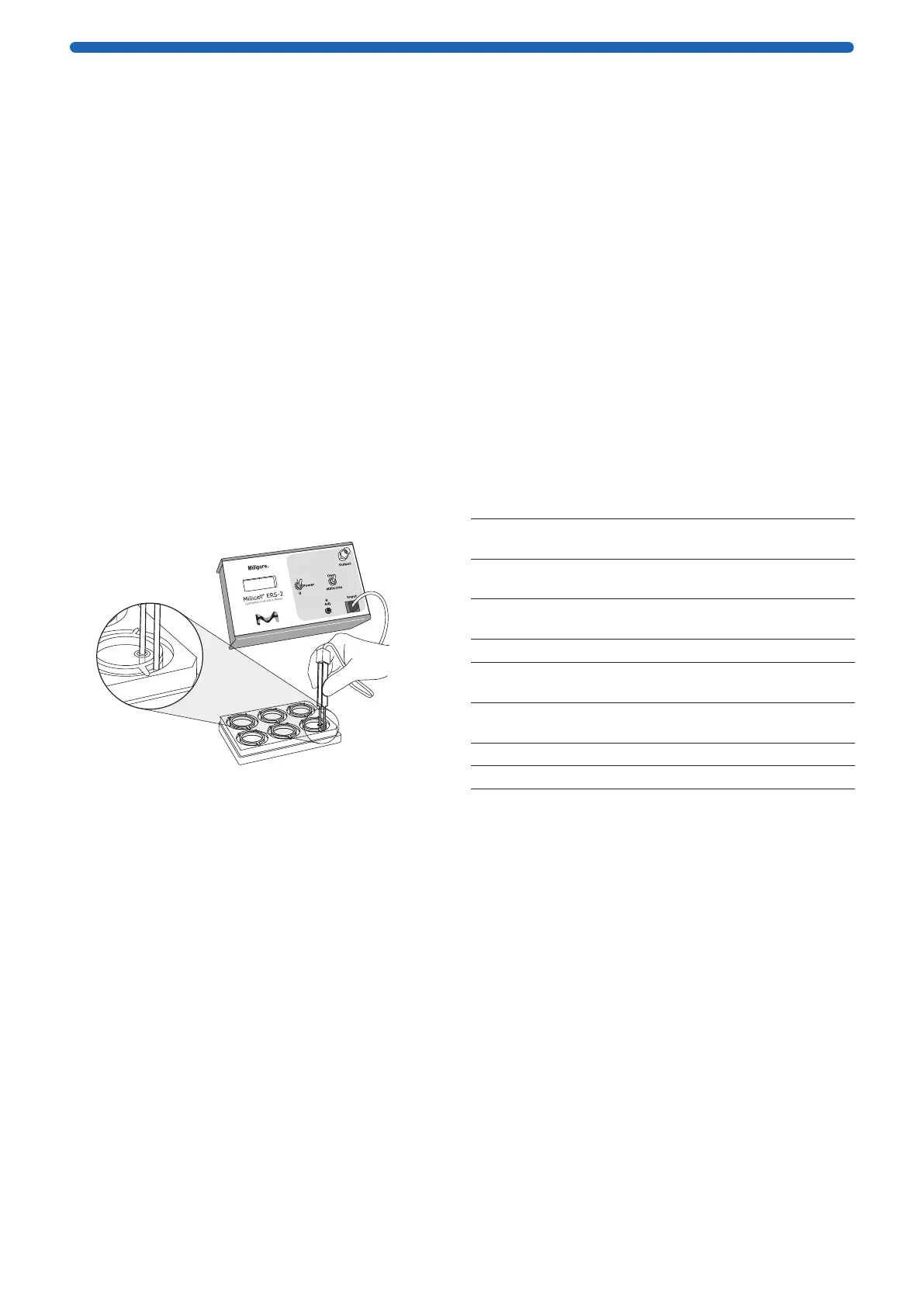
5. Immerse the electrode so that the shorter tip is in
the Millicell
®
culture plate insert and the longer tip is
in the outer well. The shorter tip should not contact
cells growing on the membrane and the longer tip
should just touch the bottom of the outer well. To
ensure stable and reproducible results, make sure
that the electrode is held steady and at a 90° angle
to the plate insert.
NOTE: If rinsing is required between measurements
to prevent sample carryover, use culture media
rather than distilled water.
I
I
0 0
6. Record the resistance.
How to Determine Blank Resistance
1. Add electrolyte to a blank cup
(i.e., the cell culture insert without cells).
2. Measure the resistance across the blank cup
as in step 5 of the previous section.
Resistance Calculations
Tissue Resistance
To obtain true tissue resistance, subtract the
resistance reading across the blank cup from the
resistance reading across the tissue (cell culture
insert with cells).
Unit Area Resistance
The resistance is inversely proportional to the area
of the tissue. The larger the membrane, the lower
the resistance.
NOTE: Resistance readings for 24 mm or larger
diameter inserts should not be converted to unit
area resistance because the STX electrode cannot
deliver a uniform current density over the relatively
large area of membrane. This is not a problem with
smaller inserts because of the relatively smaller area
of membrane compared to the electrode. See table on
next page for diameters of Millicell
®
cell culture inserts
and plates.
To achieve consistency across different plate formats
(excluding 24 mm or larger diameter inserts), the
product of the resistance and the area is typically
calculated and reported. This value is independent
of the area of the membrane used.
The unit area resistance is obtained by multiplying the
meter reading by the effective surface area of the filter
membrane. The unit of measure is Ωcm
2
. Effective
membrane areas for Millicell
®
cell culture inserts and
plates are listed in the table below.
Unit Area
Resistance
= Resistance (Ω) × Effective Membrane Area(cm
2
)
Unit Area = 1 cm
2
The unit area resistance is independent of the area of
the membrane used and may be used to compare data
obtained from 12 mm or smaller inserts.
Millicell
®
Cell Culture Insert and Plate Effective
Membrane Area
Product
Well Diameter
(mm)
Membrane
Area (cm
2
)
6-well standing
insert
30 4.2
24-well standing
insert
12 0.6
6-well hanging insert 24 4.5
12-well hanging
insert
12 1.1
24-well hanging
insert
6.5 0.3
24-well plate ~ 10 0.7
96-well plate ~ 4 0.11
Example Application
The following is an example of a typical Millicell
®
ERS-2 application. It is not a technically complete
experimental protocol.
Culture Cells
Seed cells onto 22 of 24 properly prepared, 24-well
Millicell
®
-CM culture plate inserts, leaving the other
two Millicell
®
culture plate inserts blank. Grow cells to
confluency, according to standard protocol.
Measure and Calculate Resistance
1. Sterilize or sanitize/disinfect the electrode according
to instructions on pages 6–7.
2. Allow the samples to come to room temperature.
3. Measure the resistance of the two blanks
(i.e., Millicell
®
-CM inserts without cells).
4. Measure cell resistance in the 22 sample wells
(i.e., Millicell
®
-CM inserts with cell monolayers).
5. Repeat step 3.



 To Next Page