miniDSP Ltd, Hong Kong / www.minidsp.com / Features and specifications subject to change without prior notice 14
5 MICROPHONE POSITIONING AND ORIENTATION
Acoustic measurements are typically one of two types: in-room and free-field.
5.1 FREE-FIELD MEASUREMENT
Free-field measurements are commonly used for measuring and designing speakers. For this type of
measurement, always point the microphone directly at the sound source and use the normal (0-degree)
calibration file.
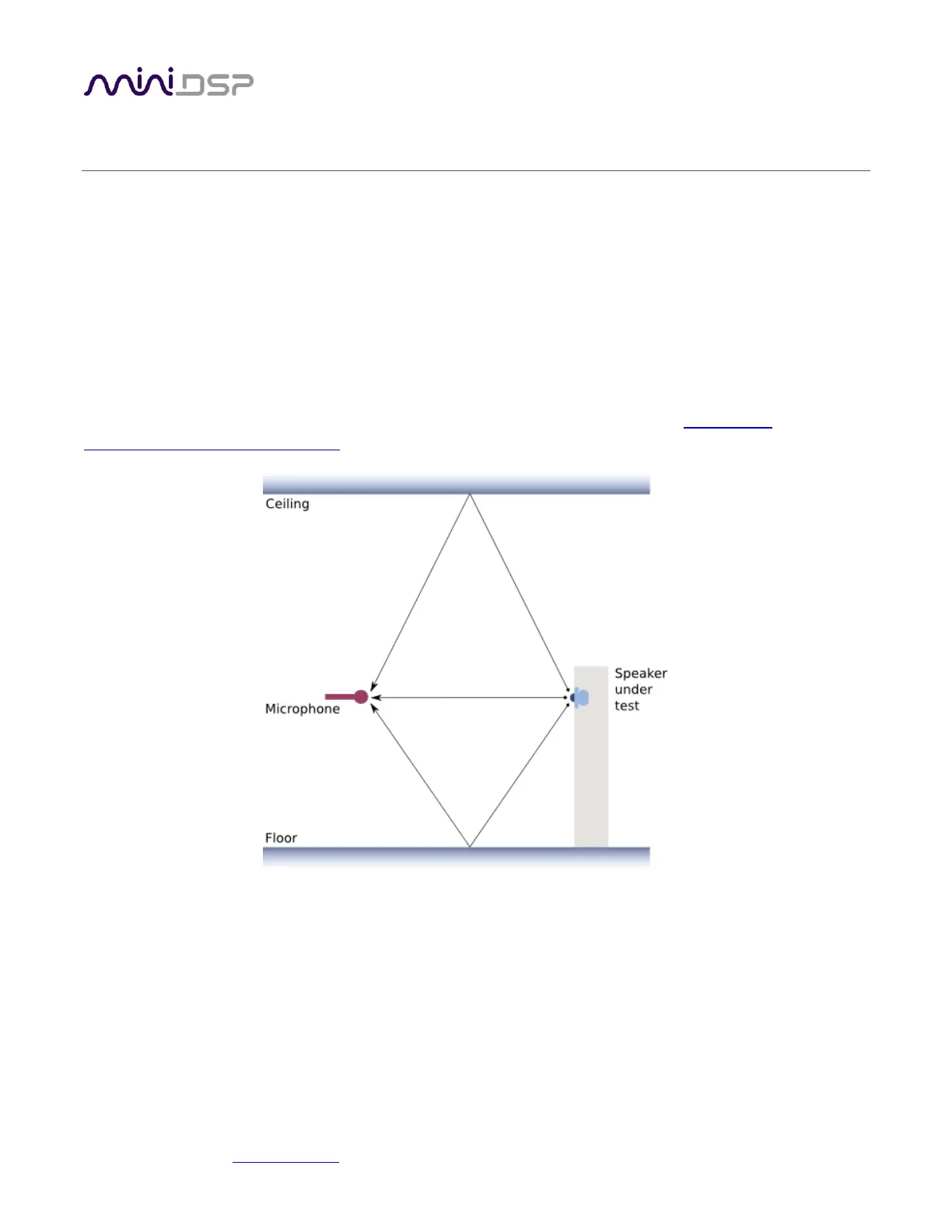
For this purpose, the sound received by the microphone would ideally be free of any reflections – that is, only
the direct sound from the speaker being measured without any reflections of influence from the room. In
practice, free-field measurements of a speaker often have to be done in a room, so various techniques are used
to remove or mitigate the effect of the room. For more information, see our app note Loudspeaker
measurement with UMIK-1 and REW.
5.2 IN-ROOM MEASUREMENT FOR SPEAKERS
In-room measurements are used to measure the combined effect of a speaker (or subwoofer) and the room in
which it’s located. The sound measured by the microphone consists of the direct sound from the speaker and
the sound caused in the room by reflections and resonance (modes).
For measurements of this kind, the microphone is typically placed at and around the center of the listening area.
If the goal is to capture the signal from the speaker most accurately with the effects of the room added, point
the microphone towards the speaker and use the normal (0 degree) calibration file.


 To Next Page