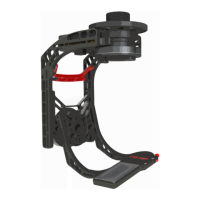
The Mo-Sys StarTracker Max is a camera tracking system designed for virtual production, augmented reality, and other applications requiring precise real-time camera position and rotation data. It operates by optically tracking retroreflective "stars" placed on a studio ceiling or floor, creating a 3D map of the environment. The system provides highly accurate 6-axis (X, Y, H, Pan, Tilt, Roll) tracking data, as well as lens data (Zoom and Focus) when integrated with compatible lens encoders.
Function Description:
The core function of the StarTracker Max is to provide real-time, highly accurate camera tracking data. This data is crucial for seamlessly integrating virtual graphics with live-action footage, ensuring that virtual elements appear correctly positioned and scaled within the real-world scene, even as the camera moves. The system achieves this by:
- Star Installation: Retroreflective stickers ("stars") are strategically placed on the studio ceiling or floor. These stars serve as fixed reference points within the environment. The manual emphasizes the importance of random placement, adequate spacing (average 1/10th of floor-to-ceiling height, not closer than 1/15th height or 5x diameter), and clear visibility to ensure robust tracking. Using stars at multiple ceiling heights improves accuracy.
- Mapping: The StarTracker sensor, mounted on the camera, observes these stars to build a 3D map of the studio. This involves moving the camera around the studio, pointing the sensor upwards (or downwards for floor-facing setups), to discover and capture as many stars as possible from various angles and heights. The mapping process is critical for establishing the spatial understanding of the environment.
- Tracking: Once a map is created and loaded, the StarTracker continuously monitors the positions of the visible stars to determine the camera's exact 3D position (X, Y, H) and orientation (Pan, Tilt, Roll) in real-time. The system aims for "OPTICAL GOOD" status, indicating stable tracking.
- Lens Encoding: The system integrates with mechanical or digital lens encoders to capture real-time zoom and focus data. This lens data is essential for rendering virtual graphics with the correct perspective and depth of field, matching the live camera's lens settings.
- Output: The tracking and lens data are streamed via UDP to a virtual set PC or rendering engine, enabling the real-time composition of virtual elements with live video.
Important Technical Specifications (Inferred from Manual):
- Tracking Axes: 6-axis (X, Y, H for position; Pan, Tilt, Roll for rotation).
- Lens Data: Zoom (Z) and Focus (F) data, with support for Iris encoding on three-split encoders.
- Sensor Field of View: 120 degrees (for star detection).
- Star Detection: Requires a minimum of 11 stars for tracking, with 30 or more recommended for robustness against occlusions.
- Star Size/Spacing: Dependent on ceiling height; a Star Chart is provided for optimal star diameter and spacing based on installation height (e.g., 30mm for 3.0-3.4m height, 50mm for 4.6-5.4m, up to 200mm for 20m).
- Connectivity: USB-C for sensor umbilical, RJ45 for ODU network, BNC for ODU sync, HDMI/USB for touchscreen/keyboard, D-Tap for power.
- Data Output Protocol: Mo-Sys F4, D1 (freed), or PSN (Posi Stage Net) via UDP.
- Sync Input: Genlock (24p, 25p, 30p, PAL, NTSC, Unknown) via BNC.
- Accuracy: Improved by applying stars at multiple ceiling heights (at least 10% height difference). Auto-Aligner calibration aims for low error, ideally less than 1, with verification showing errors typically not higher than 2cm for floor points.
- Processor: StarTracker Processor unit.
- Software: StarTracker GUI, with Basic and Advanced modes.
Usage Features:
- GUI (Graphical User Interface): The StarTracker Max features a comprehensive GUI displayed on an HDMI touchscreen.
- Mapping Status: Displays "MAPPING OFF" or "MAPPING ON," "OPTICAL GOOD" or "OPTICAL LOST," and the number of stars detected and tracked.
- Output Data: Shows real-time X, Y, H, P, T, R, Z, F values in mm/deg.
- Menus: Organized into Main, Stars, Mapping, Offsets, Data, and Tuning, with submenus for various settings.
- Touchscreen Control: Menus can be navigated via touch, with a "right-click" function for unlocking menus and an "ESC" function for closing menus.
- Keyboard Shortcuts: "O" (Toggle optical sensor camera), "S" (Save Map), "R" (Reset/unload map), "L" (Load Map), "A" (Refresh estimated star detection), "Y" (Yes/confirm), "N" (No/cancel operation), "I" (Toggle IMU), "Esc" (Close/cancel menu).
- Star Installation Guidance: Visual examples of good and bad star placement, along with a detailed Star Chart for optimal star diameter and spacing based on ceiling height.
- Mapping Process: Step-by-step instructions for creating an initial map, including moving the camera a specified distance and capturing stars from various angles and heights to build a robust constellation.
- Referencing Real World:
- O,X,Y Placement: Guides on marking origin (O), X-axis, and Y-axis points on the studio floor to align the StarTracker's coordinate system with the real world.
- Setting Dimensions: Entering the measured O-X distance to scale the map units to real-world meters.
- Manual Map Translation and Rotation: Ability to manually adjust the map's position (X,Y,Z) and rotation (Pan, Tilt, Roll) about its origin.
- Auto-Aligner: A crucial feature for fine-tuning the alignment between virtual graphics and the real camera. It involves observing known reference points through the camera lens, allowing the system to automatically tweak map and camera offsets for the closest match.
- Lens Encoding:
- Mechanical Encoders: Support for Fujinon, Canon ENG, and film lenses with interchangeable gearwheels. Calibration involves moving zoom and focus rings to end-stops.
- Digital Lens Encoding: Compatibility with Fujinon and Canon ENG lenses with "Virtual" ports.
- Camera Offsets (CCD Offsets): Detailed instructions for measuring and entering linear (TP Right, TP Down, TP Forward) and angular (Pan, Tilt, Roll) offsets to account for the physical difference between the StarTracker sensor and the broadcast camera's CCD plane.
- Floor Facing Mode: The system can be used with the sensor facing downwards to track stars on the floor, suitable for different studio setups.
- Data Output Configuration: Settings for network connection (DHCP, Local, Static IP), destination IP addresses, and data protocols (F4, D1, PSN).
- Sync Data Input: Configuration for genlock sync type (24p, 25p, 30p, PAL, NTSC).
- Delay Settings: Adjustments for pan, tilt, and lens delays to synchronize virtual graphics with live video output.
- Simulation Data: When no map is loaded, the system outputs continuously incrementing xx values for test purposes, allowing verification of data stream functionality.
- Map Sharing: Ability to copy maps between StarTracker systems via USB stick or over a network.
Maintenance Features:
- Software Update:
- Recommended Method: Via USB stick, using the GUI's Backup menu to detect the USB and update firmware.
- Fallback Method: Booting into "Engineering Mode" and using a terminal command for updates, useful if the primary method fails.
- Backup and Restore:
- Backup: Copying maps, config files, logs, and user manuals to a USB stick.
- Restore: Restoring all settings (including CCD offsets and network settings) from a backup file, with options for "Factory cfg settings," "Add Same" (for identical StarTrackers), and "Add Diff" (for StarTrackers with different CCD offsets).
- Troubleshooting Guide:
- Test Signals: Provides various test signals (e.g., "Inc pan," "PT Jump2") to diagnose whether tracking data problems are due to communication issues, virtual set problems, or tracking quality.
- Mismatching Graphics: Comprehensive checklist for identifying and resolving issues related to incorrect offsets (camera-centric, map-centric, object-centric), lens file problems (distortion, nodal offsets, FoV), encoder issues (loose gears, reversed direction), and real-world factors (curved floor, sensor mount changes).
- No Tracking Data (IP): Checklist for diagnosing network connectivity problems, including verifying cable connections, IP addresses, netmask settings, firewall status, and using a "Ping Test" feature.
- Engineering Mode: A special boot mode for making changes to hardware settings, operating system configurations (e.g., WiFi), software updates, and copying files.

 Need help?
 General

 To Next Page