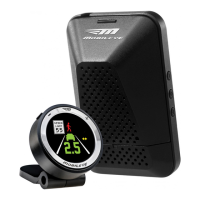
The Mobileye C2-270 is a sophisticated Collision Prevention System designed to enhance driver safety by providing timely alerts for various potentially dangerous road situations. It is not an automated driving system and does not replace the driver's responsibility to remain vigilant, adhere to safe driving practices, and obey all traffic rules. The system is intended for use on paved roads with clear lane markings and primarily detects the rear ends of fully visible vehicles, as well as pedestrians. Detection of crossing, oncoming, or passing vehicles is not supported. The system's accuracy can be affected by road, weather, and other conditions, and it does not guarantee 100% accuracy in detection or warning of all potential hazards.
Function Description:
The Mobileye C2-270 system integrates several key safety features:
-
Forward Collision Warning (FCW): This feature alerts the driver to an impending collision with the vehicle ahead. It continuously calculates the Time to Collision (TTC) and generates a loud, high-pitched audio alert and a red, flashing car icon on the Display Unit when the TTC drops to a dangerous threshold (up to 2.7 seconds before a possible collision). FCW is always active and cannot be disabled or muted, emphasizing its critical safety role. If the system is turned off, no warnings, including FCW, will be issued.
-
Pedestrian Collision Warning (PCW): The PCW alerts the driver to the danger of an impending collision with a pedestrian ahead. Similar to FCW, it calculates the TTC with the pedestrian and generates a series of loud, high-pitched beeps and a red, flashing pedestrian icon on the Display Unit when the TTC reaches a dangerous level. PCW is operational during daytime at speeds up to 75 km/h (46 mph) and has limited operation at night.
-
Lane Departure Warning (LDW): This feature warns the driver if the car begins to unintentionally swerve from its driving lane. An LDW alert is generated up to 0.5 seconds before the vehicle crosses a lane marking. The alert consists of an audio signal lasting 0.7 seconds and a flashing left or right deviation indicator on the Display Unit. LDW is active at speeds above 55 km/h (34 mph). It will not generate an alert if the turn signal is used before changing lanes, if lanes are poorly marked or unmarked, if the LDW is disabled (sensitivity level set to zero), during sharp turns, if the system is muted, or at speeds below 55 km/h.
-
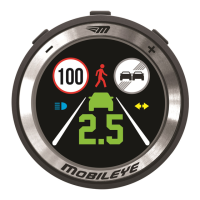
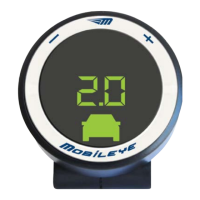
Headway Monitoring and Warning (HMW): HMW monitors the driving distance (headway) from the vehicle in front, measured in seconds. It alerts the driver when the headway falls below a pre-defined, user-configurable threshold. The Display Unit continuously shows the headway distance numerically. A green car icon indicates a vehicle ahead with headway greater than 0.6 seconds, while a red car icon warns of dangerous tailgating when headway is less than 0.6 seconds. A single chime audio alert is sounded for dangerous headway situations. The audio alert and numerical display are active at speeds greater than 30 km/h (19 mph). HMW visual indications cannot be disabled, but the audio alert can be muted or disabled if the system volume is set to "0."
-
Intelligent High-beam Control (IHC): (Available on certain C2-270 models, if activated during installation, and in specific geographical areas). IHC assists the driver by automatically switching between low and high beams when no traffic is in close proximity on dark roads. The high-beam indicator lights up on the EyeWatch Display when IHC is operational. IHC will not activate high beams if tail lights are recognized within 400m, an oncoming vehicle is detected within 800m, or if the vehicle enters a well-lit (urban) area or street lights are detected.
Important Technical Specifications:
- Power Requirement: The Mobileye C2-270 operates with 12VDC~24VDC power.
- Speed Thresholds:
- PCW: Operational up to 75 km/h (46 mph).
- LDW: Active at speeds above 55 km/h (34 mph).
- HMW: Audio alert and numerical display active at speeds greater than 30 km/h (19 mph).
- Warning Timings:
- FCW: Up to 2.7 seconds before possible collision.
- LDW: Up to 0.5 seconds before crossing a lane marking.
- HMW Audio Alert: Default 0.6 seconds, configurable from 0.1 to 2.5 seconds.
- Urban FCW Sensitivity: Configurable between 0.5 meters and 2 meters (default 1.2 meters).
- Temperature Protection: The Camera Unit automatically shuts down at 80°C and restarts at 75°C to prevent overheating.
Usage Features:
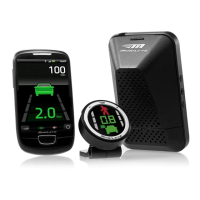
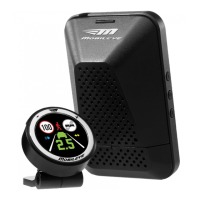
The system consists of a Camera/Buzzer Unit and a Display and Control Unit.
- Camera/Buzzer Unit: Contains the camera, main processor, and warning buzzer. It identifies lane markings, vehicles, and pedestrians, processes video data for dangerous situations, and instructs the display unit. It is attached to the front windshield via a Windshield Mount.
- Display and Control Unit: Provides visual alerts (e.g., driving distance, car icons), system status indications (e.g., low visibility), and control buttons for system configuration. It can be attached to the dashboard or front windshield.
- System ON/OFF: The system turns on automatically with the car. To turn off, press and hold the Mode Selection button for 1.5 seconds. To turn on, press any button once.
- Display Unit Brightness Level: Press the Mode Selection button once, then use the +/- buttons to adjust brightness (5 levels available). The system identifies day/night conditions and saves independent luminance settings for each mode.
- HMW Alert Timing: Press the Mode Selection button twice to enter "HMW Configuration" mode (indicated by a slow flashing red car icon and numerical display). Use +/- buttons to adjust timing between 0.1 and 2.5 seconds.
- LDW Alerts Sensitivity: Press the Mode Selection button three times to enter "LDW Sensitivity" configuration mode (indicated by flashing right/left deviation icons and numerical display). Use +/- buttons to select sensitivity levels (0, 1, or 2, with 2 being default). Level 0 disables LDW alerts.
- PCW Alerts Sensitivity: Press the Mode Selection button four times to enter "PCW Sensitivity" configuration mode (indicated by a slow flashing red pedestrian icon and numerical display). Use +/- buttons to select sensitivity levels (0, 1, or 2, with 2 being default). Level 0 disables PCW warnings.
- Volume Control: The Display Unit has +/- buttons to adjust volume (6 levels, 0-5). The Camera/Buzzer Unit also has a volume control button. Volume 0 disables LDW and HMW audio alerts. FCW volume can only be reduced to level 3, ensuring it remains audible as an emergency alert.
- Mute: To mute, set volume to 0, or press and hold the Minus (-) button on the display for 1.5 seconds. To exit mute, press (+). Alternatively, repeatedly press the Camera/Buzzer unit (-) volume control button until no sound is heard (do not press constantly, as this will turn the system off). Mute and OFF conditions are not saved; the system is ON and NOT muted upon restart.
- Urban FCW Sensitivity: Press and hold (+) then immediately press (-) for 1.5 seconds. A red car icon will flash, and numerical display will show. Use (-) to decrease sensitivity and (+) to increase (between 0.5 and 2 meters). Changes can only be made when the vehicle is at a standstill.
Maintenance Features:
- Installation: Mobileye C2 installation must be carried out by an Authorized Mobileye C2 Dealer or Installer. The system should not be transferred between vehicles except by an authorized professional.
- Clear View: Always ensure a clear camera view, as partial or full blockage can reduce or disable functionality. Do not cover or obstruct the Camera Unit or Display and Control Unit.
- Troubleshooting: The manual provides solutions for common issues like no signal, 'Power' indicator light ON but no other signals, low visibility indication, no audio alerts, and no LDW alerts. For persistent problems, contact technical support.
- Camera Unit Heat: The Camera Unit can heat up during operation; avoid touching it during or immediately after use.
- Windshield Cleaning: For low visibility due to a dirty windshield, use wipers or carefully remove the detachable bottom part of the Windshield Mount to clean the relevant area.
- Condensation: Ventilate the front windshield using the vehicle's air-conditioning system or open windows to clear condensation.
- Warranty: The Mobileye C2 comes with a one-year limited warranty covering defects in material or workmanship for the original purchaser and vehicle. It is void if transferred to another vehicle. Warranty service requires proof of purchase and a return authorization number from Customer Service.
Warnings and Cautions:
- Never configure Mobileye C2-270 settings or perform maintenance activities while driving.
- Setting HMW alert timing to a low value will activate alerts when vehicles are very close. Drivers are solely responsible for maintaining a safe driving distance.
- Setting LDW sensitivity to "0" disables LDW alerts. To enable, set to level 1 or 2.
- Setting PCW sensitivity to "0" disables PCW warnings.
- Bad weather conditions and other situations that hamper system visibility also aggravate general driving conditions; drive carefully.
- The Forward Collision Warning is a critical alert that cannot be disabled or muted.
- The Mobileye C2 is not a substitute for driver vigilance or safe driving practices. Drivers should not rely on it to assure driving safety.


 To Next Page

 General