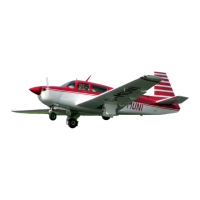
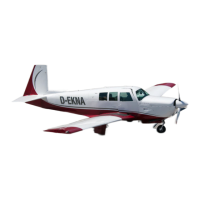
Monticello Flying Club Pilot Transition Manual: Mooney M20F
Page 11 of 42
CABIN HEATING AND VENTILATION
Pulling out the cabin air knob allows air from inside the engine cowl to enter a mixing
box located on the engine side of the firewall. Pulling out the cabin heater knob allows air that
has passed over the exhaust muffler to enter this mixing box. Air leaving the mixing box is
routed to nozzles at the right shin of the pilot, the left shin of the co-pilot, just below the cigarette
lighter on the center console, and the windshield base. These nozzles (with the exception of those
at the windshield base) have louvers to control the airflow. The nozzles at the windshield base
are primarily for defrost. For maximum defrost, you must partially close the lower louvers in
order to force more hot air to the windshield. Be careful as too much hot air on the windshield
may damage the windshield.
Twist knob openings at the left knee of the pilot and right knee of the co-pilot provide
outside air to the front cabin. A manually operated overhead air scoop provides additional
outside-air ventilation mostly to the back seat occupants, and controls for these vents are located
on the ceiling.
INSTRUMENTS
All flight instruments are located in the shock-mounted flight panel. Engine instruments
are in the co-pilot's panel. Pitot system ram air pressure operates the airspeed indicator. The
instrument static pressure system has air pickup ports, which are open to atmospheric pressure,
on each side of the empennage, and this static pressure operates the altimeter and contributes to
the airspeed reading. There is no alternate static air source, so you would need to break the
vertical speed indicator glass in case of blockage to obtain an alternate static air source (in an
emergency). The HSI and attitude indicator operate off of an engine driven vacuum pump, and
the turn coordinator and electric compass (lower center of the pilot-side panel) are driven by the
electrical system. The panel-mounted electric compass is tied to a remote compass in the tail of
the aircraft and supplements the standard compass mounted at the top of the windshield. A
dimmer knob located on the ceiling above the pilot’s head manually dims the instrument panel
lights, and red spotlights are controlled using the knob above the co-pilot’s head. Make sure to
turn the instrument lights off after a night flight to prevent the bulbs from burning out.
AUTO-PILOT SYSTEM
This aircraft originally had a wing leveler system (Positive Control) but that has been
replaced with an S-TEC System 30 Auto Pilot that provides a steering, heading, and tracking
(GPS or VLOC) modes. The autopilot on-off master switch is located just below the ignition
switch. The System 30 is combined with the turn coordinator and thus is rate based (as opposed
to gyro based). This means that the autopilot will still function in the event of a vacuum or pitot
system failure. If you become disoriented during a vacuum system failure, switching the
autopilot on to level the wings could be a lifesaver.
There is also a GPS Steering system (GPSS) run by a separate switch in front of the co-
pilot that switches the input to the HDG mode on the System 30 between the Heading Bug
(HDG) and the Garmin 430W (GPSS). With the System 30 in HD mode and the GPSS in GPSS
mode, the autopilot will fly the flight plan that is in the 430W. If the GPSS is in HDG mode, the
autopilot will fly the heading bug when HD mode is selected.
There is an autopilot disconnect switch on the pilot’s control yoke. Also located on the
yoke is the altitude hold engage/disengage switch. In altitude hold mode, indicators on the turn



 To Next Page