www.miinet.comMoore Industries-International, Inc.
- 109 -
User’s Manual
238-741-00K
May 2019
Programmable Smart HART Temperature Transmitter
THZ
3
/ TDZ
3
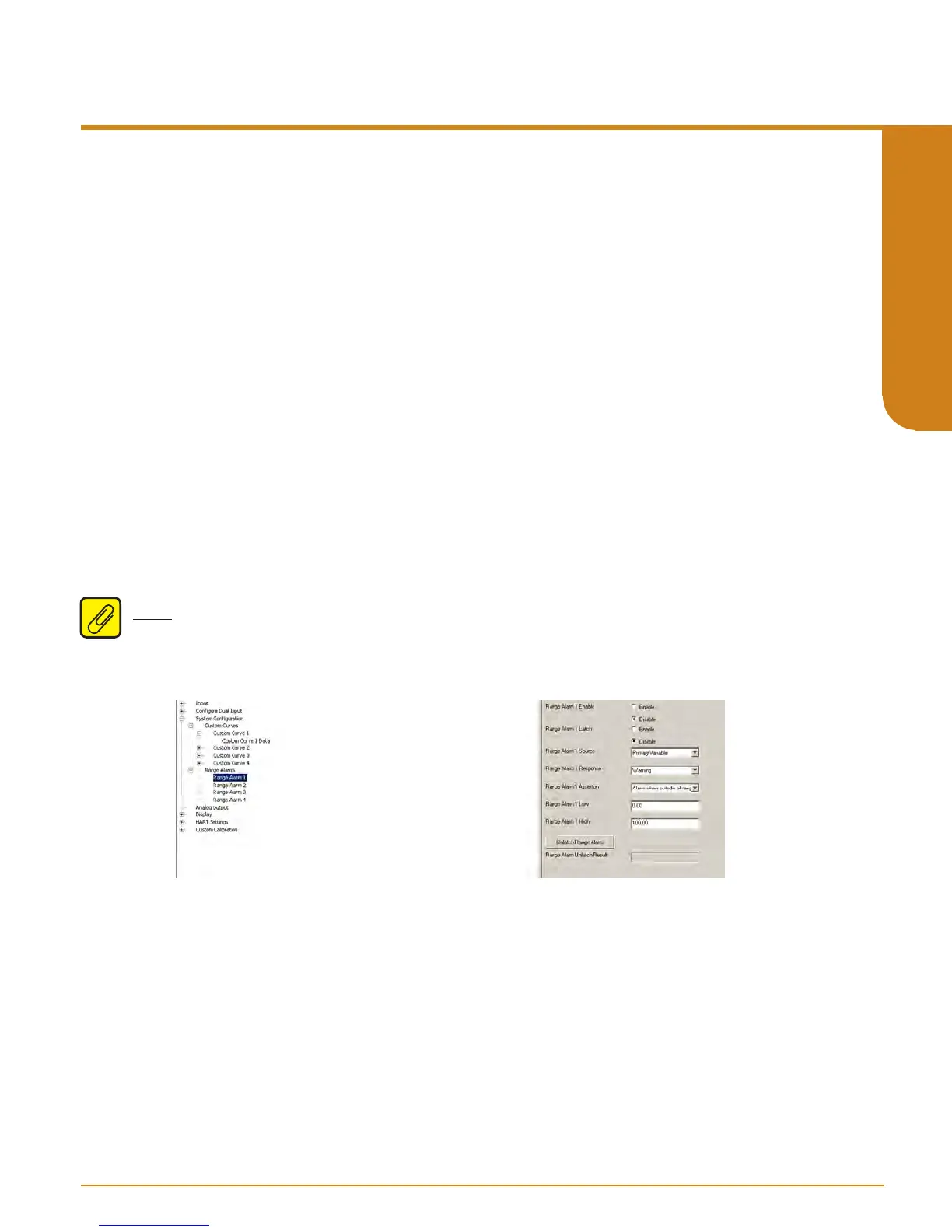
Range Alarms – This menu allows you to enable and configure each of the 4 Range Alarms.
See Section 1 more information on this feature.
Each alarm has the following settings (see Figure 5.43) :
Enable: [Disabled] Enables or Disables the Range Alarm
Latching: [Disabled] Enables or Disables latching of the alarm. Non-latching alarms
return to a non-alarm state whenever the process input returns to a non-alarm level. Once
tripped, a latching alarm remains in an alarm state until the input returns to a non-alarm
level and is reset.
Source: [Primary Variable] The Variable to be used as a source for the Range Alarm
Response: [Warning] How to react if the specified condition occurs: Warning - Sends a
warning message to the HART Handheld/DTM, TDZ
3
display and sets a HART status bit.
Alarm - Sends the AO into fail mode and sends an alarm message to the HART Handheld/
DTM, TDZ
3
display. It also sets a (different) HART status bit.
Assertion: [Out of Range] Indicates if the Range Alarm should detect if the source
variable goes Out of range, or goes In range.
Low: [0.00] The defined lower limit of the Range Alarm
High: [100.00] The defined upper limit of the Range Alarm
UnLatch Range Alarm: Reset an actively latched range alarm provided that the input has
returned to a non-alarm level.
Note: If a Range Alarm Response is set to Alarm, the AO will always perform a fail response
even if the Source Device Variable is not assigned to the PV.
SECTION 5
Figure 5.43.B. Additional Functions Menu for Range Alarms


 To Next Page